THeMIS from KNDS. The Robot That’s Quietly Redefining the Modern Battlefield

Military technology has chased a familiar ambition: remove soldiers from danger while increasing operational effectiveness. Air forces achieved it with drones. Navies are experimenting with autonomous vessels. Now, on the ground, a new generation of unmanned systems is taking center stage, and one platform is emerging as a clear benchmark.
The THeMIS (Tracked Hybrid Modular Infantry System) from Milrem Robotics is not just another unmanned ground vehicle (UGV). It is a glimpse into what tomorrow’s battlefield may look like: modular, autonomous, adaptable, and increasingly robotic.
In an era where conflicts from Ukraine to the Middle East have demonstrated the devastating impact of precision weapons, loitering munitions, and persistent surveillance, mobility alone is no longer enough. Survivability has become the defining currency of modern warfare.
This is exactly where THeMIS changes the equation.
From Vehicle to Ecosystem
The most disruptive aspect of THeMIS is not its mobility or even its unmanned nature. It is its modularity.
Traditional military vehicles are designed for a specific mission. Logistics trucks transport supplies. Combat vehicles provide firepower. Engineering platforms clear obstacles.
THeMIS breaks this convention.
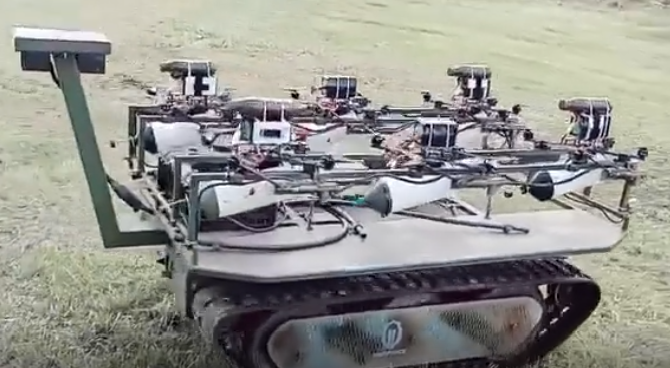
The platform serves as a common robotic backbone capable of accepting multiple mission modules. One day it can transport ammunition and supplies to frontline positions. The next it can evacuate casualties from dangerous areas. With different payloads, it can conduct reconnaissance, support combat operations, perform route clearance, or deliver counter-drone capabilities.
The result is a system that behaves less like a vehicle and more like a military operating system.
For armed forces facing budget constraints and increasing operational complexity, this flexibility offers a strategic advantage. Instead of maintaining separate fleets for every mission type, militaries can adapt a single platform to multiple operational requirements.
The Battlefield Is Becoming Unmanned
The trend is impossible to ignore.
Modern conflicts have exposed an uncomfortable reality: every soldier, vehicle, and logistics convoy is now visible, targetable, and vulnerable.
The rise of drone warfare has dramatically shortened the time between detection and destruction. Supply runs once considered routine can now become life-threatening operations.
In this environment, unmanned ground systems are not a luxury. They are rapidly becoming a necessity.
Why send soldiers to transport ammunition through artillery fire when a robotic platform can do the job?
Why expose medics to enemy observation when an unmanned evacuation vehicle can retrieve wounded personnel?
These questions are no longer theoretical. They are driving procurement decisions across NATO and allied nations.
A New Partner for Soldiers
The future battlefield is often portrayed as fully autonomous, filled with machine-versus-machine combat. Reality is likely to be far different.
Platforms like THeMIS are designed not to replace soldiers but to augment them.
Think of it as a robotic teammate.
It carries heavy loads, extends operational reach, supports reconnaissance missions, and reduces exposure to direct threats. Most importantly, it allows trained personnel to focus on decision-making instead of dangerous repetitive tasks.
Military history shows that every major technological leap—from the tank to the helicopter—initially faced skepticism before becoming indispensable.
Unmanned ground systems may be following the same trajectory.
The Race for Robotic Dominance
The global defense industry is now locked in a race to field the most effective autonomous and semi-autonomous systems.
But success will not belong to the company building the biggest robot. It will belong to the company creating the most adaptable one.
This is where Milrem Robotics and its THeMIS platform have positioned themselves at the forefront of the market. By focusing on modularity, interoperability, and mission flexibility, the company has created a platform capable of evolving alongside changing operational demands.
The battlefield of 2035 will not be defined solely by tanks, aircraft, or missiles.
It will be defined by networks of intelligent systems working together across land, air, sea, space, and cyberspace.
And while much attention remains focused on aerial drones, a quieter revolution is happening on the ground.
Its name is THeMIS.