Europe’s Drone Boom Has a New Weapon: Venture Capital
For decades, European venture capital wanted the next fintech, marketplace or SaaS unicorn. Now some of the continent’s most interesting founders are building drones, satellites, sensors and weapons.
And increasingly, investors want in.
Europe’s defence and aerospace ecosystem is undergoing a striking financial transformation. Technologies once considered too politically sensitive, too dependent on government procurement or simply too difficult for traditional venture capital are attracting a growing network of specialist funds, deep-tech investors and corporate players.
The reason is brutally simple:
Defence is no longer a niche industry. It has become a European strategic priority.
Russia’s war against Ukraine changed the equation. So did the extraordinary battlefield evolution of drones, artificial intelligence, electronic warfare, autonomous systems and commercial satellite technology.
The result is a new generation of companies sitting somewhere between Silicon Valley and the traditional defence prime.
And somebody has to finance them.
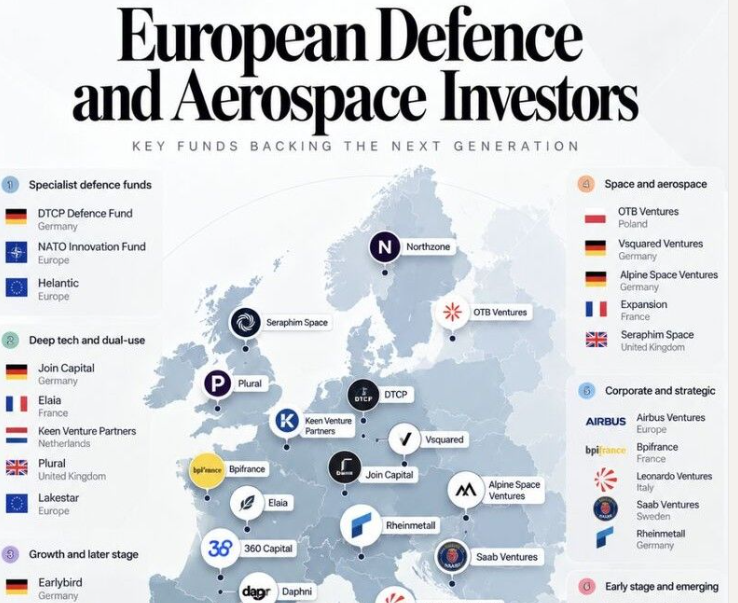
At the specialist end, investors such as NATO Innovation Fund (NIF), DTCP and HELANTIC represent an important shift in how security technology can be financed.
But specialist capital is only part of the picture.
Mainstream European venture firms including Plural, Lakestar, Balderton, Northzone and Earlybird Venture Capital belong to a broader investment ecosystem increasingly interested in deep technology and strategically important industries.
Then there is space.
Funds including OTB Ventures, Vsquared Ventures, Alpine Space Ventures, Expansion Ventures and Seraphim Space illustrate how aerospace and space technologies have developed their own sophisticated financing landscape.
That distinction matters because modern defence technology increasingly refuses to remain inside neat categories.
An Earth-observation satellite can monitor agriculture on Monday and military movements on Tuesday.
A computer-vision system developed for industrial inspection can become part of an autonomous drone.
A navigation technology designed for commercial robots may suddenly become valuable when GPS is jammed.
Dual-use is not an exception anymore. It is becoming a business model.
That changes what investors must understand.
Defence startups do not behave exactly like ordinary software companies. Government procurement cycles can be painfully slow. Security requirements are demanding. Export controls can restrict markets. Hardware consumes capital. Battlefield success does not automatically translate into a scalable peacetime business.
And perhaps the hardest problem is crossing the notorious gap between an impressive demonstration and a procurement contract large enough to sustain industrial production.
Europe consequently needs more than money.
It needs investors willing to understand certification, sovereign requirements, manufacturing capacity, procurement and the difference between a prototype soldiers love and a product governments will actually order in thousands.
Corporate capital also matters. Strategic players can offer what conventional VCs often cannot: industrial infrastructure, defence-market knowledge and routes toward military customers.
For founders, that means selecting an investor should increasingly involve more than asking:
“How large is your cheque?”
A better question might be:
“Can you help me survive the journey from prototype to battlefield-scale production?”
Because that is where Europe's defence-tech experiment will ultimately succeed or fail.
The continent does not lack engineers.
It does not lack scientific institutions.
And increasingly, it does not lack capital.
The unresolved challenge is connecting all three quickly enough to produce companies capable of competing at global scale.
For years, Europe worried that its best technology companies would eventually move to America for capital.
Defence may become the sector that reverses that conversation.
Because when governments start spending hundreds of billions on security, venture capital eventually notices.
And Europe's investors have noticed.