GDU Tech. Why Drone Docks Are Becoming the Invisible Infrastructure of Modern Operations
The drone industry has been obsessed with the aircraft itself. Faster drones. Smarter drones. Longer-range drones. Yet as unmanned aviation moves from experimentation to everyday operations, a different technology is quietly becoming the real game changer: the drone dock.
The future of enterprise UAV deployment is no longer defined by how far a drone can fly. It is defined by how often it can fly without human intervention.
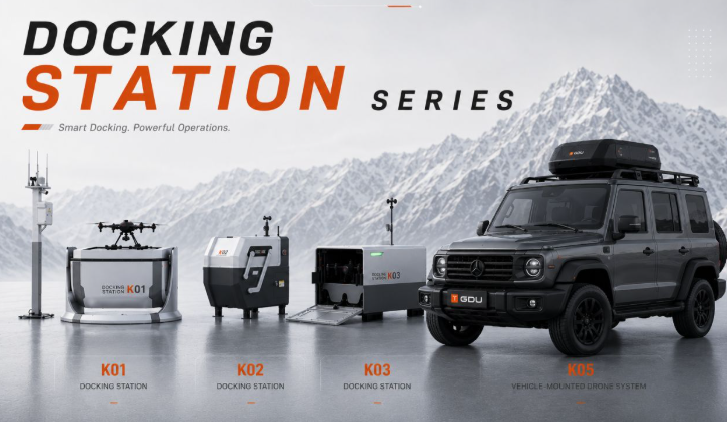
That is precisely where intelligent docking solutions such as the GDU Docking Station Series are reshaping the conversation.
In infrastructure inspection, public safety, environmental monitoring, and smart city management, organizations are facing a common challenge. They need aerial intelligence not occasionally, but continuously. Traditional drone operations require skilled personnel, battery management, transportation logistics, and ongoing deployment efforts. While effective in specific missions, this model struggles to scale.
Enter the autonomous docking station.
A docking station transforms a drone from a manually operated tool into a persistent operational asset. Instead of waiting for an operator to launch, retrieve, charge, and prepare the aircraft, the drone can automatically return to its station, recharge or swap batteries, and prepare itself for the next mission. The result is a dramatic reduction in downtime and a significant increase in operational readiness.
The implications are larger than they first appear.
Consider infrastructure inspection. Power lines, railways, pipelines, and industrial sites require constant monitoring. Traditionally, inspections are periodic, leaving gaps between observations. Autonomous drone docks enable scheduled flights multiple times a day, creating near real-time visibility. Problems can be detected earlier, maintenance costs reduced, and operational risks minimized.
Public safety agencies face a similar challenge. During emergencies, every minute matters. A drone stored in a vehicle-mounted docking station can be rapidly deployed to provide situational awareness before personnel arrive. Whether responding to accidents, natural disasters, or search-and-rescue missions, faster access to aerial intelligence can improve decision-making when time is critical.
Smart cities represent another frontier. Urban authorities are increasingly looking for efficient ways to monitor traffic flows, construction projects, environmental conditions, and public infrastructure. The vision of autonomous aerial networks operating from distributed docking stations is no longer science fiction. It is rapidly becoming part of the digital infrastructure supporting modern urban management.
What makes the latest generation of docking solutions particularly significant is their focus on operational flexibility.
Automated charging minimizes human involvement. Automated battery swapping pushes mission availability even further. Lightweight deployment allows rapid setup in remote locations. Vehicle-mounted mobility brings the docking station directly to where operations are needed, eliminating dependence on fixed infrastructure.
Together, these capabilities address one of the biggest barriers to widespread drone adoption: operational friction.
The drone industry often talks about autonomy as if it begins and ends with aircraft navigation. In reality, true autonomy requires an entire ecosystem. The aircraft, the charging system, the data connection, the mission planning tools, and the docking station must operate as a unified platform.
This is why docking technology may ultimately become more important than many observers realize.
As governments invest in low-altitude economies, industries accelerate digital transformation, and organizations seek smarter ways to manage assets and public services, drone docks are moving from optional accessories to mission-critical infrastructure.
The winners in the next phase of the UAV revolution will not simply be those who build better drones. They will be the organizations that create systems capable of maintaining persistent aerial presence with minimal human intervention.
In that future, the most important piece of equipment may not be flying at all.
It may be waiting on the ground—ready, connected, intelligent, and prepared to launch the next mission at a moment's notice.
.png)