Greensea IQ and Ocean Power Technologies: This Unmanned Boat Just Delivered Its Own Seabed Vehicle
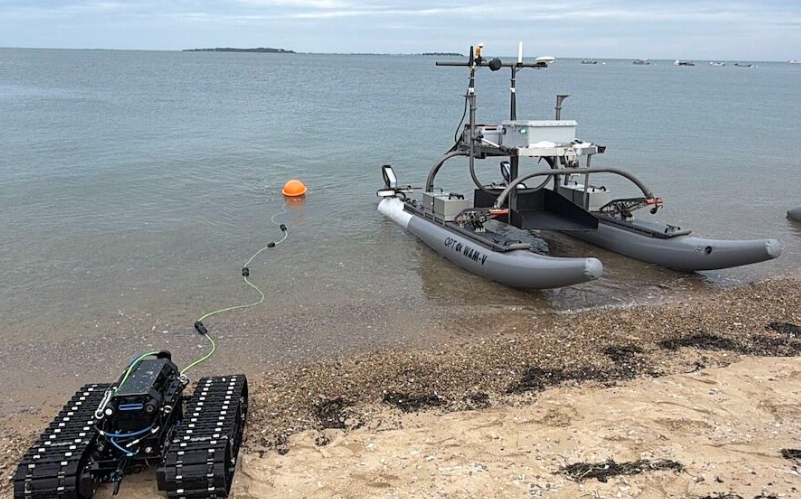
One unmanned vehicle sailed offshore. Then it dropped another robot into the sea and let that machine make its own way back to the beach.
It sounds like a maritime robotics nesting doll. But the demonstration by Greensea IQ and Ocean Power Technologies points toward a potentially important idea in autonomous naval operations: instead of building one robot to do everything, make different unmanned machines deploy each other.
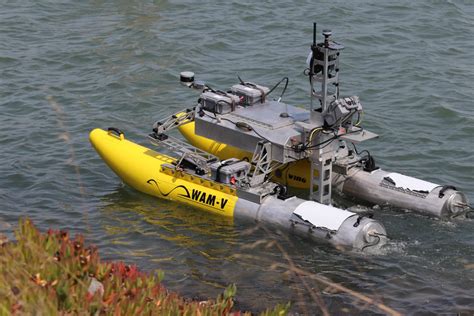
On October 6, Ocean Power Technologies, or OPT, announced the completion of a proof-of-concept requested by Greensea IQ. The test paired OPT’s WAM-V 16 unmanned surface vessel with Greensea IQ’s unusual Bayonet 150 Autonomous Underwater Ground Vehicle, or AUGV.
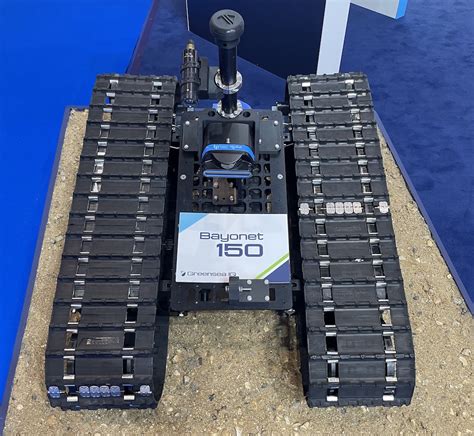
The Bayonet is no lightweight passenger.
At 300 pounds, the amphibious robotic vehicle required OPT to modify the WAM-V 16 specifically to transport and deploy it offshore. During the demonstration, the unmanned surface vessel carried Bayonet out to sea, initiated a remotely triggered release and safely deployed the robot’s umbilical.
Then came the interesting part.
After separation, Bayonet operated under Greensea IQ’s control system and completed the journey from its offshore release point back to the beach. The companies say the proof-of-concept concentrated specifically on transport, deployment and safe separation of the two vehicles.
That's an important boundary around what was actually demonstrated. The test showed one unmanned platform deploying another and the Bayonet subsequently reaching shore. The published announcement does not report an operational mine-clearance mission during this demonstration.
One mission, two environments
What makes the combination interesting is the division of labor.
The WAM-V operates on the surface. Bayonet is designed for amphibious and surf-zone operations, with applications relevant to mine countermeasures and other littoral missions. Greensea IQ itself lists mine countermeasures, unexploded-ordnance inspection and explosive-ordnance disposal among the defense applications of its robotic technologies.
Paco Santana, Greensea IQ’s vice president of business development, described the pairing as a way for a single unmanned system to cover the surface while also working on the seabed during the same mission. Bayonet deploys directly from the WAM-V’s open chassis.
That is the provocative part of the demonstration.
The future of maritime autonomy may not belong to a single spectacular platform packed with every possible capability. It may belong to modular teams of relatively specialized machines.
A surface vessel becomes transport. Another robot handles the underwater or amphibious task. Each can have its own control system and specialist role.
OPT is openly pitching that model. Acting President and CEO Tracy Pagliara said the test demonstrates the WAM-V 16’s potential as a modular surface transport and deployment platform, carrying specialized systems created and controlled by mission partners instead of requiring OPT to own every part of an operation.
Ocean Power Technologies already describes WAM-V unmanned surface vehicles as part of its broader portfolio of maritime systems for markets including defense and security.
The mothership idea is getting smaller
Navies have long worked around carriers, tenders and ships that deliver other assets into an operational area.
What this experiment suggests, on a much smaller scale, is the same logic without people aboard the delivery platform.
A robot transports another robot to where it is needed. It releases the payload. The second machine takes over in an environment the first one cannot effectively work in.
The October demonstration remains a proof of concept, not evidence of a fully proven operational system.
But the architecture is worth watching.
Because the next big leap in maritime robotics may not be building a smarter individual drone.
It may be teaching unmanned machines how to carry, launch and extend the reach of other unmanned machines.