The Day the Sea Shot Back: Ukraine’s Drone Boat Just Turned the Shahed Hunt Upside Down
For years, military planners imagined a future where autonomous systems would fight each other across land, sea, and sky. That future may have just arrived in the Black Sea.
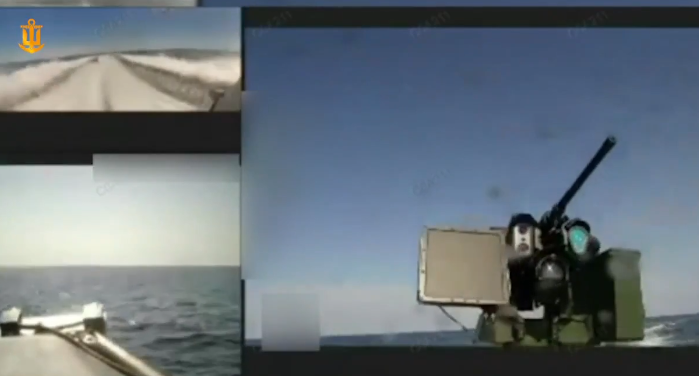
In what sounds more like a scene from a science-fiction blockbuster than a modern battlefield, the Ukrainian Navy says its unmanned surface vessel, the Sargan 3000, successfully shot down a Russian Shahed-type attack drone using a remotely operated gun turret mounted on the vessel.
Let that sink in.
A drone at sea spotted a drone in the air and destroyed it. No pilot. No crew. No sailors standing behind a machine gun. Just sensors, software, and firepower working together in a lethal chain of autonomous warfare.
If confirmed, the engagement represents far more than another drone kill. It signals a potential turning point in how wars will be fought in the coming decade.
The Sargan 3000 is equipped with the Protector remote weapon station, developed by Norwegian defense giant Kongsberg. Originally designed to allow operators to engage targets from protected positions, the system has now been adapted to a new reality: putting sophisticated gun systems on unmanned vessels operating in contested waters.
The result is a weapon that blurs the traditional boundaries between naval combat, air defense, and robotics.
Until now, Ukraine's maritime drones have become famous primarily for attacking ships, harbors, and critical Russian naval assets. They have transformed the Black Sea from a relatively secure operating area into one of the most dangerous environments for conventional surface warships.
But destroying an aerial target is an entirely different challenge.
A Shahed drone is fast, relatively small, and often attacks at low altitude. Hitting one from a moving vessel at sea requires rapid target acquisition, stable tracking, precision fire control, and exceptional accuracy. Doing it from an unmanned boat raises the technological bar even further.
This is why the reported shootdown matters.
The achievement suggests that unmanned naval systems are evolving beyond their original role as floating explosive charges or reconnaissance platforms. They are becoming independent combat systems capable of defending themselves and engaging threats in multiple domains.
And perhaps the most immediate consequence may not involve drones at all.
For months, Russian helicopters have played a crucial role in hunting Ukrainian maritime drones. Often operating at low altitude over the Black Sea, they represented one of the most effective counters to Ukraine's unmanned fleet.
But a sea drone that can successfully engage aerial targets changes the equation.
Every helicopter crew now has to wonder: Is that small speck on the water just another reconnaissance platform... or is it carrying an anti-aircraft weapon capable of firing back?
The psychological impact alone could be significant.
Military history repeatedly shows that new weapons matter not only because of what they destroy, but because of how they alter behavior. Tanks changed infantry tactics. Aircraft carriers changed naval doctrine. Drones changed modern reconnaissance and strike operations.
Now autonomous combat systems may be changing everything once again.
The Black Sea has become a laboratory for military innovation unlike anything seen in recent decades. Techniques that would once have required years of development are being tested, refined, and deployed within months.
What makes the Sargan 3000 story so remarkable is that it combines three revolutions at once: unmanned naval warfare, counter-drone combat, and remote weapon systems.
The image is almost surreal: a robotic boat patrolling hostile waters, detecting an incoming robotic aircraft, calculating a firing solution, and opening fire.
Science fiction has always predicted machine-versus-machine warfare.
The Black Sea may have just delivered the first convincing glimpse of what that future actually looks like.