Fire on the Move. Why Canada’s GRIZZLY LAV Could Redefine Modern Artillery Warfare
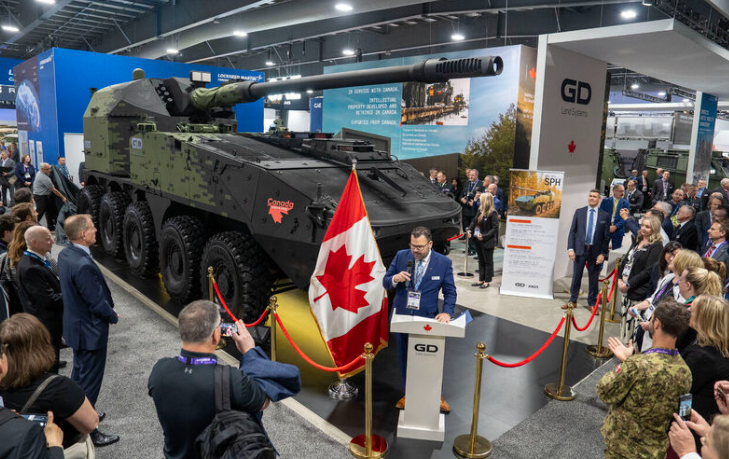
When General Dynamics Land Systems–Canada unveiled the GRIZZLY LAV 10×10 self-propelled howitzer at CANSEC 2026, it did more than showcase a new piece of equipment. It signaled a decisive shift in how armies might fight—and survive—on tomorrow’s battlefield.
At first glance, the formula looks familiar: a wheeled armored vehicle paired with a 155 mm gun. But under the skin, the GRIZZLY is something far more disruptive. It combines a Canadian-built 10×10 LAV platform with the German-designed Artillery Gun Module (AGM), a fully automated, unmanned turret system that challenges decades-old artillery doctrine.
The message is clear: the era of static artillery is ending.
The Death of “Shoot, Wait, Survive”
Traditional artillery systems—especially towed ones like the aging M777—operate with a critical vulnerability: time. The moment a round is fired, modern sensors, drones, and counter-battery radars begin hunting. The longer a system stays in place, the higher the probability of destruction.
Canada’s Indirect Fires Modernization (IFM) program explicitly addresses this reality, aiming to replace legacy systems with between 80 and 98 self-propelled 155 mm howitzers capable of rapid deployment and survivability.
Enter the GRIZZLY LAV.
Unlike conventional systems that must halt, stabilize, and fire, the AGM-equipped platform introduces something radical: fire-on-the-move capability.
This isn’t just an incremental upgrade—it’s a doctrinal leap.
Artillery Becomes Mobile Warfare
The AGM itself is not new. Developed by KNDS, it has already been integrated on platforms like the Boxer RCH 155. But its design philosophy is what sets it apart: modular, automated, and platform-agnostic.
With a 155 mm/L52 cannon, automated loading system, and networked fire control, the module delivers high rates of fire while reducing crew requirements to a minimum.
Mounted on a 10×10 wheeled chassis, the system gains a unique edge: operational speed.
Wheeled platforms like the LAV can redeploy faster than tracked systems, reaching road speeds exceeding 100 km/h and repositioning alongside mechanized units.
In practical terms, this means artillery is no longer lagging behind maneuver forces—it becomes part of the maneuver itself.
Automation as a Force Multiplier
The GRIZZLY’s deeper revolution lies in automation.
The AGM’s autonomous turret processes targeting data, calculates ballistic solutions, and executes firing sequences with minimal human intervention. This reduces crew size while increasing reaction speed and precision.
In a battlespace saturated with sensors and electronic warfare, speed is survival—and automation delivers it.
The system also aligns with a broader trend: the digitization of fire support. Modern artillery is not just about range or firepower; it is about integration into a networked battlefield where sensors, shooters, and decision-makers operate in real time.
A Strategic Industrial Statement
The GRIZZLY LAV is also a political message.
By combining domestic LAV production with European artillery technology, Canada positions itself not just as a buyer—but as a contributor—to next-generation defense systems.
This hybrid approach strengthens domestic industry while ensuring interoperability with NATO systems—an increasingly critical factor in coalition warfare.
The Bigger Question: Is This the Future?
The real question isn’t whether the GRIZZLY is capable—it is whether it represents the direction all artillery will take.
Evidence suggests yes.
Modern conflict—from Ukraine to emerging NATO doctrine—has made one reality unavoidable: static artillery doesn’t survive long enough to matter.
Mobility, automation, and rapid displacement are no longer advantages—they are baseline requirements.
The GRIZZLY LAV doesn’t just meet those requirements. It anticipates the next phase of warfare, where artillery systems operate like hunters rather than targets.
And perhaps most importantly, it forces competitors to rethink their own designs.
Because once artillery can shoot accurately while moving, standing still becomes the most dangerous choice on the battlefield.