Battle-Tested Meets Industrial Power. Airbus and Ukraine’s SkyFall Redefine Europe’s Air Defense at ILA 2026
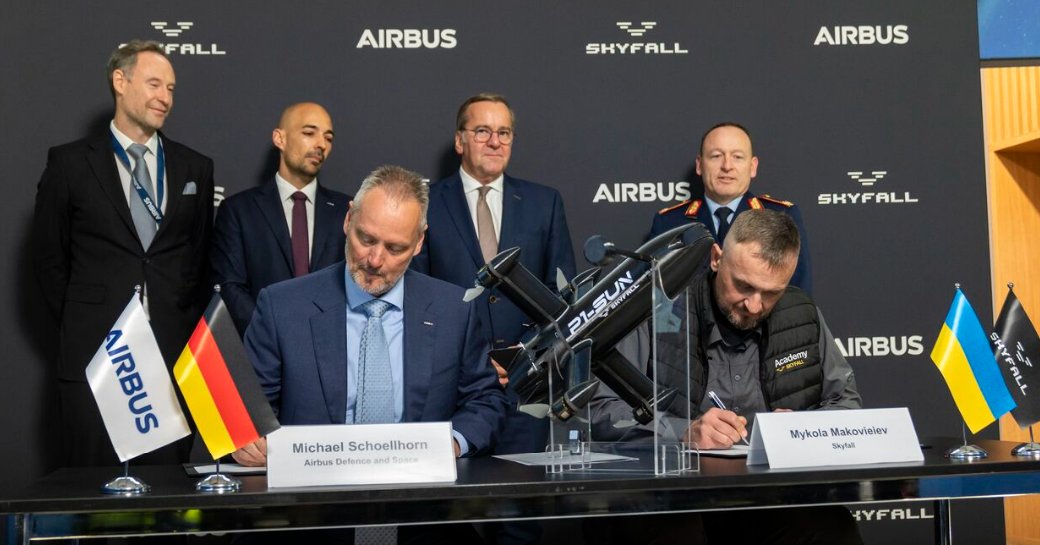
At ILA Berlin 2026, one partnership cut through the noise of futuristic concepts and high-level promises with something far more tangible:
combat reality meets industrial scale.
Airbus Defence and Space and the Ukrainian defense-tech company SkyFall signed a strategic Memorandum of Understanding (MoU) — and unlike many announcements at global air shows, this one was not about potential. It was about experience already forged in war.
Because SkyFall doesn’t just build drones.
It builds systems that survive.
From Battlefield to Blueprint
SkyFall represents a new category of defense company — born not in clean-sheet design labs, but in the harsh, iterative environment of modern conflict. According to its leadership, the company’s interception drones have already neutralized over 10,000 incoming threats in active combat operations.
That number is more than a statistic.
It is validation.
At ILA 2026, Airbus recognized something critical:
the future of air defence will not be built solely on traditional procurement cycles or legacy systems. It will be built on rapid iteration, operational feedback, and scalable deployment.
That is exactly what SkyFall brings.
Airbus Makes a Strategic Shift
For Airbus Defence and Space, the partnership signals a deeper transformation. The company has long been synonymous with large-scale programs, system integration, and long development timelines.
But the nature of aerial threats has changed.
Cheap, mass-produced drones — often deployed in swarms — are redefining the battlefield. They are fast, numerous, and increasingly autonomous. Traditional air defence architectures, optimized for high-value targets, struggle to respond economically and at scale.
Airbus’ answer is clear:
combine its system-of-systems expertise with Ukraine’s combat-proven drone innovation.
The result is not a single product, but a layered air defence ecosystem.
The New Logic of Airspace Protection
At the core of this partnership lies a fundamental shift in thinking.
Airspace protection is no longer about intercepting a handful of high-end threats.
It is about countering hundreds or thousands of low-cost, highly adaptive systems.
This demands:
- Rapid detection and decision-making
- Agile, cost-effective interceptors
- Seamless integration across platforms
Airbus brings strengths in integrated air and missile defense (IAMD), command architectures, and interoperability across NATO systems.
SkyFall brings:
- fast prototyping cycles
- battlefield-proven drone interception technologies
- real-world operational data
Together, they are attempting to close what Airbus itself described as a critical capability gap between traditional defense systems and accelerated innovation cycles.
Europe’s Sovereignty Question
But this partnership is not only about Ukraine.
It is about Europe.
The collaboration explicitly supports the objectives of the European Sky Shield Initiative (ESSI) — a framework designed to strengthen Europe’s integrated air defense capabilities.
And here lies the strategic dimension:
For years, Europe has debated technological sovereignty in defense. Yet many of the most relevant innovations — especially in drone warfare — have emerged outside traditional Western defense ecosystems.
Now, instead of importing solutions, Airbus is integrating them into a European architecture.
This is a subtle but powerful shift:
- from dependency → to integration
- from isolated systems → to shared capabilities
- from theory → to operational readiness
Provocation: The Future Is Not Built in the Lab
ILA 2026 made something brutally clear:
The future of air defence is no longer being invented in isolation.
It is being stress-tested daily in real conflict zones — and refined in cycles measured not in years, but in weeks.
Companies that cannot adapt to this tempo risk becoming irrelevant.
Airbus understands this.
By partnering with SkyFall, it is effectively importing velocity into a system traditionally defined by scale.
The Real Signal from ILA 2026
This alliance is more than a bilateral agreement.
It is a signal to the entire defense industry:
- Innovation will come from where it is tested
- Speed will matter as much as sophistication
- Partnerships will replace silos
And perhaps most importantly:
The next generation of air defence will not be built alone.
It will be co-developed — across borders, across industries, and across very different realities of war and technology.
At ILA Berlin 2026, Airbus didn’t just sign a partnership.
It acknowledged a new truth:
the edge now belongs to those who can learn the fastest.