One More Recup from ILA Berlin 2026. The Day Aerospace Stopped Selling Comfort and Started Selling Security
ILA Berlin 2026 feels different—and not in a subtle way.
For decades, aerospace exhibitions like ILA were carefully balanced showcases of innovation and aspiration. Sustainable aviation, passenger comfort, next-generation engines, and futuristic air travel concepts defined the narrative. This year, that narrative has been decisively rewritten.
The new headline is simple: security first.
Walking through the Berlin ExpoCenter Airport, the transformation is impossible to ignore. The focus has shifted away from greener flight paths and toward something far more urgent—drones, missile defense, and battlefield integration. The industry hasn’t abandoned sustainability, but it has been eclipsed by a more immediate concern: Europe’s ability to defend itself.
And that shift is political as much as technological.
The presence of high-level policymakers—including Germany’s Chancellor at the opening—signals that aerospace is no longer just an industrial sector. It has become a strategic pillar of national and European security policy. The war in Ukraine and the broader geopolitical climate have pushed defense technology to the forefront, turning ILA into something closer to a security summit with wings.
The exhibits reflect this new reality.
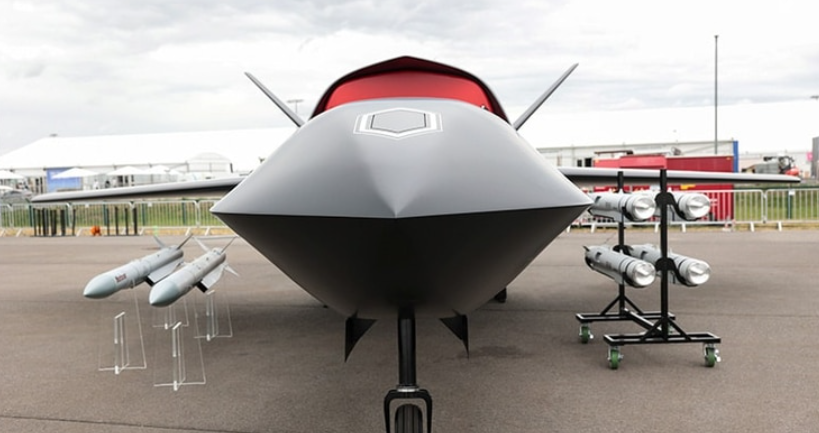
Airbus’ unveiling of the U760 “Ravenstorm” concept points directly to the future of aerial combat—unmanned systems operating alongside, and potentially replacing, traditional platforms. Loyal wingman concepts are no longer experimental; they are becoming operational priorities. The message is clear: future airpower will be hybrid, networked, and increasingly autonomous.
Meanwhile, Germany’s Heron TP drone stands as a symbol of endurance and strategic surveillance—long-range, long-duration intelligence gathering now considered essential infrastructure in modern conflict.
But perhaps the most telling developments are happening in air defense.
Diehl Defence’s IRIS‑T SLS MK4 and Rheinmetall’s Skyranger 30 system represent a new urgency around protecting airspace from emerging threats—particularly drones and low-flying systems that challenge traditional defenses. These are not niche capabilities anymore. They are central to how nations think about air security.
And they are becoming interconnected.
Because what ILA 2026 reveals is not just a shift in products—but a shift in systems thinking. Platforms are no longer evaluated in isolation. Instead, they are part of integrated architectures—linking sensors, weapons, aircraft, and ground-based systems into unified operational networks.
The battlefield is no longer linear. Neither is aerospace.
Yet, this transformation comes with tension.
On one side, the defense sector is accelerating—driven by urgency, funding, and political focus. On the other, the civilian aviation industry is under pressure. Airlines and operators are grappling with high operating costs, energy challenges, and regulatory burdens, all while competing in a global market that offers little room for error.
The contrast is stark inside the exhibition halls.
Lufthansa’s presence captures this duality perfectly. A centenary celebration aircraft reminds visitors of aviation’s heritage, while Lufthansa Technik Defense highlights the company’s growing involvement in military programs for NATO and the Bundeswehr. The line between civil and military aerospace is not just blurring—it is becoming strategically intertwined.
This convergence may be one of the most important long-term trends revealed at ILA 2026.
Maintenance expertise, logistics capabilities, and engineering know-how once seen as purely civilian assets are now being leveraged for defense applications. It is a shift that reflects both opportunity and necessity.
Because the industry is adapting to a new world.
A world where resilience matters as much as efficiency. Where sovereignty matters as much as globalization. And where technological leadership is measured not just in innovation—but in operational readiness.
ILA Berlin 2026 is not the first event to reflect these changes—but it may be the clearest signal yet that the transformation is complete.
Aerospace is no longer just about connecting people and places.
It is about protecting them.
And in that shift, a multi-billion-euro industry is redefining not only its priorities—but its identity.