Anduril’s Steelfin Could Change Air Defense Forever: What Happens When Interceptors Become Affordable?
For years, modern air defense has faced an uncomfortable economic reality.
The threats are getting cheaper.
The defenses are getting more expensive.
A drone costing tens of thousands of dollars can force defenders to launch interceptor missiles worth hundreds of thousands, sometimes millions. The attacker spends little. The defender spends a fortune.
This imbalance has quietly become one of the most serious strategic problems facing modern militaries.
Now, Anduril Industries believes it has a solution.
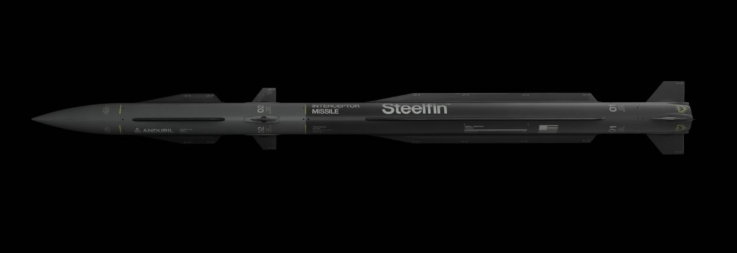
With the unveiling of Steelfin, a new family of interceptor missiles designed to engage everything from drones and aircraft to cruise missiles, ballistic missiles, and even hypersonic threats, the company is targeting something rarely discussed in defense procurement: economics.
The promise is bold.
According to Anduril, Steelfin is designed to deliver these capabilities at a fraction of the cost of traditional interceptors.
If that claim proves true, the implications could be enormous.
The modern battlefield is being overwhelmed by quantity. Conflicts across the globe have demonstrated that mass matters. Swarms of drones, saturation missile attacks, and coordinated strikes are exposing the limits of air-defense systems built for an era when threats were fewer and more expensive.
The challenge isn't merely technical.
It's financial.
A nation can build a highly effective defensive shield, but if every engagement costs dramatically more than the threat being destroyed, the defender eventually faces a sustainability problem.
This is where Steelfin's architecture becomes particularly interesting.
Rather than creating a single interceptor optimized for one mission, Anduril has created a family of missiles built around a modular design philosophy. Different boosters can produce variants capable of operating at supersonic or hypersonic speeds, while covering engagement envelopes from low-altitude threats to targets in the upper atmosphere.
The significance of this approach extends beyond performance.
Traditional defense programs often require entirely new designs, supply chains, testing processes, and production facilities whenever a new capability is introduced. Modular architectures seek to break that model.
With shared components and common manufacturing processes, multiple variants can be produced on the same production line.
That means lower costs.
Faster production.
Greater scalability.
And perhaps most importantly, a faster response to evolving threats.
The timing is no coincidence.
Defense planners worldwide are wrestling with the emergence of increasingly sophisticated unmanned systems. Small drones, loitering munitions, cruise missiles, ballistic weapons, and hypersonic systems are forcing military organizations to rethink how they protect critical assets.
The traditional approach of using expensive, highly specialized interceptors for every engagement is becoming increasingly difficult to justify.
Future air defense systems may need to function more like industrial-scale production networks than elite precision weapons.
The side that can manufacture thousands of effective interceptors may gain a significant advantage over the side that can produce only hundreds of exquisite ones.
Anduril appears to be positioning itself for exactly that future.
The company has built its reputation around challenging conventional defense acquisition models. Rather than treating software, autonomy, and manufacturing as separate disciplines, it combines them into an integrated approach focused on speed and scalability.
Steelfin reflects that philosophy.
The most provocative aspect isn't its speed.
It isn't its range.
It isn't even its ability to counter hypersonic threats.
It's the possibility that air defense may finally begin winning the cost equation.
That equation increasingly defines strategic success.
During future conflicts, victory may depend less on possessing the single most advanced interceptor and more on having enough affordable interceptors available when adversaries launch attacks in overwhelming numbers.
Missile defense is no longer just an engineering challenge.
It has become a production challenge.
An economics challenge.
A scalability challenge.
If Steelfin succeeds, Anduril may not have merely introduced a new missile.
It may have introduced a new business model for air defense.
And in an era of drone swarms and mass missile attacks, that could prove just as disruptive as any breakthrough in propulsion or guidance technology.
The future of air defense may not belong to the most powerful interceptor.
It may belong to the most affordable one.