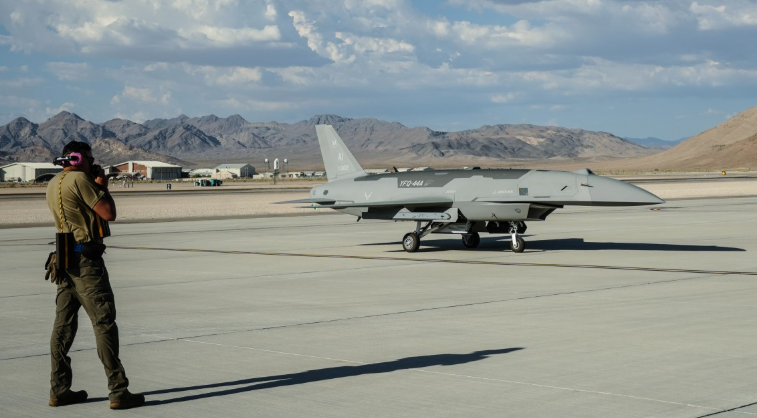
Missiles, Drones, and Industrial Power: Boeing and Anduril Aim to Rewrite America's Air Defense Playbook
The battlefield is changing faster than many defense planners expected. Cheap cruise missiles and mass-produced drones have transformed modern warfare, creating a new reality in which advanced militaries can be overwhelmed not by technological superiority, but by sheer volume. The United States Army believes the next war will demand a different answer. Boeing and Anduril believe they have it.
This week, the Army selected Boeing and Anduril Industries to advance to the next phase of competition for the Integrated Fires Protection Capability (IFPC) Increment 2 Second Interceptor program. The mission is straightforward but vital: protect fixed installations and forward operating bases from cruise missiles, weaponized drones, and a growing range of aerial threats.
Behind the announcement lies a much bigger story. This is not simply a competition between defense contractors. It is a test of whether the United States can rebuild the industrial capacity required to sustain modern warfare.
For years, defense analysts have warned about an uncomfortable truth. Potential adversaries, including China, Russia, and Iran, have invested heavily in affordable missile and drone systems that can be manufactured at scale. The strategic objective is simple: exhaust the inventories of Western defenses faster than they can be replenished.
A sophisticated interceptor may successfully destroy an incoming threat, but if it costs vastly more and takes longer to produce, the economic equation favors the attacker.
Anduril's response is as much industrial as it is technological.
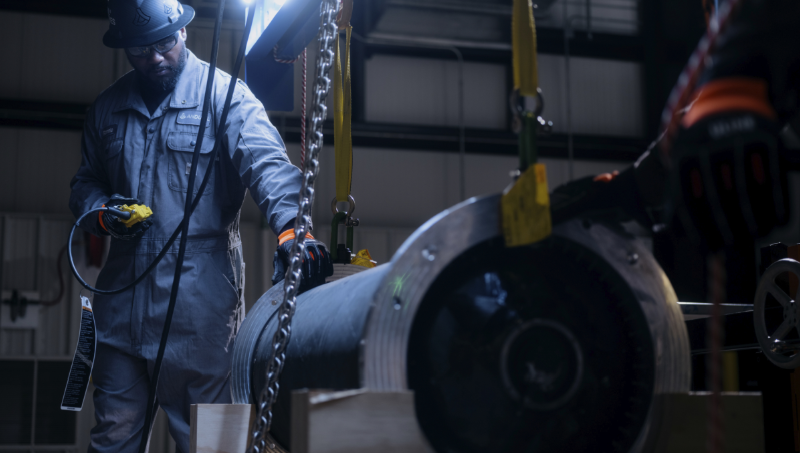
At the center of its strategy is the Mississippi Solid Rocket Motor Complex, a 450-acre manufacturing campus designed to expand the capacity and resilience of the American defense industrial base. Unlike traditional facilities built around decades-old processes, the complex was developed from first principles with one goal in mind: produce more rocket motors, faster and at greater scale.
The company invested more than $100 million of its own capital, supplemented by $58 million in Defense Production Act funding. The result is a modern production ecosystem featuring advanced automation and a unique bladeless high-speed mixer said to be the only system of its kind in the world.
Perhaps more importantly, the facility employs parallel manufacturing processes, allowing multiple production steps to occur simultaneously. The approach dramatically shortens production timelines while providing flexibility to manufacture different rocket motor configurations on the same production line.
In an era where speed may determine strategic outcomes, manufacturing innovation is becoming a weapon in its own right.
The interceptor proposed by Boeing and Anduril combines two distinct strengths. Boeing contributes advanced seeker technology and a compact airframe optimized for interception missions. Anduril provides the solid rocket motor, leveraging propulsion technologies already proven across its existing programs.
Together, the companies aim to deliver a high-performance interceptor capable of filling a critical gap in U.S. air defense architecture. The system is designed to engage threats in the midrange battlespace, operating between short-range point-defense systems and high-end long-range interceptors typically reserved for the most valuable targets.
That positioning could prove decisive. Modern conflicts increasingly demand layered defenses capable of responding to diverse threats at multiple distances. An interceptor that is effective, affordable, and scalable could become one of the most valuable tools in the Army's arsenal.
The partnership itself began in 2024 when Boeing and Anduril joined forces to explore technologies suitable for the Army's future interceptor requirements. What started as a technology collaboration has now evolved into a serious contender for one of the military's most strategically important modernization efforts.
The next phase of the competition will focus on detailed design, system development, integration, and demonstration. Ultimately, the teams will have to prove that their solution can meet demanding Army requirements in a competitive capability demonstration.
The significance extends far beyond a single contract award. The real question is whether America can once again align innovation, manufacturing, and military readiness at the speed demanded by modern conflict.
If Boeing and Anduril succeed, the future of air defense may not be defined solely by the interceptor itself, but by the factory that builds it.