Zmiy Mini Strike UGV. Ukraine’s New Silent Killer Fits in a Pickup and Hunts Infantry and Armour
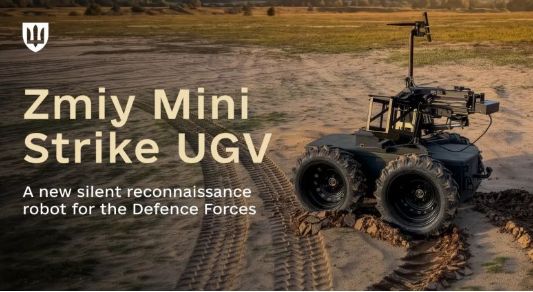
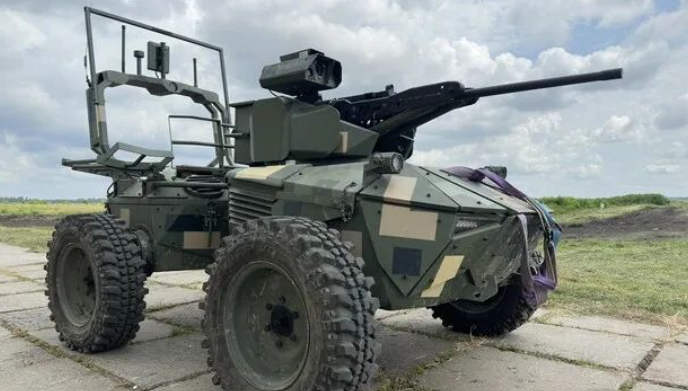
Ukraine’s latest battlefield robot is small enough to fit inside a civilian vehicle, quiet enough to approach without announcing itself and versatile enough to scout, observe and deliver fire support.
The Ukrainian Ministry of Defence has codified and authorised the Zmiy Mini Strike, also known as the Udarnyi, for operational use by the Armed Forces of Ukraine.
The new unmanned ground vehicle is designed for remote reconnaissance, battlefield surveillance and direct engagement of enemy infantry and armoured vehicles. Its combination of mobility, compact dimensions and strike capability reflects how quickly ground robotics are moving from experimental systems into routine military service.
The Zmiy Mini Strike is built around a fast wheeled chassis with enhanced off-road performance. This allows it to move across damaged roads, fields and difficult terrain while keeping soldiers farther away from exposed positions.
Its electric motor is another important feature.
Electric propulsion reduces noise, making the vehicle more difficult to detect acoustically during reconnaissance or approach. A quieter platform can observe enemy positions, move ammunition or position a weapon system without producing the engine sound associated with conventional military vehicles.
For a small reconnaissance-and-strike robot, silence is not simply a comfort feature.
It is survivability.
The vehicle is also designed for rapid deployment and recovery. According to the available information, it can be transported in the trunk of a minibus, on a small car trailer or in the cargo bed of a pickup truck.
That mobility gives units greater freedom to move the system between positions without depending on specialised transport vehicles.
Compact dimensions and low weight may also allow operators to conceal the platform more easily, deploy it closer to the front and recover it quickly when the tactical situation changes.
The Zmiy Mini Strike uses both daytime and thermal-imaging cameras. This gives operators the ability to observe targets during daylight, at night and in difficult visibility conditions.
Thermal imaging is particularly useful for identifying personnel, vehicles and heat sources where normal cameras may struggle.
However, the system is not limited to observation.
Its strike role reportedly includes grenade-launcher fire support, allowing the UGV to engage enemy personnel and potentially lightly protected targets while the operator remains at a safer distance.
This changes the risk equation.
Tasks that once required soldiers to approach a firing position, expose themselves during reconnaissance or carry a weapon system into a dangerous area can increasingly be transferred to robotic platforms.
The UGV may be replaceable.
The operator is not.
The Ministry of Defence stated that the Zmiy Mini Strike met its stated tactical and technical requirements during testing and combat use. That combat validation is significant because battlefield conditions expose weaknesses that controlled demonstrations often hide.
Mud, damaged terrain, electronic interference, signal loss and enemy fire can quickly reveal whether a system is genuinely useful.
The broader numbers show that Ukraine is no longer treating UGVs as niche equipment.
The Defence Procurement Agency has reportedly contracted more than 22,000 unmanned ground vehicles for the Defence Forces in 2026. That is almost twice the number ordered during the whole of the previous year.
Since the beginning of 2026, Ukraine’s defence authorities have also codified and approved 72 new UGV models. All of them are domestically produced, and the total already exceeds the figure for all of 2025 by around 20 percent.
These figures point to a much larger transformation.
Ukraine is building not one universal ground robot, but an ecosystem of specialised machines. Some carry ammunition. Others evacuate wounded soldiers, lay mines, conduct reconnaissance or deliver direct fire.
This variety is likely to be essential because the battlefield demands different combinations of size, endurance, mobility, payload and communications.
Challenges remain.
Small UGVs still depend on reliable control links, and electronic warfare can disrupt communications or navigation. Their cameras and sensors must perform in rain, smoke and dust. They must also survive mines, artillery fragments and small-arms fire long enough to complete their missions.
Yet Ukraine’s approach suggests that perfection is not the immediate goal.
The priority is fielding practical systems quickly, learning from combat use and producing them in numbers large enough to affect operations.
The Zmiy Mini Strike represents that philosophy.
It is compact, transportable, quiet and armed. It does not need a crew, a large logistics chain or a specialised transporter.
Ukraine’s newest iron warrior can arrive in the back of a pickup, disappear into the terrain and move toward the fight without placing another soldier in the line of fire.