Ukraine’s Sea Trident Sends a Message the Crimean Bridge Cannot Ignore
The next great shock in the Black Sea may not arrive from the sky. It may not come with the roar of missiles, the flash of aircraft, or the dramatic swarm of surface drones racing across open water. It may come silently, slowly, and from below.
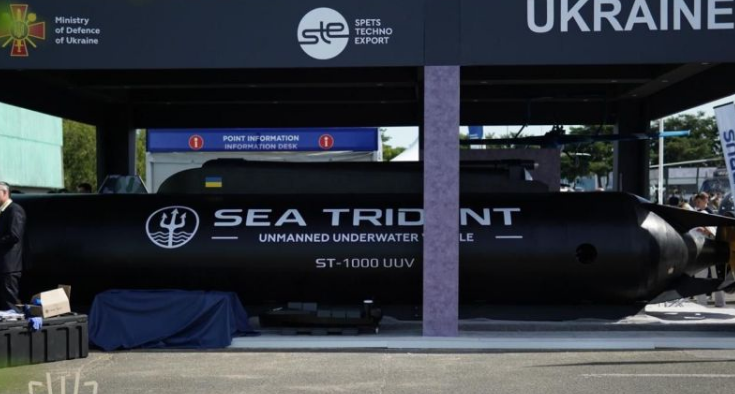
That is the unsettling message behind Sea Trident, Ukraine’s newly unveiled heavy underwater drone—a system presented at Eurosatory 2026 in Paris and described in public reports as capable of carrying up to 1,000 kilograms of payload while operating at depths of up to 60 meters.
On paper, these are technical specifications. In war, they are political language.
Because every new Ukrainian unmanned system carries a message far beyond its dimensions. It says that geography is no longer protection. It says the sea is no longer a barrier. It says that the infrastructure Moscow once treated as untouchable now lives under permanent psychological pressure.
And nowhere is that message more symbolic than around the Crimean Bridge.
The bridge is more than steel and concrete. It is a monument, a supply artery, and a political trophy. For Russia, it represents control. For Ukraine, it represents occupation. That is why any Ukrainian capability designed for covert maritime operations immediately fuels speculation about what could become vulnerable next.
Reports describe Sea Trident as a 10-ton underwater platform built for autonomous maritime missions, adaptive navigation, low visibility, cargo delivery, logistics, strike roles, and even the interception or neutralization of other unmanned underwater vehicles.
That combination matters. The story is not simply that Ukraine has another drone. The story is that Ukraine is building an ecosystem of unmanned warfare—air, surface, and now underwater—designed to stretch Russian defenses across every layer of the battlespace.
The old naval equation was brutally simple: bigger fleets, bigger ships, bigger budgets. Ukraine has spent the war challenging that logic. With naval drones, improvised strike platforms, and rapid defense innovation, Kyiv has shown that asymmetric technology can force a conventionally stronger adversary to rethink where safety begins and ends.
Sea Trident pushes that logic deeper—literally.
A surface drone can be seen. A missile can be tracked. An aircraft can be intercepted. But an underwater vehicle operating with a low signature introduces a darker form of uncertainty. It turns ports, naval bases, bridges, terminals, and maritime routes into questions rather than certainties.
For commanders, uncertainty is expensive. It forces surveillance. It forces countermeasures. It forces redeployment. It forces doubt.
That may be the real power of Sea Trident. Not only what it can carry, but what it can make the enemy imagine.
Still, caution is essential. Public specifications are not the same as battlefield proof. Defense exhibitions are stages where ambition, prototype, marketing, and capability often stand shoulder to shoulder. Some reports note that development status and operational readiness have not been fully disclosed.
But even as a signal, the unveiling is significant. Ukraine is not merely buying time; it is designing pressure. It is turning engineering into deterrence, improvisation into doctrine, and the Black Sea into a contested technological laboratory.
If the first drone war was fought in the air, the next chapter may be written underwater.
And that is what makes Sea Trident so provocative. It does not need to make noise to change the conversation. It does not need to promise the fall of any single bridge to alter the strategic atmosphere.
It only has to exist.
Because once a state proves it can send machines beneath the waves, across distance, with autonomy and payload, the battlefield expands in the minds of everyone watching.
The bridge may still stand. But the myth of invulnerability is already taking on water.