Zelenskyy Dismisses German Merz’s Plan for Ukraine’s Associate EU Status
Ukraine has drawn a line - and it runs straight through Brussels.
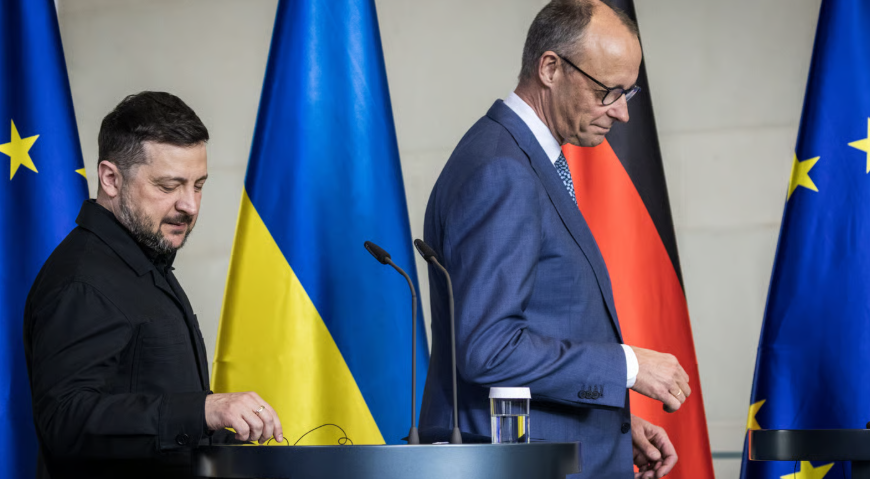
In a move that cuts through months of carefully calibrated European diplomacy, President Volodymyr Zelenskyy has firmly rejected Germany’s proposal to grant Ukraine an “associate membership” in the European Union. The reason is as blunt as it is political: a seat without a voice is not a seat worth having.
“There can be no complete European project without Ukraine,” Zelenskyy declared publicly. But more importantly, he made clear that anything less than full, equal membership is not a compromise—it’s a limitation. And for a country fighting a war on behalf of its own survival and, arguably, Europe’s security architecture, limitations are no longer acceptable.
The German proposal, championed by Chancellor Friedrich Merz, aimed to create a middle ground: offer Ukraine access to key EU structures and benefits without granting full voting rights. It was a pragmatic attempt to balance enlargement fatigue within the EU with geopolitical urgency. Associate membership, in this sense, was designed as a bridge—a way to integrate Ukraine incrementally while postponing difficult institutional decisions.
But Zelenskyy has effectively burned that bridge before it could be crossed.
At the heart of his objection is a principle that resonates far beyond Ukraine’s borders: sovereignty is not divisible. Participation without representation, even under the EU’s banner of solidarity, risks creating a two-tier Europe—one where some states shape policy while others merely follow it.
Zelenskyy’s message is also deeply strategic. Ukraine is not approaching EU accession as a passive candidate waiting for approval. It is positioning itself as an active contributor—militarily, politically, and economically—to the European project. His letter to EU leaders emphasizes this point with clear intent: Ukraine is defending Europe “fully, not partially, and not with half-measures.” The implication is unmistakable—Ukraine’s commitment demands an equivalent response.
Yet, from the European side, the hesitation is equally real.
Leaders like European Parliament President Roberta Metsola have echoed the logic behind incremental integration. Opening access to programs such as the single market, customs union, and research initiatives is seen as a manageable pathway, both politically and administratively. It allows the EU to move forward without triggering internal resistance over full enlargement.
But this is where the friction lies: Europe is thinking in phases; Ukraine is operating in urgency.
Since applying for EU membership just days after the full-scale Russian invasion in February 2022, Ukraine has moved at remarkable speed through the accession process. Official candidate status followed within months, and formal negotiations began in 2024. The expectation in Kyiv is that this momentum should not be diluted by proposals that risk institutional second-class status.
The debate now unfolding is not simply about Ukraine—it’s about the EU itself.
Is the European Union prepared to adapt its structures to geopolitical reality, or will it continue to rely on gradualism in a moment that demands decisiveness? The associate membership idea reflects a cautious Europe, wary of overextension and internal division. Zelenskyy’s rejection reflects a Europe under pressure—a continent whose security is being actively contested.
This creates a deeper tension. The EU has long positioned itself as a project of values: democracy, equality, and shared governance. Offering Ukraine participation without full rights risks undermining that very narrative. Conversely, fast-tracking full membership could strain institutions not designed for such rapid expansion.
There is no easy resolution.
But what Zelenskyy has done is force clarity. By rejecting the halfway model, he has transformed the conversation. The question is no longer whether Ukraine will join the EU, but under what conditions—and on whose terms.
And perhaps most importantly, how quickly Europe can decide what it truly stands for.
Because in moments like this, ambiguity is not neutrality.
It’s a decision.