Why Choose Between Flying and Swimming? China's New Drone TJ-FlyingFish Does Both
For decades, drones have dominated the skies. Underwater robots, meanwhile, have explored oceans, lakes, and submerged infrastructure. But what if a single autonomous vehicle could do both?
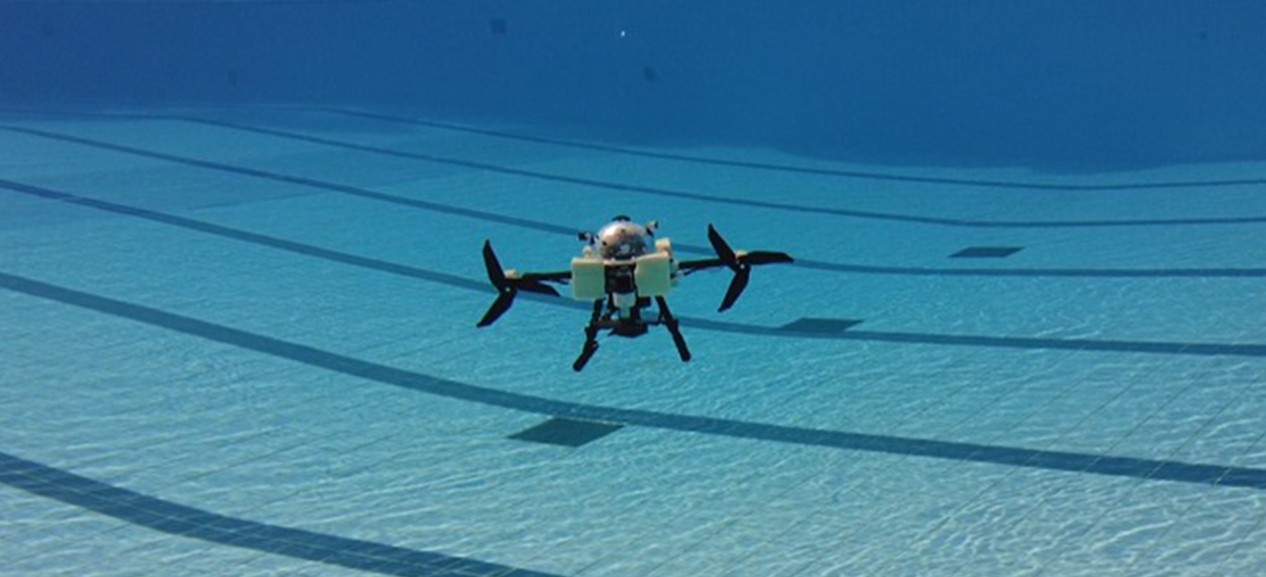
Researchers in China have unveiled the TJ-FlyingFish, a remarkable amphibious drone capable of operating in the air and underwater. Developed through a collaboration between Tongji University and the Chinese University of Hong Kong (CUHK), the platform represents a major step toward a new generation of multi-domain unmanned systems that can seamlessly transition between two of the most challenging operating environments on Earth.
At first glance, the TJ-FlyingFish resembles a conventional quadcopter. Weighing just 1.63 kilograms, the drone features four arms, each equipped with a propulsion unit. However, beneath its familiar appearance lies an engineering breakthrough. The propulsion system incorporates a dual-speed gearbox and independently rotating mechanisms that allow the vehicle to optimize performance both in the air and underwater.
This capability enables the drone to perform something that very few unmanned systems can achieve: fly through the air, enter the water, continue its mission underwater, and then return to the surface without human intervention.
The TJ-FlyingFish is fully autonomous throughout the entire process. To navigate across both environments, it relies on an advanced positioning and navigation suite that combines GPS, an inertial measurement unit (IMU), a depth sensor, and a miniature Doppler Velocity Log (DVL). Together, these systems allow the drone to maintain situational awareness whether it is flying above the surface or navigating underwater where GPS signals cannot reach.
The performance figures are particularly impressive considering the drone's compact size. In aerial mode, the TJ-FlyingFish can hover for approximately six minutes on a single battery charge. Underwater, where energy consumption differs significantly, the platform can remain operational for up to 40 minutes. It can dive to depths of around three meters (10 feet) and travel underwater at speeds of up to two meters per second.
While these specifications may not seem revolutionary compared with dedicated aerial drones or underwater vehicles, the real innovation lies in combining both capabilities within a single lightweight platform.
The implications could be substantial.
Search-and-rescue operations represent one of the most promising applications. Imagine a drone rapidly flying to a flooded area, locating a victim from above, then diving beneath the water's surface to inspect submerged vehicles, structures, or obstacles. Current rescue operations often require multiple specialized systems to perform these tasks.
Marine research could also benefit significantly. Scientists studying coastal ecosystems, coral reefs, or aquatic wildlife frequently rely on separate aerial and underwater platforms. A hybrid system could collect data from both environments during a single mission, improving efficiency while reducing operational costs.
The offshore energy sector presents another opportunity. Wind farms, oil platforms, pipelines, and underwater cables require regular inspection. A drone capable of flying between assets and then diving underwater for close inspection could dramatically streamline maintenance operations.
Military and security applications are equally difficult to ignore. Multi-domain drones could conduct reconnaissance missions across coastal environments, harbors, and maritime infrastructure while maintaining operational flexibility unavailable to traditional UAVs.
Of course, significant technical challenges remain. Air and water are fundamentally different environments. Propulsion, communications, navigation, energy management, and structural design all require careful optimization. What works efficiently in the air often performs poorly underwater, and vice versa.
That is precisely what makes the TJ-FlyingFish so interesting. Rather than accepting these limitations, the research team has demonstrated that practical hybrid systems are becoming increasingly achievable.
The broader trend is clear. The future of unmanned systems is moving beyond individual domains. Tomorrow's drones may not simply fly, drive, sail, or dive. Instead, they will seamlessly transition between multiple environments as mission requirements change.
The TJ-FlyingFish offers a glimpse of that future — one where the boundary between sky and sea becomes just another waypoint.
%20(1)%20(1).jpg)