When Everyone Has Left, Who Saves the Dog? The Other Lives Ukraine’s War Leaves Behind
There is a moment when war leaves a place but does not leave it empty.
The people are gone.
Windows are shattered. Apartments stand abandoned. Artillery can still be heard somewhere beyond the horizon.
And then, between the ruined houses, there is a dog waiting for someone who will never return.
Polish reporter Wojciech Tochman has seen this other side of the Russo-Ukrainian war repeatedly.
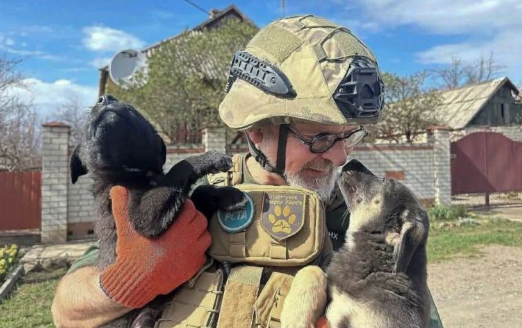
Since Russia's full-scale invasion, the renowned journalist and co-founder of Poland's Institute of Reportage has become not only an observer of Ukraine but an active volunteer, helping evacuate animals from frontline areas and raising money for shelters.
His experiences appear in his latest book, Dolphins and Beelzebub.
But perhaps one story explains his work better than statistics ever could.
The princess from Druzhkivka
Her name is Druzhka.
Her owner left their home in Druzhkivka to buy bread.
He never returned.
Outside, the temperature fell to around −20°C.
Druzhka had puppies. Every one of them froze to death.
And still she stayed.
She remained inside the house, guarding her dead puppies until rescuers eventually found her and brought her to Kharkiv.
There she was treated and fed.
Later, Tochman took her home with him to Greece.
He calls her his “Ukrainian princess.”
It is an almost unbearably small story compared with the scale of a war involving millions of people.
And that is precisely why it matters.
What happens after humans disappear?
We usually understand war through human categories.
Territory gained.
Territory lost.
Soldiers killed.
Civilians evacuated.
Buildings destroyed.
Weapons delivered.
But animals do not understand evacuation orders.
A dog does not know why its family disappeared.
A cat does not understand why the windows suddenly exploded.
Animals simply remain inside the human world after humans have been forced to abandon it.
Tochman describes traveling through frontline settlements around Druzhkivka, Kupyansk, Bilozerske and Dobropillia.
Empty apartment blocks.
The sound of artillery.
Broken windows.
Glass everywhere.
And animals.
No people. But still life waiting to be rescued.
“Rescue is a bottomless pit”
There is no clean victory in this kind of work.
Save one animal and another is still waiting.
Empty one shelter and another needs food.
Evacuate one village and the front moves toward another.
“Rescue is a bottomless pit,” Tochman says.
But then comes the essential second half:
You cannot simply say, “I’m tired.” A life still needs saving.
That sentence describes something larger than animal rescue.
It describes the moral exhaustion produced by a long war.
After years of destruction, people far from Ukraine inevitably become tired of reading about it.
Another missile attack.
Another destroyed building.
Another fundraiser.
Another victim.
Attention becomes exhausted even while the reality continues.
But the person—or animal—waiting to be rescued does not become less real because someone elsewhere has stopped paying attention.
Saving animals means saving something human
Tochman's most interesting argument is therefore not really about animals.
He says that by participating in their rescue, “we are ultimately saving people.”
What he means is that compassion itself needs protecting.
War does not only destroy buildings and bodies.
It can normalize indifference.
It can teach people to look at suffering and calculate whether that particular life matters enough.
Saving an abandoned dog cannot stop a missile.
It cannot retake territory.
It cannot end the war.
But it makes a statement about what kind of world should exist after the war is over.
A world in which vulnerability still creates responsibility.
That may also explain Tochman's striking position on gratitude.
He says he does not expect Ukrainians to thank him.
Instead, he believes Poles and other Europeans should be grateful to Ukrainians for what they are enduring and sacrificing.
Whatever one's politics, there is something powerful in reversing the usual image of the volunteer as a heroic benefactor.
Help does not have to create a debt.
Sometimes you help simply because someone needs help.
And somewhere near the front, after everyone else has left, there may still be a dog sitting beside a broken window.
Waiting.
Saving it will not end the war.
But walking past it might change who we become.
%20(1).jpg)