The War Inside Ukrainian Child. “I could never kill an animal, but I would not hesitate to shoot a Russian soldier.”
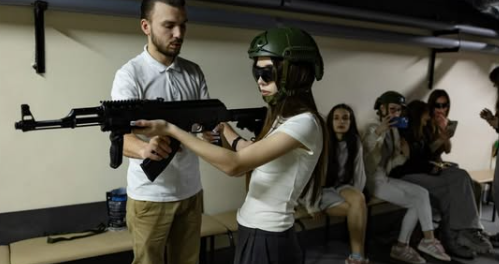
“I could never kill an animal, but I would not hesitate to shoot a Russian soldier.”
The sentence is short. Brutally simple. And deeply unsettling.
It does not come from a trained soldier, hardened by years of combat. Nor from a politician shaping narratives or a strategist calculating outcomes. It comes from a schoolgirl.
A child.
That alone should stop us.
Because wars are often measured in maps, losses, victories, and billions spent. But their most profound consequences are invisible—written not in territory, but in the minds of those growing up inside them.
Across Ukraine today, children are learning first aid, survival tactics, and even how to handle weapons. For them, war is not an abstract concept. It is daily reality. Sirens are routine. Fear is normalized. Loss is personal.
When a child says she cannot harm an animal but is ready to kill a human being, it reveals more than anger. It reveals transformation.
War does this. It rearranges the moral hierarchy. It rewrites instinctive empathy. It redraws the line between what feels unthinkable and what becomes necessary.
History shows this pattern again and again. In prolonged conflicts, the enemy stops being seen as an individual. He becomes a symbol—a source of threat, fear, destruction. Over time, this perception is not only accepted; it becomes essential for survival.
From the child’s perspective, the logic is clear: animals do not bomb cities, destroy schools, or take parents away. Soldiers do. The distinction is emotional, immediate, and deeply human.
But it is also dangerous.
Because once a generation begins to perceive human life through the lens of threat rather than shared humanity, something fundamental shifts. Violence becomes understandable. And what is understandable can, over time, become acceptable.
Yet there is another layer to this reality—one that is far less discussed.
The individuals at the receiving end of that threat—the soldiers themselves—are often products of another cycle of pressure, constraint, and circumstance. Many come from economic hardship, social limitations, or systems that offer few alternatives. Some are driven by ideology, others by survival.
None of this removes responsibility. But it complicates the narrative.
War thrives on simplification: us versus them, right versus wrong, human versus enemy. It must simplify, because complexity is difficult to act upon. But reality remains more tangled.
On one side, a child shaped by fear and loss. On the other, individuals shaped by a system that sends them into conflict.
Between them stands a widening gap of empathy.
This is the true cost of long-term war: not just destruction, but separation. Not just death, but the erosion of the idea that the other side is human at all.
That is why this single quote matters. Not because it is shocking—but because it is understandable.
And that is exactly what makes it alarming.
The hardest question is not about who is right or wrong in any given moment of war. The harder question comes later:
What kind of society emerges when its children grow up learning that killing another human being can feel more acceptable than harming an animal?
Ending war is already difficult. Rebuilding the human perception of “the other” afterwards is even harder.
Because peace is not just the absence of weapons. It is the return of recognition—that the person on the other side is, first and foremost, a human being.
And once that recognition is lost in childhood, restoring it may take generations.
What makes a Russian soldier the real enemy? I will answer.
For many of them, it is about money: around $2,000 monthly income for going to war, and about $70,000 paid to their family if they die at the front.
Many people in Russia become soldiers simply to provide food and basic survival for their families. This reflects the harsh economic conditions in the country.
But can we really blame them for trying to survive in such circumstances?
The real responsibility lies elsewhere — in the political system and leadership that create these conditions and send people to war. This is #Putler wonderful economy and wonderful country. A fish rots from the head down.
How much morality should we lose?