War, Love and Death. How to be a Ukrainian Family in 2022.
You've been living in Ukraine since 2002. By 2022, your son has grown up and reached draft age. Your husband, meanwhile, is not quite past it yet.
And then, at 4:30 in the morning on February 24, you all wake up to explosions outside your window.
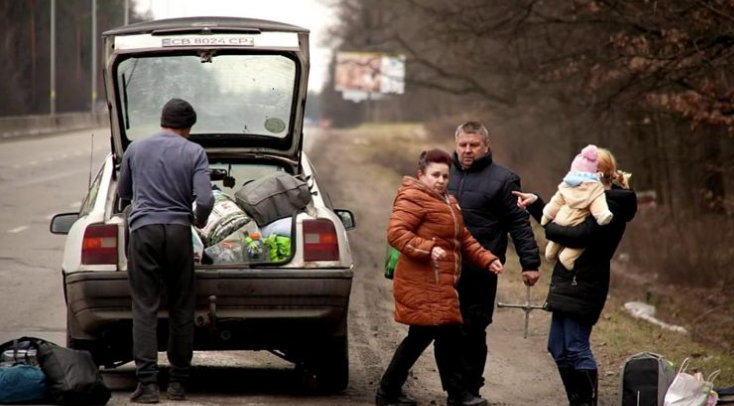
Before you've even had time to fully lose your mind, you grab your emergency backpacks (yes, they've been packed and ready for a long time; you're not idiots, after all. You've got degrees and diplomas and all that), rush down to the garage, where people just like you are already running around with the same backpacks and suitcases.
You cram everything into the trunk and suddenly discover that your husband never filled up the tank yesterday, even though he'd planned to.
Swearing, you try to find out whether the nearest gas station is open. You drive there. There's a line of eighty cars.
And the explosions are getting closer.
When something detonates right nearby and the shockwave knocks your son off his feet, shattering the windows at the gas station, you decide it's safer to drive to your mother's village. At least you have enough fuel for that.
The village is in the Hostomel direction.
Or the Zhytomyr direction.
Borodianka, perhaps.
Or Moshchun.
Or Yahidne.
It doesn't matter.
You arrive there and, on the way, clear out the shelves of the nearest store. Again, remember: diplomas and all that.
You start carrying things down into the cellar, planning to "wait it out."
All day and all night you hear fighting near Hostomel Airport.
The explosions are getting closer, but you don't leave. There's no fuel anyway, and you're terrified. Russian helicopters are flying overhead and firing.
You sleep piled together in the cellar on a couple of rugs and blankets.
It's damp. It's cold.
But upstairs is worse.
The next morning, you go upstairs to make yourself a coffee and discover there's no gas.
A neighbor manages to get through to you and says that a gas pipe has been damaged. Someone needs to shut off the valves at the substation, otherwise the entire village could burn.
Your husband goes with the neighbor.
Your son wants to go too.
But you and your mother grab hold of him and refuse to let go, screaming hysterically.
Your husband has been gone for forty minutes.
Shelling begins.
Explosions strike throughout the village.
You call him.
No signal.
Along with the gas pipe, the blast took down the cell tower.
That's it.
There will be no more communication.
Unless someone climbs the embankment above the garage.
Your son tried.
He came back pale as death, with a bullet hole in the sleeve of his jacket.
Nobody goes up there again.
And your husband?
He came back.
Three hours later.
By then you'd already buried him a hundred times in your mind.
The stress locks your jaw and your shoulder.
You can no longer raise your arm.
You speak as though you've suffered a stroke.
You don't know it yet, but it will pass.
Two years later.
In another country.
After starting antidepressants.
Anyway, back to the cellar.
While your husband was gone, the electricity disappeared.
Now you have neither light nor water, because the well pump runs on electricity.
But your husband also has a diploma, so he and the neighbor return with a generator and five liters of fuel for it.
Your mother timidly suggests pouring the fuel into the car and trying to leave.
Your husband is outraged. His car doesn't run on that garbage.
So he fills the generator.
And then a heavy bombardment begins.
Everybody tumbles into the cellar.
Everybody except your dog, who is terrified of stairs and hides under the sofa in the living room.
You hear glass shatter somewhere upstairs.
After that, all you can hear is the howl of incoming shells, bursts of gunfire, and explosions, explosions, explosions...
Forty minutes later, when it finally quiets down, you cautiously go upstairs.
The window has been pierced by bullets.
Several of them appear to have ricocheted around the room.
The dog under the sofa is alive.
But it's impossible to pull her out.
And she has urinated herself from terror.
She lies there in her own puddle.
You begin to realize this is serious.
Neighbors arrive carrying small children and ask to use your cellar.
They don't have one of their own.
An hour later, there are thirty people in your cellar.
Four of them are children.
Plus two cats in carriers.
Plus your dog.
Your husband and son carried her downstairs.
No, nobody is sobbing.
Nobody is wringing their hands.
Not even the children are crying.
A crushing silence hangs over everything.
A neighbor suggests going outside to see what's happening.
He, another neighbor, and your husband head upstairs.
The generator has been damaged by shrapnel and needs repairs.
The men start working on it.
Then they test it.
Because of the engine noise, they miss the heavy rumble approaching.
Russian tanks have entered the village.
Only when an insane firefight erupts do they finally hear it.
They abandon the generator and run for cover.
One neighbor lies on the porch trying to get the front door open.
You drag him into the house by the collar.
You ask where your husband and the other man are.
"I don't know," he croaks.
He's terrified.
You slide down the wall.
And that's when the first gray hairs appear on your head.
The battle lasts about an hour.
A tank fires into the neighboring house.
Then rakes it with machine-gun fire.
You don't know whether the neighbors are alive.
Above you is hell itself.
You're afraid to stick your nose out of the cellar.
But staying in the cellar isn't much better.
Everything shakes.
Plaster rains down from the ceiling.
You're shaking too.
From sheer nervous strain.
Your teeth chatter.
Your hands won't do what you tell them to.
One of your legs keeps giving way.
You left the front door half open.
Just in case.
Just in case your husband comes back.
Like the neighbor did.
When everything finally goes quiet, you shoot upstairs.
Sorry for the pun.
Looking for your husband.
Your husband and the second neighbor hid in the garage.
Though they seem to have acquired some gray hair as well.
Or maybe that's just dust and plaster.
You look around.
Smoke.
Destruction.
Everywhere.
You sprint to the neighboring house.
The kitchen is gone.
A hole remains.
The cellar entrance is partially collapsed.
You hear the neighbor woman screaming from inside.
You start throwing chunks of concrete away from the entrance.
A few months later, this will leave you with a serious neuromuscular back disorder. Pain will shoot from your shoulder blade into your lower back every time you move suddenly.
But that's a minor detail.
The neighbor is screaming:
"The boys were upstairs! Where are they?!"
She has two sons.
The boys emerge with white faces from the swimming pool that had been drained for winter.
One of them has a bullet graze on his cheek.
They were lucky.
Buryat soldiers firing from an infantry fighting vehicle had been shooting at them.
Just for fun.
The neighbor is shaking.
You are shaking.
Everyone is shaking.
And let me remind you:
This is only the fourth day.
On the seventh day, after somehow obtaining gasoline again, without anyone caring what grade it is anymore, you leave the village in a convoy of five cars, seizing a brief gap between bombardments.
The village is being pounded.
Rockets.
Bombs.
Gunfire.
On the day the tanks entered, one of them fired point-blank at a twenty-two-year-old woman who lived on the next street.
It tore her in half.
Anyway.
Day seven.
In your hands is a bag containing documents, a couple of pairs of underwear, a couple of warm sweaters.
And your laptop.
The dog is on a leash.
You drag the dog, your son, and your mother into the car.
Your mother has practically fused to her chair, muttering:
"Leave me. I'm not going anywhere."
You get her in.
You leave.
Along the road you see destroyed homes, shell craters, and missiles flying toward Kyiv.
It is March 2.
That day you'll only make it as far as Vinnytsia, to a shelter set up in a summer camp for children.
You will stand under a hot shower and cry.
Tomorrow you'll continue.
And then you discover that your husband and your son won't be allowed to cross the border.
They push you, your mother, and the dog through and say:
"Go. Get everything ready for our arrival. We'll find a way."
And so you go.
You travel.
Volunteers pass you from hand to hand.
Somewhere they house you.
Somewhere they feed you.
Somewhere they give you clothes and hygiene supplies.
You still can't unclench your jaw.
You still can't raise your arm.
An interpreter is brought in and tells you:
"The dog has to go to a shelter. You can't stay here with a dog."
You break down.
The dog urinates herself again.
You are given a bed behind a curtain and two days to solve the problem.
That night, a thunderstorm begins.
Your heart pounds.
Your mother swallows her pills.
And then you suddenly notice that the dog is no longer moving.
Her heart gave out. Death.
You are spared the choice.
The next morning your son sends you a photograph of your house.
Two walls remain.
And the chimney.
A year later, a missile will hit your apartment in Kyiv.
Your husband and your son are drafted into the army.
A few months later your son comes home on a shield. He is 20 years old and he is dead.
That is when your hair turns completely gray.
Don't forget:
You still have to spend three hours a day learning German.
You still have to build a career.
And at the same time care for your mother and find a good nursing home for her.
After the death of her grandson, she is no longer in her mind.