Ukraine Is Building Its Own Answer to Patriot: Meet the New Koral Air Defense Missile
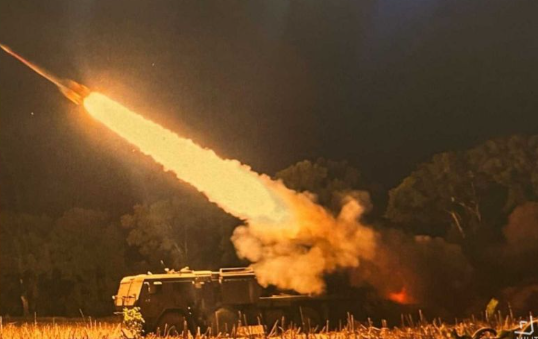
Ukraine has revealed the launcher for its domestically developed Koral surface-to-air missile, offering the clearest look yet at a weapon that has evolved dramatically from its original concept.
Displayed at the MSPO defense exhibition in Poland, the latest Koral is more than an incremental upgrade. It reflects Ukraine's push to build an increasingly independent air-defense ecosystem at a time when access to Western interceptors remains strategically critical.
From Naval Missile to Ballistic Defense
Koral's story began in 2016, when the missile appeared as part of a prospective Ukrainian ship-based air-defense system. By 2021, the Luch Design Bureau had publicly displayed a full-size mockup and discussed a modular missile family suitable for naval and land-based applications.
The original Koral was relatively modest: approximately 300 kilograms, a 25-kilogram warhead, an engagement range of around 30 kilometers and an altitude ceiling of roughly 10 kilometers.
The missile revealed in 2026 is a very different weapon.
Koral now weighs approximately 450 kilograms—around 50% more than the early design—and carries a 36-kilogram warhead. Its length has increased to 4.8 meters, while the launcher shown publicly is mounted on a Czech-made Tatra truck chassis.
More importantly, its mission appears to have expanded.
The missile is being developed to engage conventional aerodynamic targets such as aircraft while also providing capability against ballistic threats. Its current maximum engagement range has not been publicly disclosed.
A Sophisticated Guidance Architecture
Koral combines three guidance elements: inertial navigation, radio-command correction and an active radar seeker.
That architecture allows the missile to fly toward an interception area while receiving updated targeting information before using its own radar seeker during the terminal stage.
This is particularly significant for Ukraine because the interceptor is only one part of the equation. Modern air defense depends on the integration of missiles, radars, command-and-control systems, targeting data and production capacity.
Ukraine is increasingly attempting to develop all of them.
The Bigger Story Isn't Just the Missile
For years, Ukraine's ability to defend its cities and critical infrastructure against advanced missile threats has depended heavily on Western systems—particularly scarce high-end interceptors.
Patriot has demonstrated the importance of advanced missile defense, but every imported system creates another dependency: foreign production capacity, export authorization, political decisions and limited interceptor inventories.
Koral points toward a different long-term model.
Ukraine cannot instantly replace Patriot, nor does the publicly available information establish that Koral currently matches Patriot's capabilities. But that may be the wrong comparison.
The strategic significance is that Ukraine is building another layer of defense that it can potentially manufacture, modify and improve domestically.
That changes the equation.
A locally produced interceptor can be adapted according to battlefield experience without waiting for a foreign manufacturer. Production can potentially be expanded according to Ukraine's own priorities. Components and technologies can also migrate into other missile programs.
Indeed, commonality was part of Koral's philosophy from the beginning. Ukrainian engineers envisioned technologies and subsystems being shared across several missile families rather than creating an entirely separate industrial chain for every weapon.
Europe's Missile Laboratory
There is also a wider lesson for Europe.
Ukraine is simultaneously fighting one of the world's most missile-intensive wars and developing technologies specifically shaped by that experience. Few European defense industries receive such immediate feedback between operational requirements, engineering and real-world threats.
That makes projects such as Koral relevant far beyond Ukraine.
The most interesting question is therefore not whether Koral is "Ukraine's Patriot."
It is whether Ukraine is beginning to build something potentially more important: its own layered air-defense architecture, designed around its battlefield experience and increasingly independent of the political and industrial timelines of its allies.
Koral began as a missile.
It is increasingly looking like a declaration of strategic autonomy.