Buntar’s $10.4M Signal. The World Is No Longer Betting on Ukraine’s Future. It’s Betting on Ukraine’s Weapons.
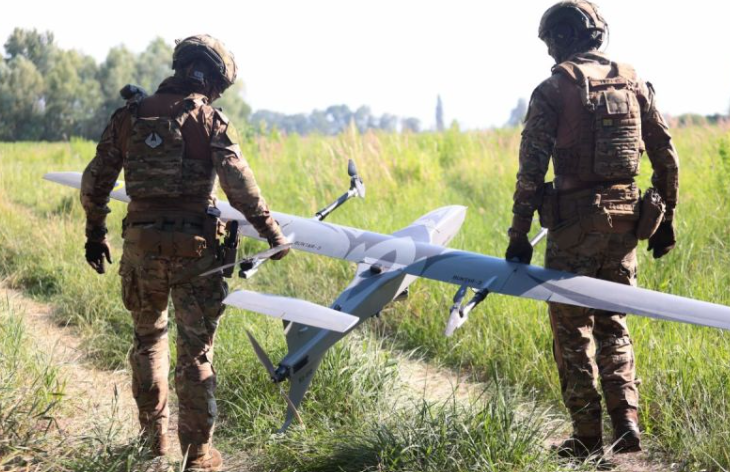
For years, international investors viewed Ukraine as a high-risk market defined by uncertainty, conflict, and geopolitical turbulence. Today, that narrative is rapidly changing. The latest proof comes from an unexpected source: a drone manufacturer.
Ukrainian defense-tech startup Buntar Aerospace has secured $10.4 million from U.S. public safety giant Axon Enterprise and Norwegian investor Munkene AS, making it one of the largest disclosed funding rounds in Ukraine this year. On paper, it is just another venture capital announcement. In reality, it represents something much bigger: the emergence of Ukraine as one of the world's fastest-growing defense innovation hubs.
The funding places Buntar among Ukraine's six largest disclosed startup rounds, alongside much larger and more established technology companies. Yet what stands out isn't the deal size. It is the sector.
Four of the six largest disclosed venture rounds in Ukraine this year were defense-related.
That statistic would have seemed extraordinary just a few years ago. Today, it reveals how dramatically investor priorities have shifted.
The war transformed Ukraine into what many analysts describe as the most intense real-world testing environment for military technologies since the Second World War. Drones, electronic warfare systems, reconnaissance platforms, battlefield software, and autonomous technologies are no longer theoretical products seeking customers. They are operational systems being tested under the harshest conditions imaginable.
Investors notice that.
Unlike traditional startups that spend years validating their products and searching for market demand, many Ukrainian defense companies have gained validation directly on the battlefield. Their technologies are not being evaluated in simulation labs. They are being deployed in active combat zones.
For venture capital, this changes everything.
Buntar's newly raised capital will support the expansion of its reconnaissance drone production and mission software capabilities. But the significance of the round extends beyond one company. The deal was led by Axon Enterprise, a publicly traded American company known globally for its Taser devices and body-camera ecosystem. Strategic investors rarely invest for symbolism. They invest when they see technology, talent, and long-term market potential.
The participation of Munkene AS is equally revealing. The Norwegian investment vehicle has become associated with efforts to build dedicated financial infrastructure around Ukrainian defense innovation, including involvement in the creation of Gardar, a specialized fund designed to support Ukrainian military technology startups.
What is emerging is not a collection of isolated investments. It is an ecosystem.
The numbers reinforce that conclusion.
According to figures cited by Defence Builder, Ukrainian defense-tech startups attracted more than $129 million in grants and equity financing during 2025, representing 119% growth compared with the previous year. Nearly half of that capital originated from foreign investors.
This is perhaps the most important statistic of all.
Foreign capital is traditionally cautious during wartime. Investors fear political instability, supply chain disruptions, regulatory uncertainty, and operational risks. Yet international investors now account for almost half of Ukraine's defense-tech funding.
That means global capital markets are increasingly viewing Ukrainian defense companies not as wartime exceptions but as viable long-term businesses.
The trend is also becoming institutionalized. Defence Builder argues that the sector is evolving beyond small individual investments into a market increasingly driven by venture capital firms, specialized funds, and corporate strategic investors. In other words, defense technology in Ukraine is beginning to mature into a professional asset class.
This shift carries implications far beyond Ukraine.
Europe is accelerating defense spending. NATO countries are modernizing military capabilities at unprecedented speed. Autonomous systems, AI-enabled battlefield awareness, electronic warfare technologies, and advanced drone platforms are becoming essential rather than optional.
Ukraine possesses something few competitors can offer: real-world operational experience.
That experience has become one of the country's most valuable exports.
Buntar's $10.4 million raise therefore represents more than startup financing. It reflects a broader geopolitical and economic reality. Global investors are no longer simply supporting Ukraine because they believe in its future. Increasingly, they are investing because Ukrainian companies are building technologies the world urgently needs.
The message from capital markets is becoming impossible to ignore.
Ukraine is not just defending itself.
It is building the next generation of defense technology.