Europe Spent Years Building Defence Frameworks. Two Guys Built 80 Companies.
Europe has strategies.
Europe has funding programs.
Europe has working groups, institutions, roadmaps and increasingly ambitious plans for defence innovation.
And then two people organized a hackathon.
Two years later, roughly 80 companies reportedly exist that did not exist before.
That contrast should make Europe's defence establishment slightly uncomfortable.
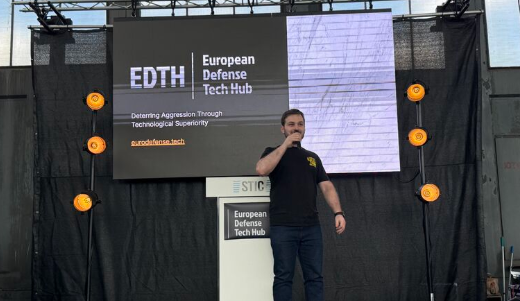
Benjamin Wolba, co-founder of the European Defense Tech Hub, describes an initiative that did not begin with an EU mandate, NATO funding or some grand institutional strategy.
It started with curiosity.
A theoretical physicist and a co-founder organized a defence hackathon in Munich in 2024 because they thought it would be interesting.
It worked.
So they did another.
And another.
Eventually: 43 hackathons.
No permission required
Perhaps the most interesting thing about the European Defense Tech Hub is what it apparently isn't.
It isn't an EU institution.
It isn't a NATO program.
And according to Wolba, it receives neither EU nor NATO funding.
That matters because Europe has spent years discussing how to create a stronger defence innovation ecosystem.
The instinct is usually top-down.
Coordinate governments. Create programs. Allocate budgets. Build frameworks. Harmonize requirements. Then connect industry, investors, researchers and militaries.
There are good reasons for doing all of that.
But EDTH appears to have approached the problem backwards.
Instead of first building the European structure, it started building places where people could actually begin.
Europe doesn't only need capital. It needs doors.
A talented engineer may be interested in defence.
A robotics student may have an idea.
A software developer may realize that technology from another industry has an obvious military application.
But then what?
Where do they go?
Who do they meet?
How do they find a co-founder?
How do they discover whether their idea solves a real problem?
The answer cannot always be:
“Read this 80-page funding call and apply to a European program.”
America's defence-tech ecosystem has become remarkably good at creating visible entry points into the industry.
Europe often appears better at describing the ecosystem than creating obvious doors into it.
A hackathon is one such door.
It says:
Come here this weekend.
Meet people.
Pick a problem.
Build something.
And maybe on Monday, don't stop.
A weekend can become a company
Zero Industries is one example cited from the network.
The company emerged from a Warsaw event and now works on drone autonomy. Other companies reportedly originated from events in Amsterdam, Munich and elsewhere.
That is what makes the claimed figure of roughly 80 companies interesting.
The real product of these hackathons isn't the prototype created over a weekend.
It's the team that still exists after the weekend ends.
A hackathon compresses something institutions often struggle to manufacture: collision.
Engineers meet operators.
Software developers meet hardware people.
Researchers meet founders.
People who would never have written a business plan together suddenly spend 48 hours solving the same problem.
Most projects disappear.
They are supposed to.
But some don't.
And those few can become companies.
Bottom-up because top-down wasn't there
Wolba's explanation is especially revealing.
The organizers didn't necessarily choose a decentralized, country-by-country approach because they believed bottom-up organization was philosophically superior.
They did it because the European top-down infrastructure they needed simply wasn't available.
So they built locally.
Warsaw.
Amsterdam.
Munich.
One community at a time.
That raises a provocative question.
What if Europe's defence-tech bottleneck isn't primarily a shortage of talent, technology or even money?
What if it is a shortage of activation energy?
People need somewhere to start.
Can you scale something that works because nobody controls it?
That may now become the harder problem.
Institutions will inevitably notice successful grassroots ecosystems.
Funding arrives.
Programs appear.
Governance develops.
Reporting requirements grow.
And sometimes the thing becomes more professional—and less alive.
Europe therefore faces an interesting challenge.
It should learn from initiatives like this without suffocating the conditions that allowed them to emerge.
Because perhaps Europe doesn't need another giant framework before people can begin building.
Perhaps it needs hundreds of small doors.
And sometimes creating one requires surprisingly little:
A room. A problem. The right people. And nobody telling them to wait for permission.