Rheinmetall’s Japan Mission Signals a New Axis of Tech Power
Some partnerships are ceremonial. Others are strategic.
Rheinmetall’s participation in the German Bundesrat delegation to Japan belongs firmly in the latter category. What may appear on paper as a high-level diplomatic visit reveals something far more significant: the quiet, but unmistakable formation of a new global axis in advanced defense and space technology.
And it runs between Europe and Japan.
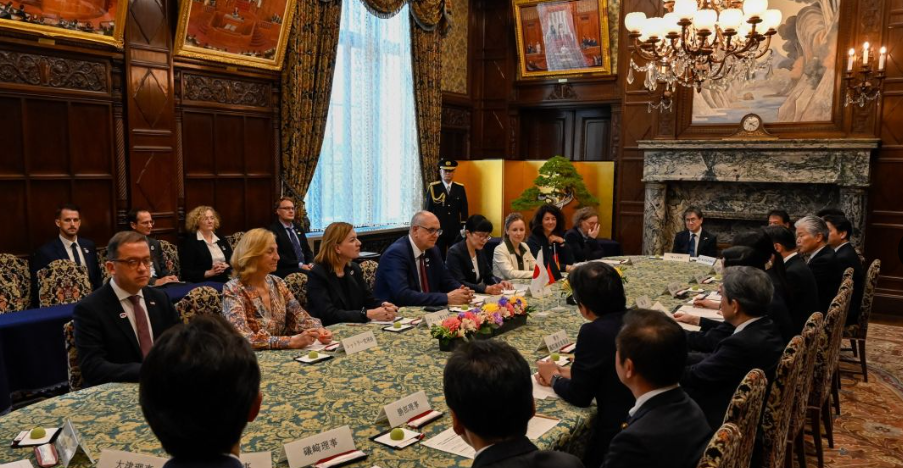
Led by Bundesrat President Andreas Bovenschulte, the delegation brought together political leadership, industry, and academia—an increasingly common but still underestimated trio in shaping the future of technological power. The agenda was broad: high-tech innovation, aerospace collaboration, and industrial partnerships. But behind the official program lies a deeper strategic narrative.
This is about alignment in an era of fragmentation.
As geopolitical tensions intensify and global supply chains become more contested, the importance of trusted technological partnerships is rising sharply. Europe and Japan—both technologically advanced, both politically stable, and both increasingly aware of their strategic vulnerabilities—are finding common ground.
Rheinmetall, traditionally known for its defense systems, is positioning itself precisely at this intersection.
The presence of Dr. Roman Sperl, Head of Space at Rheinmetall Digital, underscores where the focus is shifting: from conventional defense platforms to the rapidly evolving domain of space and satellite technology. The visit to the Japanese Aerospace Exploration Agency (JAXA) highlights this transition in stark terms.
Space is no longer a distant frontier.
It is the backbone of modern defense systems—enabling communication, navigation, intelligence gathering, and increasingly, real-time decision-making. Cooperation in this domain is not optional. It is essential for maintaining operational independence and technological competitiveness.
And this is where the partnership becomes provocative.
Europe has long struggled with fragmented defense initiatives and slow alignment across member states. Japan, meanwhile, operates within a different strategic framework, balancing technological ambition with regional security concerns. Bringing these two ecosystems together is not just about exchange—it is about synchronization.
The goal is clear: accelerate innovation through collaboration.
Bremen’s role in this equation is far from incidental. As one of Germany’s leading aerospace hubs, it represents a microcosm of the broader European ambition to remain relevant in global high-tech competition. By connecting local expertise with international partnerships, Rheinmetall is effectively extending its innovation network beyond national borders.
But the implications go further.
This visit reflects a broader trend in defense: the shift from isolated national projects to interconnected, multinational ecosystems. No single country, no matter how advanced, can cover the entire spectrum of modern defense technologies alone. From AI and cyber capabilities to satellite constellations and autonomous systems, the complexity has outgrown national boundaries.
Strategic collaboration is no longer a choice.
It is a necessity.
At the same time, such partnerships raise new questions.
How is intellectual property shared? Who controls critical technologies? Where does collaboration end and competition begin? These tensions are inherent in any international cooperation, especially in sectors where technological superiority directly impacts national security.
Yet, the trajectory is unmistakable.
The future of defense innovation will not be built behind closed borders. It will be shaped in networks—fluid, adaptive, and increasingly global. Countries and companies that can navigate these networks effectively will define the next era of technological leadership.
Rheinmetall’s engagement in Japan is a case study in this new reality.
It is not about one project, one agreement, or one visit.
It is about positioning—placing itself within a global architecture of innovation that spans continents and domains. From New Space initiatives to satellite technologies, the company is expanding its role from a traditional defense supplier to a player in a much broader technological ecosystem.
And that shift matters.
Because in the emerging landscape of defense and aerospace, the winners will not be those who build the best individual systems.
They will be those who build the strongest partnerships.