The War Before the War. Russia's Shadow Campaign Reaches Denmark
The most dangerous attacks rarely begin with explosions.
They begin with observation.
A photograph of a factory gate. A note about a security shift. A seemingly harmless question about access routes or delivery schedules. Individually, these actions appear insignificant. Together, they can become the blueprint for sabotage.
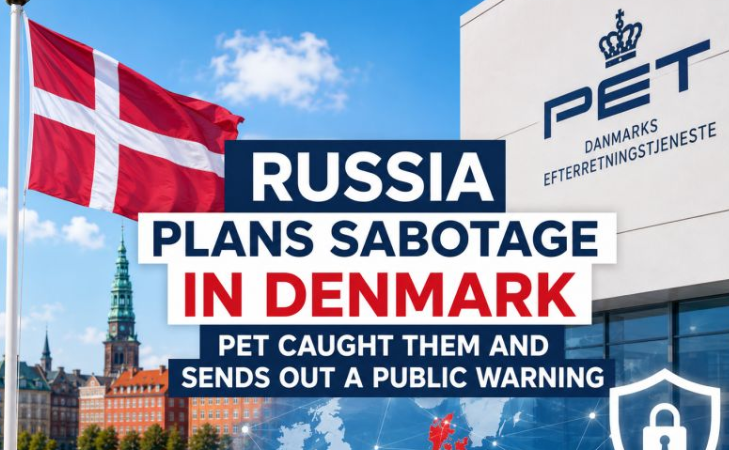
According to Denmark's Security and Intelligence Service (PET), this threat is no longer theoretical. Danish authorities have warned that Russian intelligence services are actively targeting the country's defense sector and companies involved in supporting Ukraine. More troubling still, intelligence officials believe the groundwork for potential sabotage may involve the recruitment of ordinary citizens.
This is not the Cold War many Europeans remember. There are no dramatic spy exchanges at border crossings or agents hiding behind diplomatic cover.
Instead, modern conflict increasingly operates in the shadows.
Russia's strategy, according to security agencies across Europe, relies on what military experts call hybrid warfare: a combination of espionage, cyber operations, disinformation, sabotage, economic pressure, and the use of intermediaries that create distance between decision-makers and actions on the ground.
The objective is simple.
Create disruption without triggering open war.
For years, many Europeans viewed such incidents as isolated events taking place elsewhere. A cyberattack in one country. A suspicious fire in another. Disrupted transportation networks somewhere else.
Today, those incidents look increasingly connected.
Across Europe, intelligence services have reported concerns over hostile activities directed at critical infrastructure, logistics hubs, transportation systems, energy facilities, and defense-related industries. The common thread is not necessarily physical destruction. Often, it is uncertainty.
Modern hybrid warfare seeks to make societies question their own security.
Can critical infrastructure be protected?
Can military supplies reach their destination?
Can democratic societies identify hostile influence before damage is done?
These questions matter because the battlefield itself has changed.
Military power is no longer measured solely by the size of armies or the range of missiles. Influence now extends deep into civilian society. Economic systems, digital networks, supply chains, and public trust have become strategic targets.
In such an environment, the distance between civilian life and national security becomes remarkably small.
A warehouse worker. A contractor. A student. A delivery driver.
Any individual who unknowingly provides information or access can become part of a much larger operation.
That is precisely why intelligence agencies focus so heavily on awareness.
The challenge facing Denmark is not unique. It reflects a broader European reality.
The continent has entered an era where peace and conflict increasingly overlap. Traditional warfare begins with tanks crossing borders. Hybrid warfare begins long before that stage. It thrives in ambiguity, uncertainty, and deniability.
There may never be a formal declaration.
There may never be a single defining incident.
Instead, pressure accumulates gradually through countless small actions, each seemingly disconnected from the larger picture.
This approach offers strategic advantages to hostile actors. It complicates attribution. It slows political responses. It creates debate about whether an attack has even occurred.
That ambiguity is not a weakness of hybrid warfare.
It is its greatest strength.
For democratic societies, the response cannot rely solely on intelligence agencies or military organizations. Resilience has become a national capability. Awareness, vigilance, cybersecurity, and protection of critical infrastructure are increasingly as important as traditional defense spending.
PET's warning serves as a reminder that modern security challenges rarely arrive with advance notice.
The encouraging news is that Danish authorities are identifying and monitoring potential threats.
The uncomfortable reality is that they are seeing enough activity to issue public warnings.
And perhaps that is the most important lesson.
The first phase of modern conflict does not begin with a military strike.
It begins when societies realize they are already being tested.