The War After the War Began - How Ukraine Became the World’s Fastest Military Laboratory

Modern war no longer unfolds in sweeping offensives or decisive tank battles. It flickers instead in short “windows of life”—brief moments when vehicles move, signals connect, and systems survive before drones, sensors, or electronic warfare shut them down again.
That is the reality emerging from the battlefield in Ukraine, as documented in the latest Defense Tech Monthly by the Snake Island Institute. [1772807107524 | PDF]
Across land, air, sea, space, and cyberspace, the conflict has become a continuous experiment in adaptation. Every platform is provisional. Every advantage is temporary. And innovation now moves faster than doctrine.
The compression of time
One of the most striking observations in the report is how mechanized warfare has been compressed. Armored vehicles—IFVs, APCs, logistics trucks—no longer maneuver freely. They rush forward under electronic‑warfare cover, unload in minutes, and withdraw before drones reacquire them. Survival is no longer about armor thickness, but timing.
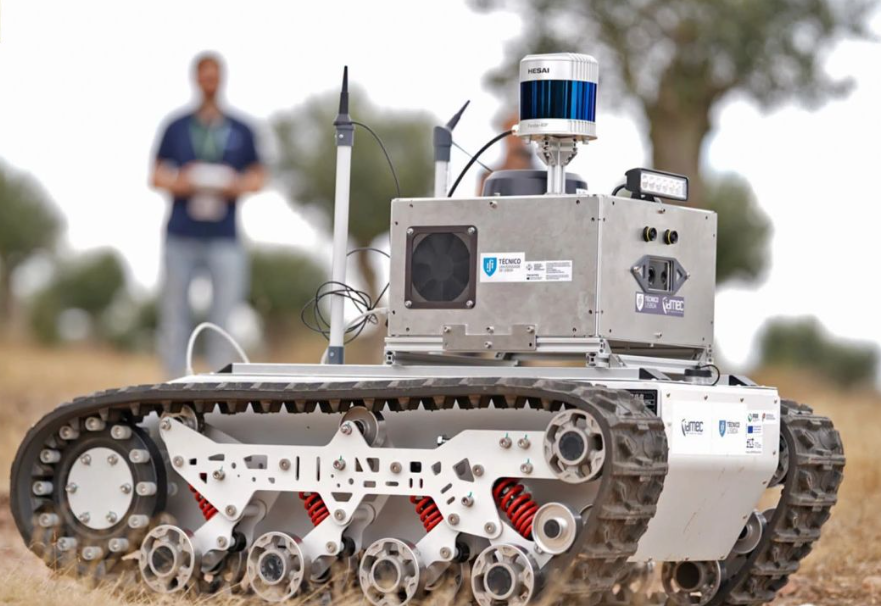
This compression has pushed functions once reserved for manned vehicles onto unmanned ground vehicles (UGVs). Robotic platforms now handle frontline logistics, fuel delivery, evacuation, and even fire support. In January 2026 alone, Ukraine reported more than 7,000 UGV missions, a scale that would have seemed implausible just two years ago.
Russia, adapting in parallel, has begun retrofitting its own UGVs with improvised anti‑drone armor—metal cages, rotating cables, even gas cylinders used as sacrificial mine trawls. Crude, heavy, and inefficient, these solutions nevertheless reflect the same logic: survivability now matters more than elegance.
The sky gets smarter—and louder
In the air, the evolution is even starker.
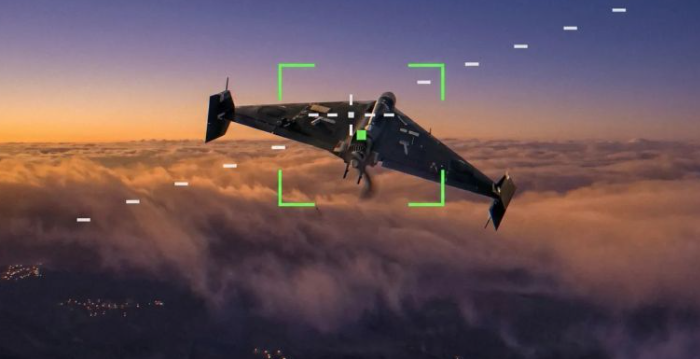
Russian forces have transformed legacy platforms like Gerbera, Molniya, and Shahed into FPV drone “motherships”, capable of carrying and releasing smaller strike drones close to targets. This tactic compresses air‑defense reaction times and degrades detection, effectively turning one drone into a delivery system for another.
At the same time, Russia is standardizing its drone fleet around Chinese‑made mesh modems, creating distributed airborne networks where each UAV acts as both transmitter and relay. If one node is lost, traffic reroutes automatically. Control persists even under jamming.
This is not improvisation—it is industrial unification. Open‑source data cited in the report suggests negotiations for hundreds of thousands of these modems, signaling a long‑term commitment to networked attrition warfare.
Connectivity as a weapon
Connectivity itself has become a battlefield.
In February 2026, Ukrainian measures to restrict unauthorized Starlink usage effectively severed Russian drone feeds. Speed‑based cutoffs and a verified whitelist system disabled terminals used by Russian forces, dramatically reducing enemy UAV activity and increasing Ukrainian radio intercepts.
Russia responded by accelerating alternatives—from recruitment and coercion efforts to cyber deception, and even testing Barazh‑1, a stratospheric aerostat pitched as a pseudo‑satellite for localized communications. Vulnerable and short‑lived, such systems nevertheless underscore a deeper shift: digital sovereignty is no longer abstract policy—it is operational necessity.
Beyond machines: living systems
Perhaps most unsettling is what comes next.
The report documents the transition of bio‑robotic systems from theory into operational use. German startup SWARM Biotactics has completed field testing of insect‑based robotic swarms equipped with neural interfaces, sensors, and secure communications—designed for reconnaissance in confined or dangerous environments.
Russia, too, has reportedly tested early “bio‑drone” concepts involving birds fitted with cameras and control modules. Scaling, in these systems, relies not on factories—but biology.
The Western gap
All of this has unfolded faster than Western militaries have adapted.
During NATO’s Hedgehog 2025 exercise, Ukrainian drone operators acting as a notional adversary reportedly neutralized the equivalent of two NATO battalions in a single day. Vehicles clustered. Camouflage failed. Drone threats were ignored until it was too late.
The lesson is not about drones alone. It is about speed.
Ukraine’s battlefield is no longer just a warzone. It is the world’s most advanced proving ground for modern warfare—where systems are designed, tested, broken, and rebuilt in weeks.
The danger for the West is not that it lacks technology.
It is that it is learning too slowly.
.png)