The Recovery Giant. Why Liebherr’s MLTB 1025 Could Become NATO’s Battlefield Tow Truck
Military technology conferences are usually dominated by drones, artificial intelligence, autonomous systems, and futuristic concepts promising to transform warfare.
Yet one of the most important vehicles at Defence Vehicle Dynamics 2026 is neither autonomous nor armed.
It is a recovery crane.
And that may be exactly why it matters.
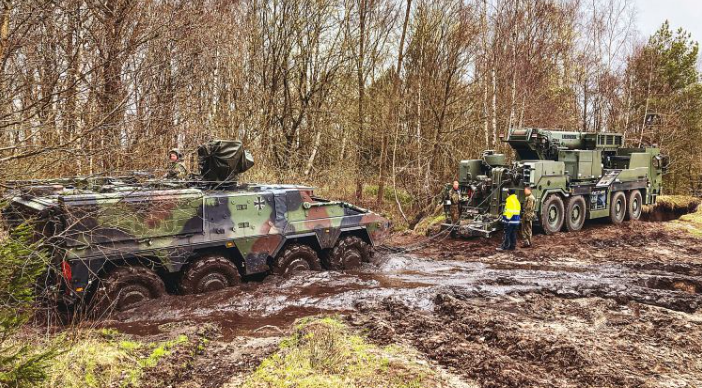
At this year's Defence Vehicle Dynamics exhibition in Millbrook, Liebherr is showcasing the MLTB 1025-4.1, a heavy military recovery and lifting platform designed for one of the least glamorous but most essential military missions: getting broken vehicles off the battlefield before they become permanent losses.
In an era obsessed with destroying equipment, the MLTB focuses on something equally important.
Saving it.
The Forgotten Side of Modern Warfare
Military planners spend enormous resources discussing how tanks destroy tanks, how drones strike armored vehicles, and how missiles penetrate defenses.
Far fewer conversations focus on what happens afterwards.
A disabled vehicle is not necessarily a destroyed vehicle.
A stranded armored vehicle can often be repaired, recovered, or returned to service if a capable recovery force reaches it quickly enough.
That reality has become increasingly important in Ukraine, where both sides have learned that logistics, maintenance, and equipment recovery influence operational success almost as much as combat itself.
The side that repairs and recovers faster preserves combat power.
The side that abandons equipment loses it.
This is where the MLTB enters the picture.
Built for Heavyweight Recovery
The MLTB 1025-4.1 was designed specifically for tactical and operational recovery missions involving heavy wheeled and tracked vehicles.
Its specifications reveal a system built for extreme conditions.
The platform combines a high-mobility 8×8 chassis with multiple recovery systems capable of lifting, pulling, towing, and transporting damaged military equipment.
Two integrated rear-mounted Rotzler recovery winches provide pulling power of 80 kN and 200 kN respectively. Used in combination with synchronized remote-control systems, they allow operators to conduct coordinated extraction operations while minimizing exposure to danger.
Speed matters.
Every minute spent recovering a disabled vehicle under battlefield conditions increases risk from artillery, drones, and enemy observation.
The ability to execute recovery operations quickly can make the difference between success and catastrophe.
A Mobile Recovery Workshop
The MLTB is far more than a tow truck.
Its telescopic crane can extend to nearly 21 meters and lift loads up to 22.8 tons.
That capability enables crews to remove damaged powerpacks, replace major components, recover equipment, and assist in engineering or disaster-response operations.
Even more impressive is its towing capability.
The underlift system can raise disabled vehicles weighing up to 16 tons, while the platform can tow systems with a combined weight of up to 48 tons.
In practical terms, this means recovering a wide range of military vehicles without needing additional specialized equipment.
For commanders managing dispersed forces across large operational areas, that flexibility is invaluable.
Maneuverability Meets Protection
Despite weighing 44 tons, the MLTB is designed for remarkable mobility.
Powered by a 400-kilowatt diesel engine paired with a ZF 12-speed transmission, the vehicle features all-wheel steering across eight wheels.
This allows exceptionally tight turning radii and even "crab steering," enabling the vehicle to move diagonally while maintaining orientation.
Such capabilities are particularly useful in confined spaces, damaged urban areas, and challenging terrain.
But mobility alone is not enough.
Modern battlefields are increasingly saturated with drones, artillery, mines, and improvised explosive threats.
Recognizing this reality, Liebherr offers protected crew and crane cabins manufactured by Rheinmetall, providing protection against ballistic threats, mines, and IEDs while incorporating NBC filtration systems.
Recovery crews often operate closer to danger than many frontline units.
Protecting them is not optional.
It is essential.
Interoperability: The NATO Factor
Perhaps the most strategically significant aspect of the MLTB is not a winch, crane, or armor package.
It is interoperability.
Liebherr describes the platform as aligned with contemporary NATO interoperability requirements, making it suitable for multinational operations and mixed vehicle fleets.
As European defense spending continues to rise and NATO forces seek greater operational integration, systems capable of working seamlessly across allied formations gain significant value.
Recovery assets are only effective if they can support the vehicles they encounter.
The MLTB is designed precisely for that reality.
The Silent Revolution in Military Logistics
Alongside the MLTB, Liebherr is also exhibiting the LPO 100 mobile energy storage system.
At first glance, a portable battery system might appear unrelated to military operations.
In fact, it points directly toward the future.
Modern military forces increasingly depend on electrical power for sensors, communications, command posts, drones, and autonomous systems.
The LPO 100's ability to provide low-noise autonomous power generation highlights a growing challenge: armies no longer move only on fuel.
They move on electricity.
The Machines Behind the Machines
History tends to celebrate tanks, fighter aircraft, missiles, and drones.
Rarely does it celebrate recovery vehicles.
Yet wars are often won by the systems that keep combat forces moving long after the headlines fade.
The MLTB 1025-4.1 embodies that reality.
It does not destroy enemy vehicles.
It returns friendly ones to the fight.
And in a future battlefield defined by attrition, logistics, and operational endurance, that capability may prove more valuable than many weapons systems themselves.