The Jammer Is Dead. Long Live the Network.
For years, electronic warfare was often imagined as a relatively simple contest.
A drone appears.
A jammer turns on.
The signal disappears.
The threat falls from the sky.
That era is ending.
The war in Ukraine is demonstrating that the future of electronic warfare no longer revolves around individual jammers. It revolves around networks, software, automation and continuous adaptation.
The distinction is far more important than it sounds.
Recent insights from Ukraine's Khartia Corps offer a rare glimpse into what frontline electronic warfare increasingly looks like in practice. And it bears little resemblance to the image many still have of a soldier pointing a handheld anti-drone gun at an incoming target.
Instead, it resembles a command-and-control system.
An operator detects an incoming drone, identifies its type and direction, enters the information into targeting software, and a network of jammers responds simultaneously. Multiple systems attack control links, video feeds and communications pathways at the same time.
What previously required several operators can increasingly be coordinated by one.
This sounds like automation reducing complexity.
In reality, it is doing the opposite.
The operators may be fewer.
The system is becoming dramatically more sophisticated.
One of the clearest lessons from Ukraine is that every electronic advantage has a short lifespan. Frequencies change. Protocols evolve. Navigation methods adapt. Manufacturers modify hardware. Operators develop new tactics.
Success is temporary.
The side that learns fastest gains the advantage.
Until the other side learns.
Russian FPV drones have steadily expanded across wider frequency bands while incorporating multiple communications and video channels. What worked yesterday may become ineffective tomorrow.
As a result, the traditional vision of electronic warfare equipment is becoming obsolete.
The handheld jammer represented a relatively simple answer to a relatively simple threat.
Modern drone warfare is neither.
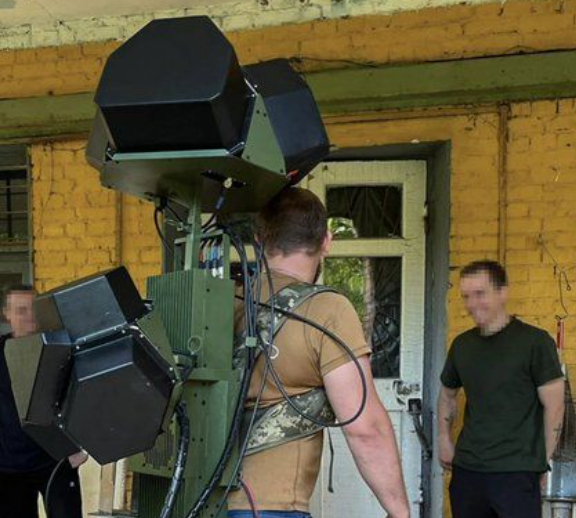
Covering a growing electromagnetic battlespace requires more power, more antennas, more amplifiers and more integration. Electronic warfare systems are becoming larger, more capable and increasingly interconnected.
Ironically, automation is making operations easier while simultaneously making infrastructure more complex.
This is one of the great paradoxes of modern warfare.
Technology often appears to reduce human workload.
Behind the scenes, it increases dependence on highly specialized expertise.
Because electronic warfare is no longer simply about broadcasting interference.
It is increasingly about understanding a rapidly changing environment and rebuilding solutions faster than an adversary can adapt.
The most valuable person in the unit may not be the operator pushing a button.
It may be the engineer who understands why the button stopped working.
That is a profound shift.
Consider another revealing detail.
The Khartia unit reportedly describes operating multiple layers of protection. Larger systems positioned further behind the line, compact systems closer to the front and localized trench-level protection where soldiers face the greatest threat.
This layered architecture looks remarkably similar to modern air defense.
Because that is increasingly what electronic warfare has become.
Not a device.
A system.
Detection, classification, software, power generation, emitters, networking, field engineering and command-and-control must all function together.
Remove one element and the entire architecture can suffer.
Add one innovation and the effectiveness of the whole system can change dramatically.
This is precisely why discussions about Counter-UAS capabilities often focus too heavily on equipment.
Organizations frequently ask which jammer to buy.
That may already be the wrong question.
The better question is:
How quickly can the organization adapt when today's jammer stops working?
Because adaptation has become the defining characteristic of successful electronic warfare.
The most effective military capability is no longer necessarily the most powerful.
It is increasingly the one that can evolve the fastest.
That lesson extends far beyond Ukraine.
Armies around the world are investing billions in counter-drone technologies. Many remain focused on platforms and hardware.
Ukraine increasingly suggests that the true competitive advantage lies elsewhere.
Not in the jammer.
Not in the antenna.
Not even in the software.
But in the system that continuously improves all three.
The future of electronic warfare may therefore belong to organizations capable of creating rapid adaptation loops between operators, engineers, intelligence teams and software developers.
The jammer remains important.
But it is no longer the centerpiece.
The network is.
And behind the network lies something even more decisive:
The ability to learn faster than the threat evolves.