The Firefighter of the Future Has No Pulse. Meet MINITHOR, the Robot Built to Walk Into Hell
For decades, robotics companies have promised revolutionary machines that would transform emergency response.
Most never left the prototype stage.
Many looked impressive in glossy presentations but struggled when confronted with smoke, heat, debris, water, and the chaos of a real disaster.
MINITHOR appears to represent a different philosophy.
No futuristic marketing spectacle. No science-fiction aesthetics. No promises of changing the world overnight.
Just a compact tracked robot designed to enter places where firefighters should not.
And that may be exactly why it matters.
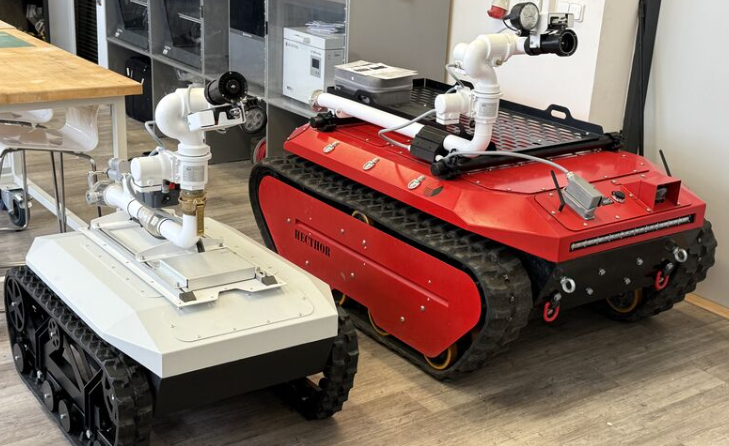
Developed by Czech company ProLab Engineering, MINITHOR is the newest member of the HECTHOR unmanned ground vehicle family. Its purpose is straightforward: to operate inside burning buildings, industrial facilities, and hazardous environments while keeping human responders out of immediate danger.
The concept is deceptively simple.
If a robot can enter first, humans do not have to.
Yet that simplicity masks a profound shift occurring across emergency services worldwide.
Robotics is finally moving beyond demonstrations and into operational reality.
The most striking thing about MINITHOR is not its technology.
It's its practicality.
The vehicle was engineered around a clear operational requirement: fit through a standard doorway while maintaining enough power, endurance, and durability to perform meaningful work once inside.
That design choice tells an important story.
Real-world emergencies rarely occur in controlled environments. Fires break out in apartment blocks, factories, chemical facilities, logistics hubs, underground infrastructure, and office complexes. Access restrictions often determine what equipment can actually be deployed.
A robot too large to enter a building is little more than an expensive ornament.
MINITHOR's compact dimensions address that challenge directly.
And once inside, it is far from underpowered.
With up to 18 kW of drive power and a substantial battery system enabling extended missions, the platform is clearly designed for sustained operations rather than short demonstrations.
Endurance matters.
In major incidents, emergency responders often work for hours under difficult conditions. Equipment that can remain operational throughout a crisis becomes exponentially more valuable than systems requiring frequent intervention or recharge.
Another signal of maturity lies in what ProLab Engineering emphasized.
Not artificial intelligence.
Not autonomous swarms.
Not revolutionary algorithms.
Instead, the company highlighted ruggedization, waterproof construction, reliability, and mission functionality.
In other words, engineering over hype.
That distinction is increasingly important.
The robotics industry is flooded with concepts, renderings, and presentations showcasing what machines might eventually do.
First responders are interested in something different.
What can the machine do today?
MINITHOR appears designed to answer exactly that question.
Its remotely controlled firefighting monitor allows operators to project extinguishing agents into dangerous areas without exposing crews to collapsing structures, extreme temperatures, toxic environments, or potential explosions.
For firefighters, every meter of separation from danger matters.
For commanders, every risk removed from the mission matters even more.
The significance extends beyond firefighting.
Around the world, emergency services face growing challenges. Industrial facilities are becoming more complex. Lithium-ion battery fires are increasing. Hazardous material incidents remain a constant risk. Critical infrastructure protection has become a national security concern.
These trends create a growing demand for robotic intervention capabilities.
What starts as a firefighting platform today could evolve into a multi-role emergency response system tomorrow.
Inspection.
Reconnaissance.
Hazard mapping.
Search operations.
Infrastructure assessment.
The possibilities expand rapidly once a reliable robotic platform exists.
There is also a broader European story here.
MINITHOR was designed and engineered internally using Czech and European components. At a time when supply chain resilience, technological sovereignty, and industrial independence are becoming strategic priorities, such decisions carry increasing significance.
Europe's robotics sector is no longer content to observe innovation.
It wants to lead it.
The emergence of practical systems like MINITHOR demonstrates that ambition translating into tangible products.
And perhaps that is the most important takeaway.
The future of robotics will not be defined by flashy demonstrations.
It will be defined by machines that show up, survive harsh environments, perform useful work, and return home.
The robots that succeed will not necessarily be the smartest.
They will be the most useful.
MINITHOR embodies that philosophy.
Small enough to fit through a doorway.
Tough enough to enter a burning building.
Practical enough to save lives.
In an age obsessed with technological spectacle, that may be the most revolutionary thing of all.