The Fastest Army Wins. Why Military Learning Velocity Is Replacing Technology as the Real Measure of Power
For more than two centuries, military power has largely been measured by technology.
Who had the better artillery.Who built the faster aircraft.Who fielded the most advanced tanks.Who mastered nuclear weapons first.
Today, that logic is beginning to break down.
Not because technology no longer matters. Quite the opposite. Technology has become so accessible, so rapidly distributed, and so quickly replicated that possessing a capability first no longer guarantees maintaining an advantage for long.
Artificial intelligence, commercial drones, open-source software, low-cost sensors, additive manufacturing, and commercial satellite imagery are spreading faster than any military technology in history. What once took decades to diffuse now takes years, months, or sometimes weeks.
The consequence is profound.
The critical question is no longer:
Who invented it first?
The critical question is:
Who learns to use it best before everyone else catches up?
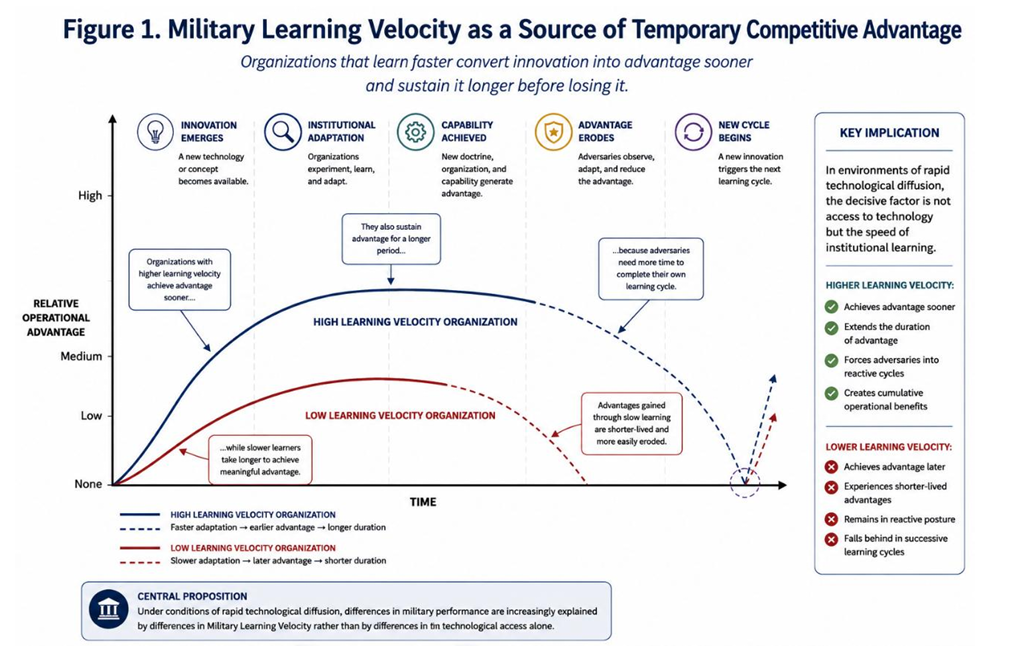
This shift marks the emergence of a new competitive variable in warfare: Military Learning Velocity (MLV).
Military Learning Velocity is not about technological innovation. It is about organizational adaptation.
It measures how quickly an armed force can identify a problem, experiment with solutions, absorb battlefield lessons, modify doctrine, update training, reorganize forces, integrate new technologies, and turn those changes into operational capability.
In short:
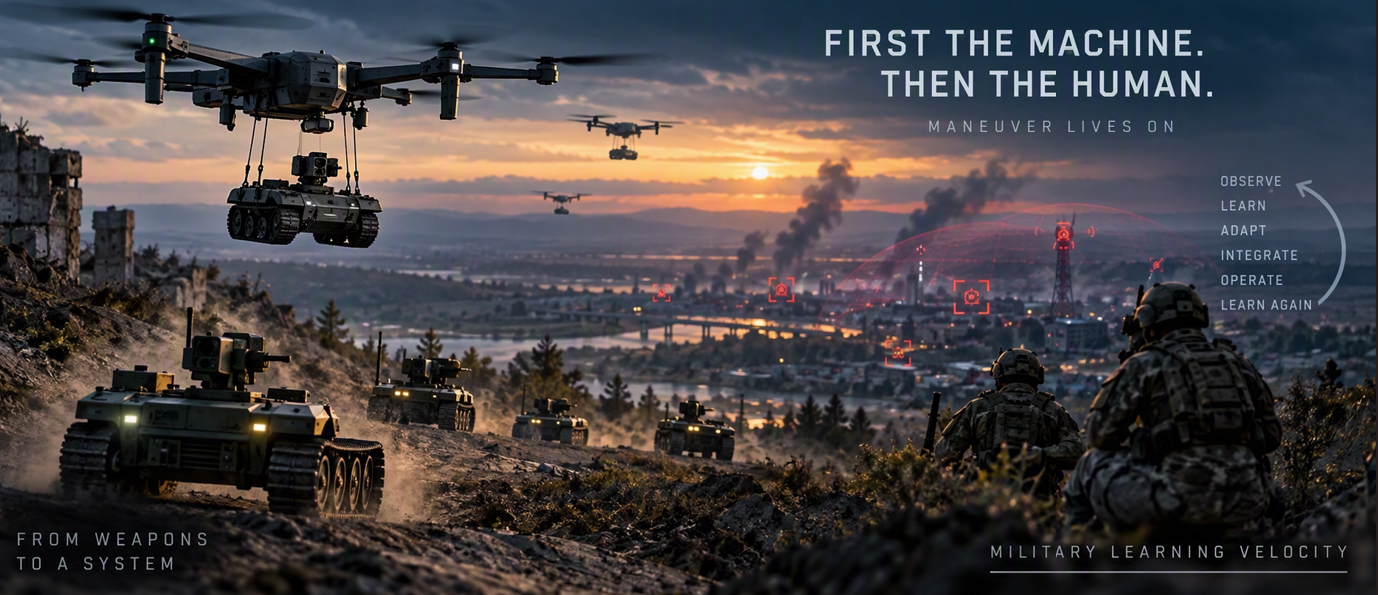
Observe. Learn. Adapt. Integrate. Operate. Repeat.
Military history has always rewarded learning organizations.
Helmuth von Moltke understood that battle plans inevitably collide with reality and require adaptation. John Boyd's famous OODA Loop revolved around the ability to cycle through observation and decision faster than an opponent. Stephen Peter Rosen demonstrated that military effectiveness often depends on institutional innovation rather than technological superiority alone.
What's changing today is the speed.
The learning cycle itself has become a battlefield.
The war in Ukraine provides perhaps the clearest demonstration.
Early Ukrainian success with commercial drones transformed battlefield reconnaissance. Russia adapted with electronic warfare. Ukraine responded with frequency changes and decentralized drone production. Russia introduced specialized interceptor systems. Ukraine integrated artificial intelligence. Russia developed new electronic countermeasures.
Each innovation generated a response.
Each response generated another adaptation.
The cycle compressed from years to months.
In some sectors of the front, adaptations now emerge in weeks.
This dynamic reveals a harsh truth about modern warfare:
No advantage remains uncontested for long.
A drone is not revolutionary because it exists.
A drone becomes revolutionary when a military organization learns how to integrate it into doctrine faster than its enemy can develop a countermeasure.
The same principle applies to artificial intelligence, autonomous systems, electronic warfare, precision strike networks, and future technologies that have not yet reached the battlefield.
Technology starts the race.
Learning determines who wins it.
Military Learning Velocity is also fundamentally relative.
A military organization can improve rapidly and still lose strategic advantage if its opponent adapts even faster.
This explains why temporary superiority increasingly characterizes modern conflicts.
The side with higher learning velocity creates what might be called "windows of opportunity"—temporary periods during which adaptation outpaces the enemy's response.
But these windows close.
Knowledge spreads.Technologies diffuse.Countermeasures emerge.
Every advantage carries the seeds of its own expiration.
This reality forces military planners to rethink how they define superiority.
Instead of asking how many advanced systems a force possesses, leaders may increasingly ask how quickly that force can absorb lessons, revise doctrine, and transform experience into action.
The decisive weapon may not be a drone swarm, an AI algorithm, or a hypersonic missile.
The decisive weapon may be the institution itself.
An institution capable of learning faster than its opponent.
The military competition of the twenty-first century is therefore becoming something different from an arms race.
It is becoming a learning race.
The winners will not necessarily be those who invent the next breakthrough.
They will be those who adapt to it first, integrate it fastest, and reinvent themselves before their adversaries can do the same.
Because in modern warfare, technology creates opportunities.
Learning creates advantage.
And learning faster than the enemy may become the ultimate form of military power.