Operation Vivaldi. From Deep Maneuver to Spectrum Denial: A New Race in Military Learning Velocity / by Diego Bavio
War has always been a laboratory for weapons, systems and doctrines—or, put another way, for organizational learning. The First World War accelerated the adoption of the machine gun and paved the way for the tank; the Second World War brought mechanized warfare and large-scale armored operations to a new level; Vietnam consolidated the helicopter as a tool of maneuver.
The war in Ukraine has turned the drone into much more than a new platform. Its real impact does not lie solely in adding sensors, loitering munitions or low-cost attack capabilities to the battlefield. Its significance lies in the way it has forced military organizations to learn how to fight differently.
This process can be examined through the lens of Military Learning Velocity (MLV): not as the speed at which a new weapon appears, but as the speed at which a military organization identifies a problem, learns from it, modifies its procedures, integrates existing capabilities and turns that learning into a new way of operating.
Operation Vivaldi is interesting precisely from this perspective.
Not because the Ukrainians have discovered UGVs, heavy drones or electronic warfare. None of these elements is new. Unmanned ground systems had already been used for logistics, evacuation and support missions.
What appears to be changing with Vivaldi is the scale and operational function assigned to them.
For the first time, at least according to the information available so far, these systems appear to be integrated into a deep-penetration operation at a scale and with an operational function that make it difficult to regard them simply as a support capability.
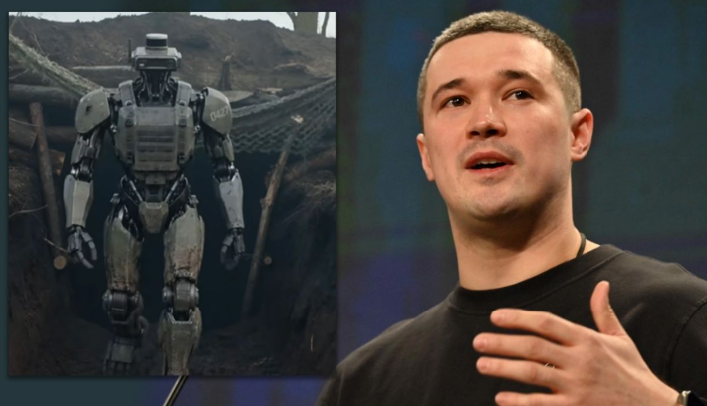
The question, then, is not what a robot can do.
It is what happens when a military organization begins designing an operation around what robots can do.
From the Airborne Soldier to the Robot
For decades, a deep penetration conducted by helicopters or aircraft rested on a fundamental premise: the first element entering the enemy's rear area was made up of human beings.
The logic was familiar: insert a force deep enough to bypass the enemy's tactical disposition, seize or secure a specific point, establish a bridgehead and survive until ground forces could arrive and consolidate the penetration.
On a much smaller scale, one could even think of it as a kind of miniature Market Garden: a force inserted deep behind enemy lines that had to survive for a limited operational window until the second echelon arrived.
But contemporary warfare has radically altered that equation.
The proliferation of sensors, drones, communications and attack systems means that the depth that once offered relative protection can now become a kill zone.
An air-mobile force may be able to reach farther than before, but it can also be detected more quickly, located more precisely and attacked by systems that do not need to be physically close to the target.
The problem, therefore, is no longer simply getting there.
It is surviving after getting there.
And this is where the first modification we can observe in Vivaldi appears:
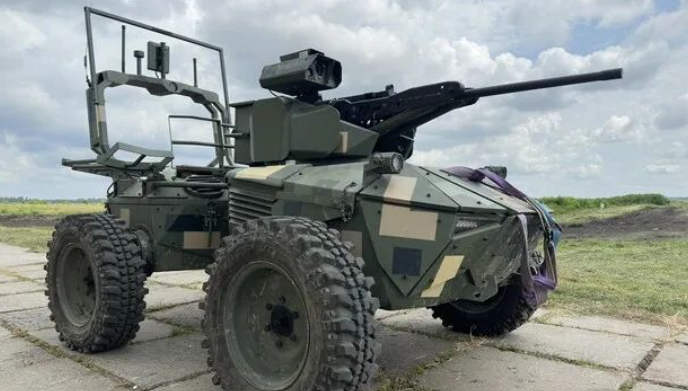
change one factor: humans for UGVs.
This does not mean that soldiers have disappeared from the operation or that UGVs have replaced conventional forces. It means something more limited and, at the same time, potentially more important: the first echelon of certain tasks can begin to be performed by unmanned systems.
The air-mobile operation thus acquires a new conceptual possibility.
A penetration can begin with machines before the human does.
Change One Factor and Add Another
But replacing a human with a UGV does not, by itself, solve the problem.
A robot must also reach its objective, navigate, communicate and survive in an environment where the adversary has sensors, drones, electronic warfare and fires.
That is why Vivaldi is particularly interesting because of a second modification: in addition to changing the first echelon, it appears to seek the degradation of the kill zone.
The difference is fundamental.
Electronic warfare, interference, degraded communications, the neutralization of sensors and operators, and attacks against the systems that allow the adversary to observe and react are not simply a collection of tactical effects.
They can serve a different purpose:
widening the operational window.
The issue is no longer simply protecting the element conducting the penetration. It is also about making it harder for the adversary to complete the chain:
detect → identify → locate → communicate → decide → attack.
If that chain can be slowed, interrupted or degraded, the kill zone does not disappear.
But it may no longer function with the same effectiveness.
And that could be enough.
The Kill Zone and the Return of Maneuver
This point connects directly with a hypothesis developed in De la Guerra, Siglo XXI III: El regreso de la maniobra.
The problem with digital warfare is not that it eliminated the need for movement. Technology reduced the ability to conceal movement and, with it, increased the cost of concentration and maneuver.
The result was an imbalance: risk could exceed the acceptable level for employing certain formations, giving the defense a temporary advantage over maneuver.
The answer does not necessarily lie in achieving zero risk.
It lies in bringing risk back within an operationally acceptable level.
Vivaldi allows us to observe one possible approach to this problem.
On one hand, it reduces human exposure through the use of unmanned ground systems.
On the other, it seeks to degrade the conditions that allow the adversary to turn information into effects.
Two different moves against the same problem:
fewer people exposed; less enemy capacity to turn detection into destruction.
The combination could create an operational window that did not previously exist.
But this is where caution is necessary.
We still do not have enough evidence to claim that Vivaldi has demonstrated the return of conventional armored maneuver on a large scale. The significant employment of large traditional armored formations does not appear, at least so far, to be the central element of the operation.
And precisely that absence makes the question more interesting:
Are we witnessing the return of maneuver, or merely the construction of the conditions that could allow its return?
From Drones as Weapons to Drones as Architecture
The first major revolution of the aerial drone was turning it into a sensor, an observer and eventually a weapon. Then came its integration with artillery, intelligence, electronic warfare and other systems.
Vivaldi allows us to imagine a different step.
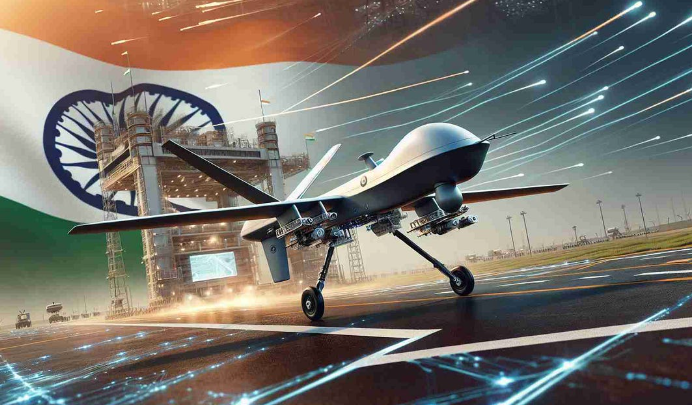
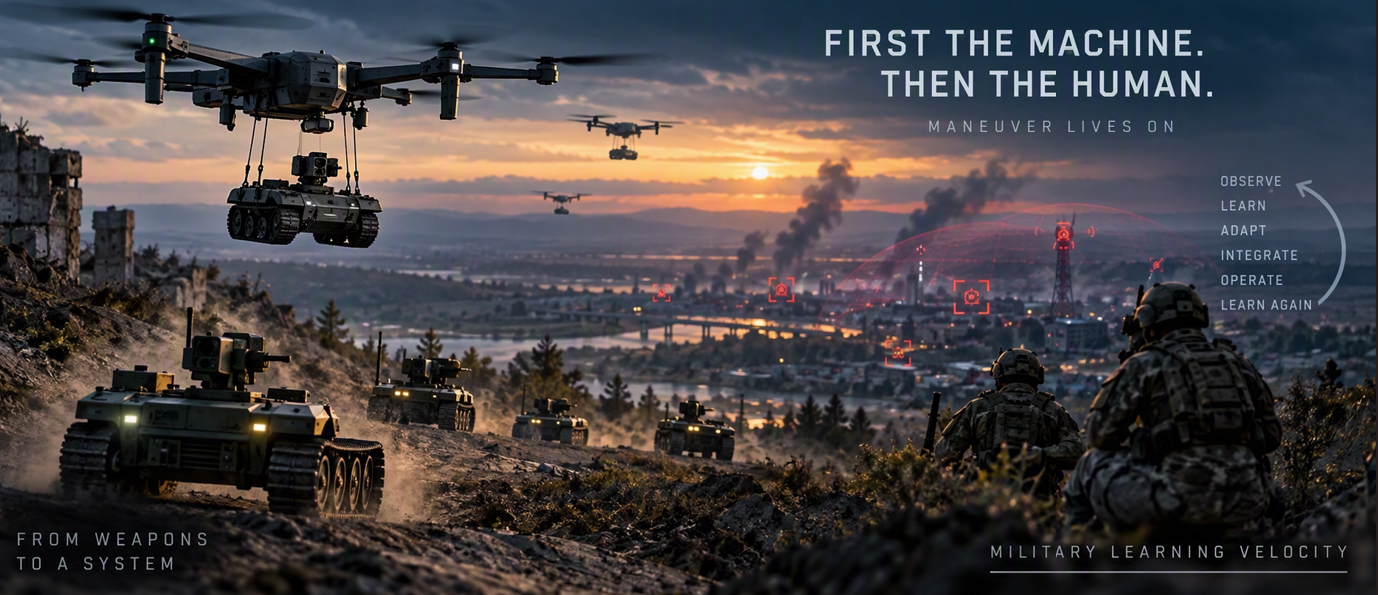
One unmanned system can become the means of transporting and deploying another unmanned system.
The UAS ceases to be merely the actor that observes or attacks. It can become the element that projects robotic capability into a depth that would otherwise be difficult to reach.
This allows us, still as a hypothesis, to speak of a robotic airborne operation.
The expression does not simply mean that a drone transports a robot. It means that a military organization begins to reproduce a function historically reserved for airborne or air-mobile forces—the penetration of depth—through an architecture of unmanned systems.
And that architecture can grow.
An aerial system can transport a ground system. The ground system can attack a position, clear an obstacle or perform other high-risk tasks. Other systems can provide ISR, electronic warfare or communications.
The result is not necessarily the replacement of the soldier.
It may be a change in the order in which the soldier appears in the operation.
First the machine. Then the human.
The Real Change Is Not the Robot
The relevance of Vivaldi to Military Learning Velocity does not lie in the robot itself. Nor does it lie in which system is the most advanced, or in how many drones or UGVs a force can field.
The real change occurs when a military organization learns to combine existing capabilities to solve an operational problem in a different way.
A force may possess UGVs, UAS, electronic warfare, precision munitions and surveillance systems for years without substantially changing the way it fights. Another may take those same capabilities, reorganize them around an identified vulnerability and turn them into a new way of operating.
The difference is not necessarily in the technology available, but in the speed at which the organization learns how to employ it.
That is precisely the meaning of Military Learning Velocity: the speed at which an organization observes a problem, learns from it, modifies its procedures, integrates existing capabilities, turns them into a new way of operating and learns again from the result.
Observe → learn → adapt → integrate → operate → learn again.
But there is an additional variable: the adversary learns as well.
MLV therefore cannot be measured only by the speed at which one force learns. It must also be understood in terms of its ability to learn and adapt before the enemy completes its own cycle.
Vivaldi is interesting because it appears to show an evolution of this process. The experience accumulated with drones, UGVs, electronic warfare and reconnaissance systems does not appear simply as a collection of independent capabilities, but as an operational architecture.
Learning stops producing only new tools and begins to modify the way the operation itself is designed.
That may be the real leap: not moving from one weapon to another, but moving from employing systems to learning how to fight as a system.
A Hypothesis, Not a Conclusion
Vivaldi is still too recent, and too many questions remain unanswered, to turn it into a conclusion.
We do not know whether this form of employing unmanned systems will become a stable doctrine, whether UGVs will remain primarily a complement to human forces, or whether they will begin to assume functions that until now have been reserved for soldiers.
Nor do we know whether degradation of the kill zone will be sufficient to enable larger-scale operations, particularly those requiring the concentration of mechanized forces in depth.
And there is an even more important question:
What will Russia do with what it has just observed?
What we can observe is a process of learning.
An organization that had already incorporated drones, electronic warfare, reconnaissance and unmanned systems is beginning to combine them within a different operational architecture.
The value of Vivaldi, therefore, may not lie in having found a definitive solution, but in having demonstrated a new way of framing the problem.
Military innovation rarely consists of inventing every component involved in an operation.
Very often, it consists of discovering a new way to make those components work together.
And when that new combination changes the way an organization fights, the real change is no longer in the technology itself.
It is in the speed at which the organization learned to employ it.
And Now Comes Russian Learning
The real test of Vivaldi begins now.
Russia has already observed what happened. From there, it may attempt to reproduce some of its elements, adapt its own capabilities or develop a response designed to prevent Ukraine from generating the same operational window again.
That response could take different forms: improving detection, strengthening electronic warfare and counter-unmanned capabilities, protecting communications and command nodes, increasing the ability to strike in depth, or developing its own robotic penetration architecture.
We do not yet know which path will be chosen.
And precisely for that reason, this stage is particularly interesting from the perspective of Military Learning Velocity.
If Russia can quickly identify what allowed Ukraine to generate that window and develop a response, the cycle will have begun again.
Ukraine will then have to learn from that response, modify its architecture and operate again.
Observe → learn → adapt → integrate → operate.
The operation would thus cease to be merely an episode of the war in Ukraine and become a case study in how military organizations learn on a battlefield where technology is constantly changing.
If the hypothesis developed in On War, XXI Century III is correct, maneuver did not disappear because it ceased to be necessary.
It became too dangerous.
Vivaldi may be showing one way of changing that equation once again: reducing human exposure while simultaneously degrading the adversary's ability to turn observation into an effective response.
We still do not know whether this will be enough to enable the return of large mechanized formations, or whether the next step will be an increasingly close combination of robotic systems and human forces.
But perhaps that is precisely the central question.
The next military revolution will not depend only on what weapons we are capable of building.
It will depend on what a military organization is capable of learning when those weapons begin to function as a system.