The Era of the Cheap Cruise Missile. How Jet-Powered Drones Are Changing the Economics of War
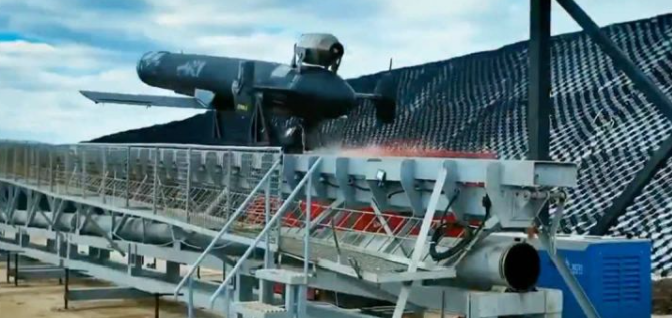
Drones were relatively slow, inexpensive, and expendable. Cruise missiles were fast, sophisticated, and costly precision weapons reserved for high-value targets.
That distinction is rapidly disappearing.
A new generation of jet-powered strike drones is emerging over Ukraine, and with it comes a fundamental question: when does a drone stop being a drone and become something else entirely?
Russia's latest systems are forcing that debate. The reported characteristics of the new Geran-5 place it in a category that sits somewhere between a traditional UAV and a cruise missile. With a launch weight approaching 800 kilograms, a warhead of up to 90 kilograms, a range of approximately 900 kilometers, and speeds reaching 600 kilometers per hour, it is becoming increasingly difficult to describe such a weapon using the language of conventional drone warfare.
The term "Shahed" no longer captures the reality.
What Ukraine is facing today is not simply an evolution of the familiar propeller-driven attack drone. It is the emergence of a new class of relatively inexpensive, mass-produced, jet-powered strike weapons designed to overwhelm defenses through scale rather than sophistication.
And scale changes everything.
For decades, cruise missiles were powerful precisely because they were expensive. Their cost naturally limited the quantities that could be deployed. Military commanders could launch dozens, perhaps hundreds, but rarely thousands.
Jet-powered attack drones are rewriting that equation.
If reports suggesting launches of 1,500 jet-powered strike UAVs in one month and 2,500 in the next are accurate, the numbers begin to resemble historical strategic bombardment campaigns rather than traditional missile operations.
The comparison with World War II is impossible to ignore.
Germany launched roughly 8,000 V-1 flying bombs against Britain over approximately nine months. Those early cruise weapons represented one of the first attempts to industrialize long-range aerial attacks.
Today's battlefield is witnessing a similar transformation.
The difference is that modern systems are far more accurate, adaptable, and capable of integrating advanced navigation and guidance technologies.
The implications for air defense are profound.
A target traveling at 600 kilometers per hour presents a significantly different interception challenge than a slower propeller-driven drone. Faster speeds reduce reaction times. Larger warheads increase potential damage. Longer ranges expand operational flexibility.
And when such systems are deployed in large numbers simultaneously, defenders face a difficult dilemma.
Every interceptor launched has a cost.
Every radar system has capacity limits.
Every defense network has saturation points.
The objective is no longer necessarily to evade defenses completely.
The objective is to overload them.
This is where the war enters a new phase.
The battle is becoming increasingly industrial.
For much of the conflict, discussions about military technology focused on innovation. Which side had the better drone? The better software? The better electronic warfare capabilities?
Those questions remain important.
But increasingly, the decisive factor may be manufacturing capacity.
Thousands of jet-powered systems require thousands of engines.
Thousands of navigation packages.
Thousands of airframes.
Thousands of guidance systems.
Thousands of warheads.
The center of gravity moves from laboratories to factories.
This reality applies to both sides.
Ukraine is not merely defending against this new class of weapon. According to reports referenced by military analysts, Ukrainian forces have also conducted thousands of launches involving jet-powered systems from the Bars family.
That matters because it demonstrates that the competition is becoming symmetrical.
Neither side possesses a monopoly on the technology.
Instead, both are racing to scale production.
The future contest may therefore be less about invention and more about industrial endurance.
Who can produce more engines?
Who can source more electronics?
Who can secure more components?
Who can sustain output over years rather than months?
These are economic questions as much as military ones.
The emergence of jet-powered attack drones represents something larger than just another technological milestone. It marks the convergence of drone warfare and cruise missile warfare into a single category of conflict defined by affordability, volume, and industrial capacity.
The battlefield of the future may not belong to the side with the most advanced weapon.
It may belong to the side capable of manufacturing thousands of "good enough" weapons faster than an opponent can destroy them.
That is why the next stage of the war is not just being fought in the skies.
It is being fought on factory floors.
Because in the age of mass-produced jet-powered strike systems, the most valuable strategic asset may no longer be technology alone.
It may be production.