Catching Drones Without Destroying Them. Germany’s Argus Interception Counter-UAS Revolution

In the rapidly evolving world of drone warfare, one assumption has long gone unquestioned: to stop a drone, you have to destroy it.
A German company is now challenging that logic—and turning it into a competitive advantage.
At Eurosatory 2026 in Paris, Argus Interception is unveiling a counter-UAS concept that feels almost counterintuitive in a defence landscape dominated by kinetic force. Instead of blowing drones out of the sky, Argus is catching them. Literally.
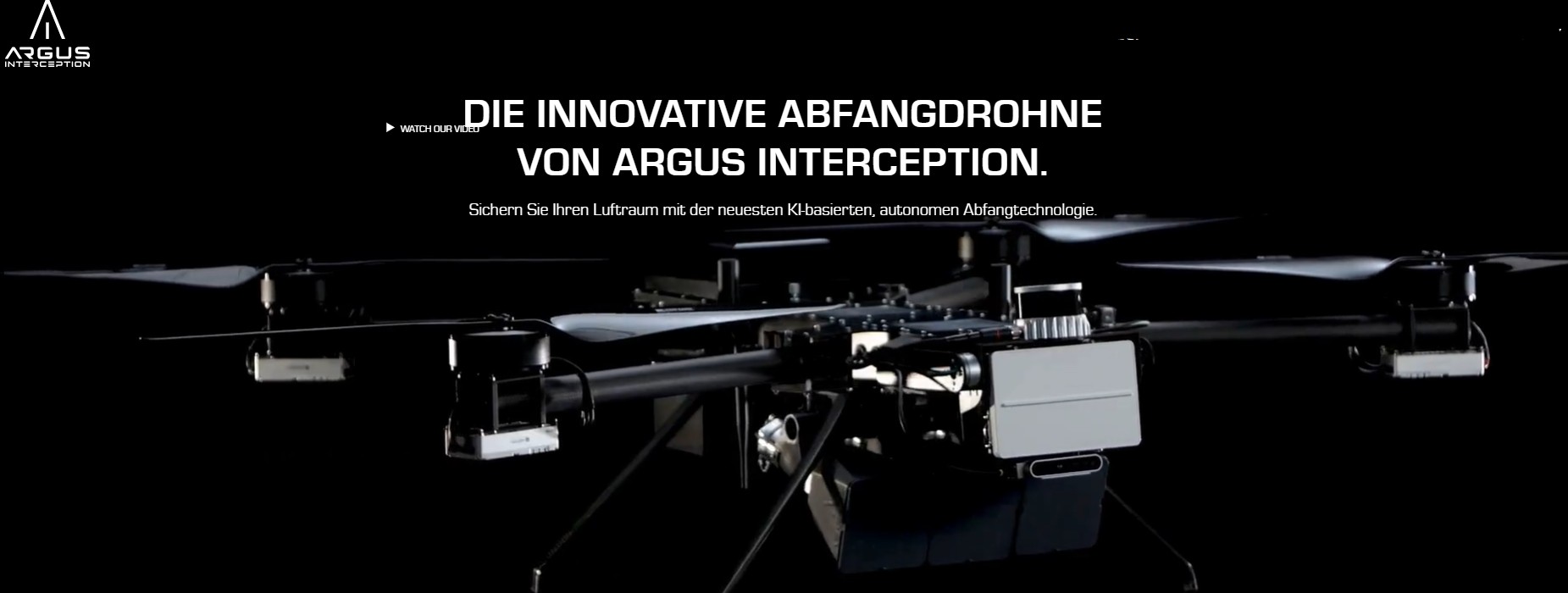
Its flagship system, the A1-Falke network interceptor, represents a distinct departure from conventional air defence thinking. Rather than relying on explosive or high-energy mechanisms, the system uses a controlled net capture to intercept uncooperative drones. The target is secured, not destroyed.
And that difference matters.
In an era where drones are increasingly used for surveillance, smuggling, sabotage, and asymmetric attacks, the value of a captured system can exceed that of a destroyed one. A downed drone yields fragments. A captured drone yields intelligence—hardware, software, data, and potentially forensic evidence capable of identifying operators and networks.
This is not just defence. It is intelligence gathering in real time.
The A1-Falke is already operationally deployed, used by the German armed forces and federal police, and officially catalogued within NATO systems. Its application spectrum is broad: protecting airports, ports, critical infrastructure, large public events, and sensitive government or military installations.
But Argus is not stopping at interception.
The real innovation unveiled this year is the “Falke Nest”—an automated, climate-controlled shelter designed to keep the interceptor ready for deployment 24/7. On the surface, it looks like infrastructure. In reality, it is a shift toward persistent, automated readiness.
The system allows the interceptor to launch, operate, and return with minimal manual intervention. Yet—and this is a deliberate design decision—the human remains firmly in control.
Argus has built its approach around a Human-in-the-Loop concept. Detection, classification, and identification of a target can be automated, but the final decision to deploy the interceptor is always made by an operator. Only after confirmation does the system act.
This balance between automation and human oversight is critical.
As counter-UAS technologies become more advanced and more autonomous, questions of proportionality, accountability, and control become unavoidable. Fully automated responses may be faster—but they also carry higher risks of unintended consequences.
By keeping human decision-making at the core, Argus positions its solution as both technologically advanced and politically responsible.
And that positioning is resonating.
According to the company, the Falke Nest has attracted particular interest from military forces, security agencies, and operators of critical infrastructure. The reason is simple: the threat is no longer occasional—it is persistent. Airports, energy networks, and public venues are increasingly exposed to low-cost, high-impact drone threats that require continuous protection.
This is where automation meets necessity.
Rather than deploying teams only when needed, systems like Falke Nest create a permanent protective layer—always ready, always connected, always responsive. Combined with sensor and command infrastructures, the interceptor becomes part of a fully integrated “effect chain,” spanning detection, classification, decision-making, and intervention.
This system-of-systems approach reflects a broader transformation in defence thinking.
It is no longer about individual products. It is about integration.
Argus’ strategy also aligns with Europe’s growing push for defence sovereignty. The company develops and manufactures its systems entirely in Germany, while expanding production capacity and international partnerships to meet rising demand. In a geopolitical environment marked by supply chain tensions and technological competition, this localised capability becomes a strategic asset.
Yet perhaps the most provocative question Argus raises is philosophical.
What does it mean to neutralize a threat?
For decades, the answer was simple: eliminate it. But in a world of complex, networked threats, that answer is evolving. Sometimes, the smarter move is not to destroy the threat—but to understand it, control it, and learn from it.
By catching drones instead of destroying them, Argus is not just offering a new tool.
It is redefining the objective.
Because in modern security, knowledge is power—and sometimes, the safest way to win is to take the drone intact.
.png)