The Drone Arms Race Has Entered a New Phase: Speed vs. Survival Over Ukraine
The future of air warfare is no longer arriving.
It is already flying over Ukraine.
On a single day, according to the Ukrainian Air Force, Russia launched 224 attack drones, most of them reportedly jet-powered. Nearly 200 were intercepted or suppressed, yet dozens still penetrated the defensive screen, while others remained in Ukrainian airspace hours after the assault began.
Behind those statistics lies a transformation that military planners around the world are watching closely.
The drone war is entering its next stage.
And this stage is faster, deadlier, and far more difficult to stop.
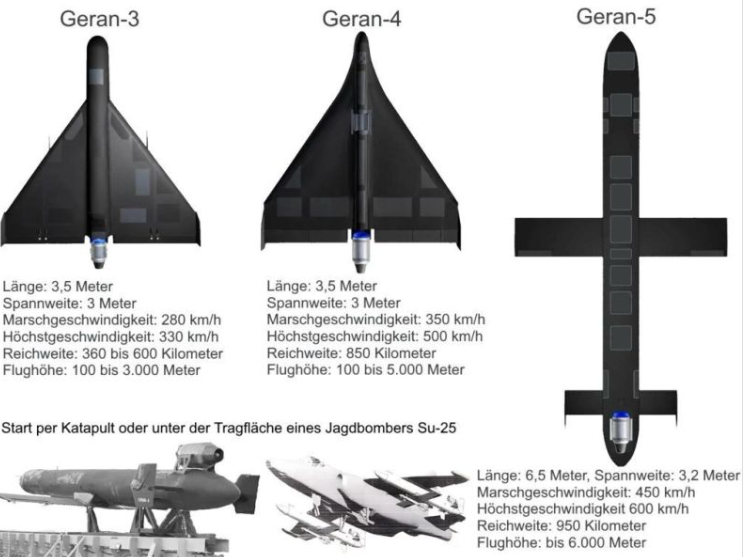
For much of the conflict, the symbol of Russia's long-range drone campaign was the propeller-driven Geran-2. Relatively cheap, capable of traveling long distances, and often deployed in large numbers, it forced Ukraine to develop new layers of air defense.
Now that equation is changing.
The emergence of jet-powered variants such as the Geran-4 and Geran-5 represents more than an incremental upgrade. Higher speeds reduce reaction times. Greater operating altitudes complicate interception. Faster approach vectors compress decision-making windows for air defense operators already working under intense pressure.
The battlefield is no longer simply testing weapons.
It is testing time itself.
Every second matters.
Traditional air defense systems were built to counter aircraft, helicopters, cruise missiles, and ballistic threats. The rise of mass drone attacks introduced entirely new challenges. Defenders suddenly needed capabilities that were not only effective but economically sustainable.
Destroying a low-cost drone with a high-cost missile is possible.
Doing it hundreds of times every week is a different question.
The response has been one of the most remarkable technological adaptations of the war.
Ukraine is increasingly developing interceptor drones designed specifically to hunt other drones.
The logic is simple.
If drones are becoming the threat, drones can become the defense.
Instead of relying solely on conventional missile systems, defensive interceptor drones can potentially provide a more scalable response to swarms of incoming targets. Faster speeds, higher altitudes, improved sensors, and autonomous guidance capabilities are becoming essential requirements for this new mission.
What is emerging resembles an aerial ecosystem.
Attack drones evolve.
Defensive drones evolve.
Electronic warfare adapts.
Navigation systems improve.
Countermeasures emerge.
Then the cycle repeats.
The pace of military innovation is accelerating to a level rarely seen in modern history.
Conflicts of the twentieth century often produced technological leaps over years. The Ukraine war is producing them over months and, in some cases, even weeks.
That should concern military planners far beyond Eastern Europe.
The most important lesson may not be about any individual drone model. It may be about the speed at which battlefield innovation now occurs.
The side that identifies weaknesses faster gains temporary advantage.
The opposing side adapts.
A new vulnerability is discovered.
The process never stops.
This dynamic is transforming warfare from a contest of equipment into a contest of innovation cycles.
In previous eras, superiority often belonged to whoever built the most advanced weapon.
Today, superiority increasingly belongs to whoever upgrades fastest.
The implications extend beyond Ukraine.
NATO members, European defense industries, and military organizations worldwide are studying these developments because the future battlefield is becoming visible in real time. Drone swarms, autonomous interceptors, AI-assisted targeting, electronic warfare, and low-cost precision strike capabilities are no longer theoretical concepts.
They are operational realities.
Perhaps the most sobering aspect of the latest attacks is what often gets lost behind technical specifications.
Every performance metric represents a human reality.
Every increase in speed reduces warning time for civilians.
Every altitude improvement changes interception challenges.
Every successful breakthrough reaches a city, a neighborhood, or critical infrastructure.
Military analysts discuss ranges, velocities, payloads, and radar signatures.
Citizens hear air raid sirens.
And that is why the drone war matters.
Because behind every technical innovation is an attempt to gain an advantage over people on the ground.
The battle over Ukraine's skies is no longer just a fight between drones and air defenses.
It is a race between offensive and defensive innovation.
And neither side can afford to slow down.