The Donbas Illusion: What If the West Is Negotiating the Wrong War?
Peace negotiations begin with a deceptively simple question: What does the aggressor actually want?
Get that answer wrong and diplomacy can become something more dangerous than failure. It can become a mechanism for rewarding aggression while postponing the next war.
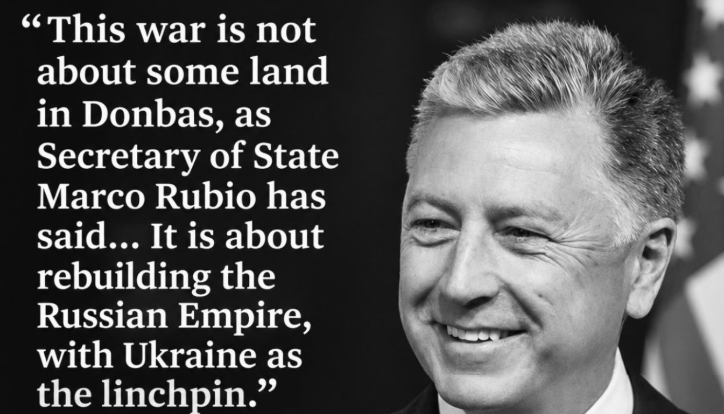
That is the uncomfortable argument Kurt Volker, former U.S. ambassador to NATO, makes in a recent Newsmax opinion piece.
“This war is not about some land in Donbas,” Volker writes. His interpretation is considerably darker: “It is about rebuilding the Russian Empire, with Ukraine as the linchpin.”
That distinction changes almost everything.
If this is fundamentally a territorial dispute, territory can theoretically become the currency of peace. A ceasefire line can be negotiated. Sanctions can be relaxed. Economic incentives can make compromise more attractive.
But if territory is the instrument rather than the objective, sacrificing territory may purchase only an intermission.
Recent diplomacy makes that question especially relevant. U.S.-mediated Russian-Ukrainian talks have resumed in Abu Dhabi, while European governments are debating future security guarantees for Ukraine. AP reported that European governments were pressing to be included in the process, arguing that Europe's security architecture cannot be decided without Europe.
The danger is believing that satisfying one Russian demand necessarily reduces the next.
Volker argues the opposite.
In his account, Vladimir Putin's objectives extend beyond capturing territory: permanent Ukrainian neutrality, political change in Kyiv and denial of a distinct Ukrainian national identity. He consequently argues that territorial concessions would not satisfy Russian ambitions.
Whether one accepts every part of that interpretation or not, negotiators cannot responsibly ignore the question it raises:
What happens the day after the peace deal?
A settlement is durable only if renewed war becomes less attractive than peace.
That is why the debate over sanctions matters.
If sanctions are simply bargaining chips to be surrendered in exchange for an agreement, their removal could restore resources to the very state expected to comply with that agreement. Volker instead argues that economic pressure should reduce Moscow's capacity to continue fighting. In earlier remarks, Volker similarly argued that mounting economic pressure was necessary to change Putin's calculation.
The same logic applies militarily.
Volker's prescription is not indiscriminate escalation. His article advocates enabling Ukraine to attack military logistics, aircraft, missile launchers, depots and other military capabilities, including at long range, while explicitly excluding civilian targets.
This leads to the uncomfortable strategic question Western governments have spent years trying to manage:
Is peace produced primarily by offering Russia something it wants, or by convincing Russia that continuing the war will no longer deliver what it wants?
Those are radically different theories of peace.
The first emphasizes accommodation.
The second emphasizes leverage.
And leverage has been the missing element in much of the Western debate.
Volker's sharpest criticism is not that the West has done nothing. The United States and Europe have supplied Ukraine, imposed sanctions and supported its survival.
His criticism is that they have done so “haltingly, hesitantly, and without a strategy for victory.”
That accusation deserves serious consideration.
A strategy designed only to prevent Ukrainian defeat is not necessarily a strategy for ending the war. It may simply prevent either side from reaching the conditions that force a strategic decision.
Diplomacy remains essential. Wars ultimately end politically.
But negotiations work differently when both sides understand that continuing the war will not improve their position.
That is ultimately the challenge Volker places before the West.
Perhaps the wrong question has dominated the peace debate:
What must Ukraine give up to make peace possible?
A more consequential question may be:
What does Russia still need to make continued war possible?
Because if Putin believes another year of fighting can produce more territory, more leverage and a weaker Ukraine, concessions today may not end his incentive to fight tomorrow.
A peace agreement stops a war on paper.
A durable peace changes the calculation that started it.