Donbas - Conquer. Destroy. Rewrite. The War on Memory in Occupied Ukraine
Empires rarely stop at conquering territory.
They eventually come for memory.
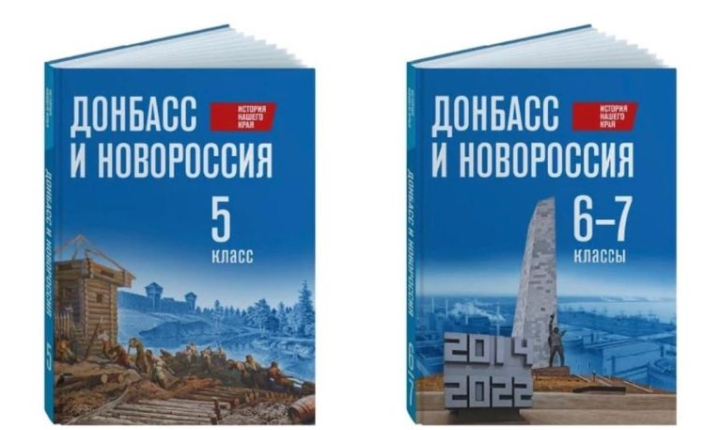
According to reports, Russian schools in occupied parts of Ukraine are set to receive a new state-approved textbook titled "History of Our Land. Donbas and Novorossiya." The book reportedly presents the history of Ukraine's Donetsk, Luhansk, Zaporizhzhia, and Kherson regions as part of Russian history and is expected to enter classrooms on September 1.
If true, this is not merely an educational change.
It is a political project.
And perhaps one of the most consequential fronts in the war.
Because every occupation faces the same problem:
How do you convince the next generation that what happened was not conquest, but destiny?
How do you persuade children that the borders they were born with were temporary mistakes?
How do you transform an occupied population into loyal subjects?
The answer is as old as empire itself.
You rewrite the story.
The Battle After the Battlefield
Modern wars are often portrayed through dramatic images: missiles launching, cities burning, soldiers advancing.
But the most enduring victories are rarely military.
They are cultural.
Military occupations can control streets.
They cannot automatically control identity.
That requires something more powerful.
Schools.
Textbooks.
Language.
Symbols.
Children.
Throughout history, conquering powers have understood a simple truth: if you control the story, you eventually influence how future generations understand themselves.
The fight is no longer about who owns the land.
The fight becomes about who owns the past.
The Meaning of "Novorossiya"
The term "Novorossiya" is not a neutral geographic label.
It carries historical and political significance connected to imperial Russian narratives regarding southern and eastern Ukraine.
Its appearance in official educational material is therefore unlikely to be accidental.
Names matter.
Maps matter.
Words matter.
When governments rename territories, they are rarely describing reality.
They are defining it.
Or attempting to.
A child opening a textbook does not see geopolitical strategy.
A child sees facts.
And whatever appears on those pages often becomes the foundation for how that child understands the world.
That is why textbooks are among the most powerful political tools ever created.
More Than Territory
The struggle over occupied Ukrainian regions is frequently discussed in military terms.
How much land was taken?
Which town changed hands?
Where are the front lines?
But there is another question.
What happens to identity under occupation?
Physical destruction can be measured.
Destroyed schools.
Destroyed homes.
Destroyed infrastructure.
The destruction of cultural memory is harder to quantify.
There is no satellite image that shows a language disappearing from a classroom.
No drone footage that captures a child gradually being taught that their homeland belonged to someone else all along.
No military map that measures the distance between reality and propaganda.
Yet these changes can shape societies for generations.
Why History Matters
Every nation teaches history.
That is normal.
The controversy begins when history is transformed from education into political engineering.
The objective ceases to be understanding the past.
The objective becomes legitimizing the present.
In conflicts around the world, competing narratives frequently mirror competing territorial claims.
If a state can establish historical ownership in the minds of future generations, current political realities begin to appear inevitable.
Occupation becomes reunification.
Conquest becomes restoration.
Resistance becomes misunderstanding.
Language changes.
Meaning changes.
Memory changes.
The Longest Front Line
Wars eventually end.
Armies withdraw.
Borders shift.
Governments change.
But the struggle over history often continues long after the last shot is fired.
That is why the introduction of a textbook may appear insignificant compared to combat operations.
In reality, it may represent something larger.
A recognition that control of territory is not enough.
Control of memory is the ultimate prize.
Because once a child is taught that their language, culture, and homeland were always someone else's, the occupation no longer needs tanks to sustain itself.
It has something much more durable.
A narrative.
And in every conflict, narratives are often the hardest territory to reclaim.