The Bradley’s New Wingman. Why Swarms of FireAnt Robots Could Change Armored Warfare Forever
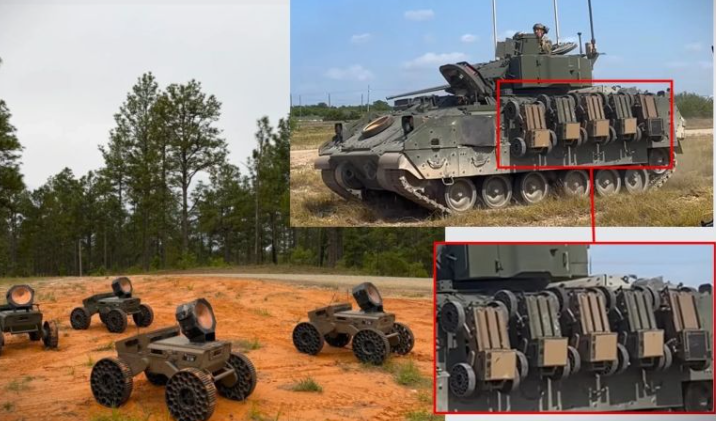
For more than a century, one brutal reality has defined ground combat:
The soldier who finds the enemy first usually survives.
The soldier who gets detected first often does not.
Now the U.S. military and defense innovators are exploring a technology that could fundamentally alter that equation. Instead of sending soldiers forward to discover mines, ambushes, artillery positions, or hidden armor, future armored formations may send robots.
Lots of them.
The FireAnt robotic swarm concept represents one of the most ambitious attempts yet to push battlefield risk away from human beings and onto expendable machines. Recent demonstrations showing multiple FireAnt systems carried aboard an M2A4 Bradley Infantry Fighting Vehicle suggest that future armored units may not require dedicated robotic carriers. Existing combat vehicles could deploy, support, and command swarms directly from the battlefield.
At first glance, FireAnt looks like another unmanned ground vehicle.
That interpretation misses the point entirely.
The real revolution is not the robot itself.
It is the swarm.
The Battlefield's New First Contact
In traditional armored warfare, reconnaissance units move ahead to identify threats before the main force advances. This mission is among the most dangerous in military operations.
FireAnt seeks to change that model.
Instead of exposing crews and scouts, commanders could release multiple low-cost robotic systems ahead of the formation. These robots would scout routes, search for mines, identify enemy positions, detect armor, monitor choke points, and deliberately force hostile units to reveal themselves.
The objective is not necessarily to destroy the enemy.
The objective is to find the enemy.
That distinction matters.
Modern warfare increasingly rewards the side that can detect, identify, and target first. Every enemy tank discovered, every artillery position exposed, every jammer activated provides valuable intelligence that can be transformed into military advantage.
The robot becomes a trigger for information.
And information has become the most valuable weapon on the battlefield.
From Operator to Swarm Commander
Perhaps the most striking element of the FireAnt concept is swarm autonomy.
Reports indicate a single operator could control six to eight robotic systems simultaneously.
That is a profound shift.
Historically, every unmanned system demanded significant operator attention. FireAnt is designed around a different philosophy. Robots manage spacing, formations, navigation, and coordination through decentralized mesh networking while the human focuses on mission objectives.
The result is not one robot performing one task.
It is a coordinated robotic team working toward a shared operational goal.
In practical terms, one Bradley crew could potentially deploy multiple robotic scouts that spread across terrain, observe different sectors, exchange information autonomously, and continuously update commanders with a dynamic battlefield picture.
That level of battlefield awareness could prove decisive in future conflicts.
The Kill Chain Is Becoming a Network
The most important function of FireAnt may not be reconnaissance.
It may be connectivity.
Future combat environments are increasingly built around sensor-to-shooter networks. Detecting a target is only valuable if that information can rapidly reach the platform capable of engaging it.
FireAnt is positioned to become a key node in that process.
A robotic scout identifies an enemy armored vehicle.
Target data flows through the network.
A loitering munition attacks.
An artillery battery engages.
A drone confirms the strike.
The robot itself may never fire a weapon.
Yet it may still be responsible for destroying the target.
This networked approach reflects the broader evolution of military operations toward multi-domain warfare, where ground robots, drones, artillery, electronic warfare systems, and armored vehicles function as a connected ecosystem rather than isolated platforms.
The Economics Favor the Swarm
There is another reason military planners are paying attention.
Cost.
Destroying a multi-million-dollar armored vehicle with a comparatively inexpensive robotic system creates an attractive military equation.
Even when robots are lost, commanders may consider the exchange favorable if the systems expose higher-value enemy assets, absorb fire, trigger enemy responses, or reveal hidden positions.
This approach introduces a new battlefield dilemma for opponents.
Ignore the robots, and they continue collecting intelligence.
Attack them, and you expose your location.
Either way, the swarm gains value.
The Challenges Remain Enormous
Despite the excitement surrounding autonomous ground systems, reality remains stubbornly difficult.
Combat environments are messy.
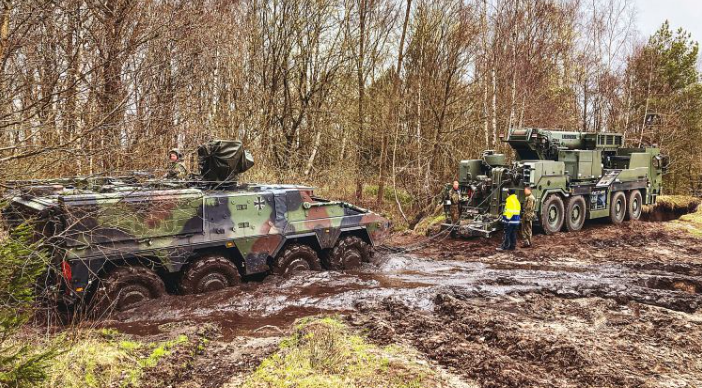
Mud, forests, urban terrain, electronic warfare, communication disruptions, maintenance requirements, and battery limitations all create obstacles that laboratory demonstrations cannot fully replicate.
Enemy forces will not sit passively and watch robotic swarms operate.
They will jam communications.
Spoof navigation systems.
Deploy mines.
Use interceptor drones.
Develop new tactics specifically designed to counter autonomous systems.
The battlefield is always a competition between innovation and adaptation.
The Future Arrives One Robot at a Time
FireAnt may never become the ultimate battlefield solution.
But it points toward an undeniable trend.
Future armored formations will increasingly use machines to find threats, machines to absorb risk, and machines to expose the enemy before human soldiers enter the fight.
The Bradley demonstration offers a glimpse of what comes next.
The first vehicle into contact may no longer carry soldiers.
It may carry robots.
And that single change could redefine armored warfare for decades to come.