The Arctic Gambit. India and Russia Are Building a Trade Route That Could Challenge the Suez Era
For more than 150 years, global trade has relied on a handful of maritime chokepoints.
The Suez Canal. The Strait of Hormuz. The Strait of Malacca.
These narrow corridors became the arteries of globalization, determining how energy moved, how supply chains functioned and how geopolitical power was projected.
Now, India and Russia are quietly betting on a different future.
Moscow has authorized Rosatom, the state corporation responsible for Russia's Northern Sea Route infrastructure, to sign a memorandum of understanding with India to deepen cooperation in Arctic maritime cargo transportation. The agreement signals a new phase in a strategic partnership that extends far beyond shipping.
At first glance, the announcement appears technical.
In reality, it may be one of the most consequential logistics developments of the decade.
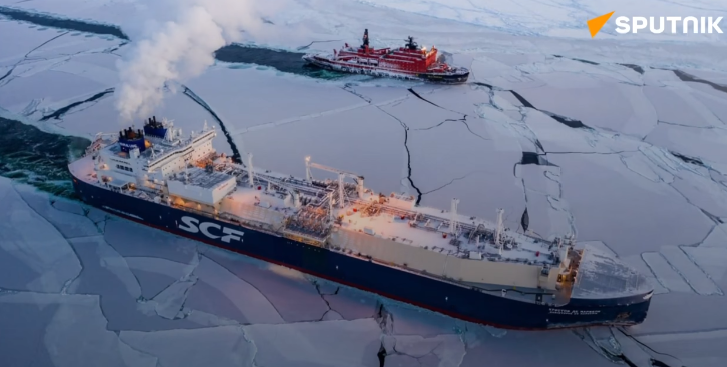
The Northern Sea Route (NSR), stretching across Russia's Arctic coastline, has long been viewed as an ambitious alternative to traditional Eurasian trade corridors. Climate change, melting sea ice, and advances in icebreaking technology are transforming what was once a seasonal experiment into an increasingly viable commercial route.
For India, the logic is straightforward.
The country's economic growth depends on secure access to energy, raw materials and export markets. Russian LNG, coal and fertilizer shipments already play an important role in bilateral trade. A more efficient Arctic route could reduce dependence on traditional maritime corridors that have become increasingly exposed to geopolitical instability and security risks.
But this is not simply about moving cargo faster.
It is about strategic insurance.
Recent disruptions in global shipping have exposed the vulnerability of concentrated trade networks. Whether caused by conflict, sanctions, piracy, infrastructure incidents or political instability, disruptions in one chokepoint can ripple across continents within days.
Diversification is becoming the new currency of resilience.
The Arctic offers exactly that.
For Russia, the benefits are equally significant.
The Northern Sea Route is more than an economic project. It is a geopolitical vision. Moscow has spent years investing in Arctic ports, navigation systems, icebreaker fleets and energy infrastructure to transform the region into a major commercial artery. Rosatom's central role demonstrates that the corridor is considered a strategic national priority rather than merely a transport initiative.
India's involvement adds credibility, cargo volume and long-term demand.
Perhaps most importantly, it introduces one of the world's fastest-growing major economies into the Arctic equation.
The cooperation extends beyond freight movements.
Reports indicate discussions involving maritime infrastructure development, seafarer training and India's potential participation in building Arctic-capable vessels and non-nuclear icebreakers. Such cooperation would move the relationship from transit partnership to industrial partnership.
That is where the geopolitical implications become impossible to ignore.
The Arctic is no longer a remote frontier.
It is rapidly becoming an arena of competition.
China has promoted the concept of a "Polar Silk Road." NATO has intensified attention on northern security. The United States has increased its Arctic focus. European countries are reassessing northern infrastructure and maritime security.
Against this backdrop, India is pursuing a characteristically pragmatic course.
New Delhi is not seeking Arctic dominance.
It is seeking optionality.
The strategy aligns with India's broader foreign policy approach: maintain strategic autonomy, diversify partnerships and avoid excessive dependence on any single trade route or political bloc.
Critics will point to obvious challenges.
Arctic navigation remains expensive. Ice conditions remain unpredictable. Insurance costs remain higher than traditional routes. Infrastructure still requires substantial investment. Seasonal variations continue to affect reliability.
All true.
But transformative trade corridors are rarely built because they are perfect today.
They are built because decision-makers believe they will matter tomorrow.
That is what makes the India-Russia Arctic partnership worth watching.
The agreement is not merely about shortening shipping distances or accelerating commodity deliveries.
It represents a broader shift in how major powers are thinking about geography itself.
For centuries, geography was destiny.
Today, technology is rewriting geography.
Icebreaker fleets, Arctic infrastructure and advanced maritime logistics are creating new commercial realities where previous generations saw only frozen barriers.
The Northern Sea Route may never fully replace the Suez Canal.
It does not have to.
Its strategic value lies in offering an alternative.
And in an increasingly fragmented world, alternatives are becoming one of the most valuable assets any nation can possess.
The race for the future of global trade may no longer run through deserts and canals.
It may increasingly run through the ice.