The 30 cm Signal - Why Even the Smallest Systems Are Now Targets
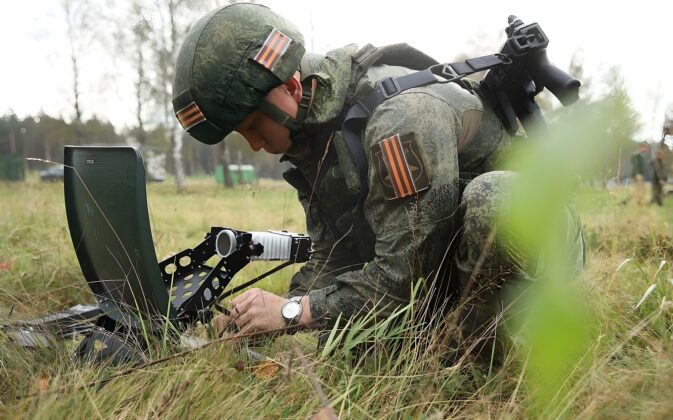
For decades, military design followed a clear instinct:
Make it smaller.
Make it lighter.
Make it harder to see.
The assumption was simple—if something is small enough, it becomes invisible.
That assumption is now broken.
Modern battlefields are no longer defined by what can be seen from afar, but by what can be detected up close, continuously, and intelligently. The rise of drones has changed the rules entirely.
Today, even the smallest systems—compact, mobile, carefully designed to avoid detection—can be found, tracked, and destroyed within minutes.
Not by massive surveillance infrastructure.
But by a single operator in the air.
This shift is not about better weapons.
It’s about faster awareness.
Drones have introduced a new layer of constant observation. They hover, scan, analyze, and react in real time. There is no delay between detection and action. No buffer between being seen and being targeted.
The battlefield has become a continuous feedback loop:
Observe → Identify → Strike.
And it happens in seconds.
This creates a new reality for system design.
Traditionally, survivability relied on physical characteristics:
- Smaller size
- Reduced signatures
- Camouflage
- Shielding
These are still relevant—but no longer sufficient.
Because visibility is no longer defined by form.
It is defined by behavior.
A system that transmits.
A system that remains stationary.
A system that operates predictably.
All of these create patterns.
And patterns are what modern sensors—and increasingly, AI systems—detect best.
This is the real shift.
The battlefield is no longer just physical.
It is pattern-based.
And in a pattern-based environment, invisibility becomes nearly impossible.
Even compact, mobile systems designed for discretion are vulnerable if they:
- Stay in one place too long
- Emit signals at predictable intervals
- Follow repeatable operational routines
The more efficient a system becomes, the more it risks becoming predictable.
And predictability is exposure.
This forces a fundamental rethink.
Survivability is no longer just about hiding.
It is about avoiding patterns altogether.
Systems must move more frequently.
Operate less predictably.
Integrate with decoys, redundancy, and distributed networks.
In other words, survival becomes a dynamic process, not a static feature.
And this has broader implications.
Technologies once considered support infrastructure—communication nodes, sensors, portable systems—are now frontline assets. They are not just enabling operations.
They are targets.
This changes priorities.
Speed of deployment matters more.
Time-on-position must be minimized.
Autonomous relocation and adaptive behavior become critical features.
Because in a world of constant aerial observation, the question is no longer:
“Can this system be detected?”
The answer is almost always yes.
The real question is:
“Can it complete its task before it is?”
This is the new equation of modern warfare.
And it applies to everything.
Not just large platforms.
Not just vehicles.
But every component that emits, moves, or interacts.
The battlefield has shifted from a game of visibility to a game of timing and unpredictability.
And in that game, size is no longer protection.
Only behavior is.