The Invisible War for Chips - Why Talent, Data and Trust Are the New Targets
The most important conflict in the world today is not fought with weapons.
It is fought with knowledge.
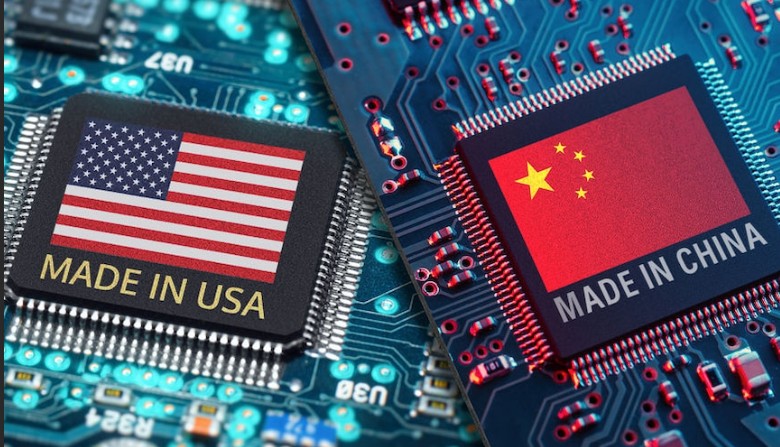
At the center of this conflict stands Taiwan—home to the most advanced semiconductor manufacturing capabilities on the planet. Companies like TSMC produce chips that power everything from smartphones and AI systems to military technologies and global infrastructure.
Control over chips means control over the digital world.
And that makes Taiwan a strategic focal point—not just geographically, but technologically.
Recent reports indicate growing pressure on Taiwan’s semiconductor ecosystem. But this pressure does not come in traditional forms. There are no direct attacks on factories. No physical confrontations.
Instead, the approach is indirect.
Subtle. Distributed. Persistent.
One of the primary vectors is talent acquisition.
The semiconductor industry depends heavily on highly specialized expertise. Engineers, process designers, materials scientists—these are not easily replaceable roles. The knowledge required to produce cutting-edge chips is concentrated in a relatively small number of people.
Which makes them valuable.
And vulnerable.
Efforts to recruit this talent—often through indirect channels—represent a strategic shortcut. Building semiconductor capabilities from scratch can take decades. But acquiring experienced professionals can significantly accelerate that process.
At the same time, the digital domain has become another critical front.
Reports of more than 170 million intrusion attempts on Taiwanese government networks in a single quarter illustrate the scale of cyber pressure. These attempts are not random. They are targeted efforts to gain access, gather information, and identify weaknesses.
Because in a knowledge-driven industry, information is as valuable as physical assets.
But the challenge goes even deeper.
A new layer of influence is emerging through information manipulation.
Deepfakes.
Synthetic media.
Fabricated narratives.
These tools are increasingly used to shape perception, influence public opinion, and potentially interfere with political processes. Elections, in particular, become sensitive targets.
Because control over perception can influence decision-making at the highest level.
Taken together, these elements form a new kind of competition.
Not a war of territory—but a war of capabilities.
It operates across three key dimensions:
- Human capital (talent)
- Cyber space (data and access)
- Information space (trust and perception)
And all of them converge on a single objective:
Technological advantage.
What makes this situation especially critical is its global impact.
Taiwan’s semiconductor industry is not just important for one region. It is deeply embedded in global supply chains. Disruptions would not stay local—they would affect industries worldwide, from automotive manufacturing to cloud computing.
This transforms the issue from a regional concern into a global dependency risk.
And it raises a fundamental question:
What happens when the world’s most critical technology relies on a single, highly specialized ecosystem?
The answer is already shaping global strategy.
Countries are investing heavily in domestic semiconductor production. Governments are treating chip manufacturing as a matter of national security. Supply chains are being restructured to reduce dependency.
But replicating Taiwan’s ecosystem is not easy.
It is not just about building factories.
It is about building:
- Expertise
- Experience
- Precision processes
- Integrated networks
These take years—often decades—to develop.
Which is why indirect approaches remain so attractive.
They are faster.
Less visible.
Harder to counter.
And they operate continuously.
The result is a persistent, low-visibility competition that rarely makes headlines—but influences everything.
From global markets to technological innovation.
From security strategies to political stability.
This is the new reality.
Power is no longer defined solely by physical assets or military strength.
It is defined by the ability to create, control, and protect knowledge.
And in that context, the battle for semiconductors is not just about chips.
It is about the foundation of the modern world.