The Battlefield Printer - How 3D Manufacturing Is Turning Soldiers Into Engineers
For decades, military logistics worked like a slow-moving machine.
A part breaks.
A request is sent.
A supplier responds.
The item is shipped.
And somewhere in between—time is lost.
Days. Sometimes weeks.
In modern operations, that delay is no longer acceptable.
Because the battlefield has changed.
It is faster, more dynamic, and less predictable. Systems are expected to operate continuously, often in remote environments where traditional supply chains struggle to keep up. And when something fails, waiting is not an option.
This is where additive manufacturing—3D printing—is quietly reshaping military capability.
Just a few years ago, almost no one in the military had access to 3D printers. Today, they are becoming a growing presence across European armed forces.
The reason is simple.
Instead of waiting for parts, soldiers can now produce them on demand.
From mechanical components to drone parts, from custom mounts to repair elements—what once required external suppliers can now be created directly in the field.
This is not just about speed.
It is about control.
Traditional supply chains create dependency. Even the most advanced military systems often rely on civilian manufacturers for spare parts. That dependency introduces vulnerability—delays, high costs, limited availability.
Additive manufacturing breaks that dependency.
It brings production closer to the point of use.
A damaged component no longer stops an operation. It becomes a design problem—something that can be solved locally, quickly, and often creatively.
But the shift is not purely technological.
It is human.
Because a machine alone does not create capability.
Knowledge does.
And this is where the real challenge emerges.
Not every soldier is trained in engineering. Not every unit understands material properties, structural limitations, or the design requirements for functional parts. A poorly designed component may fail under stress—sometimes with serious consequences.
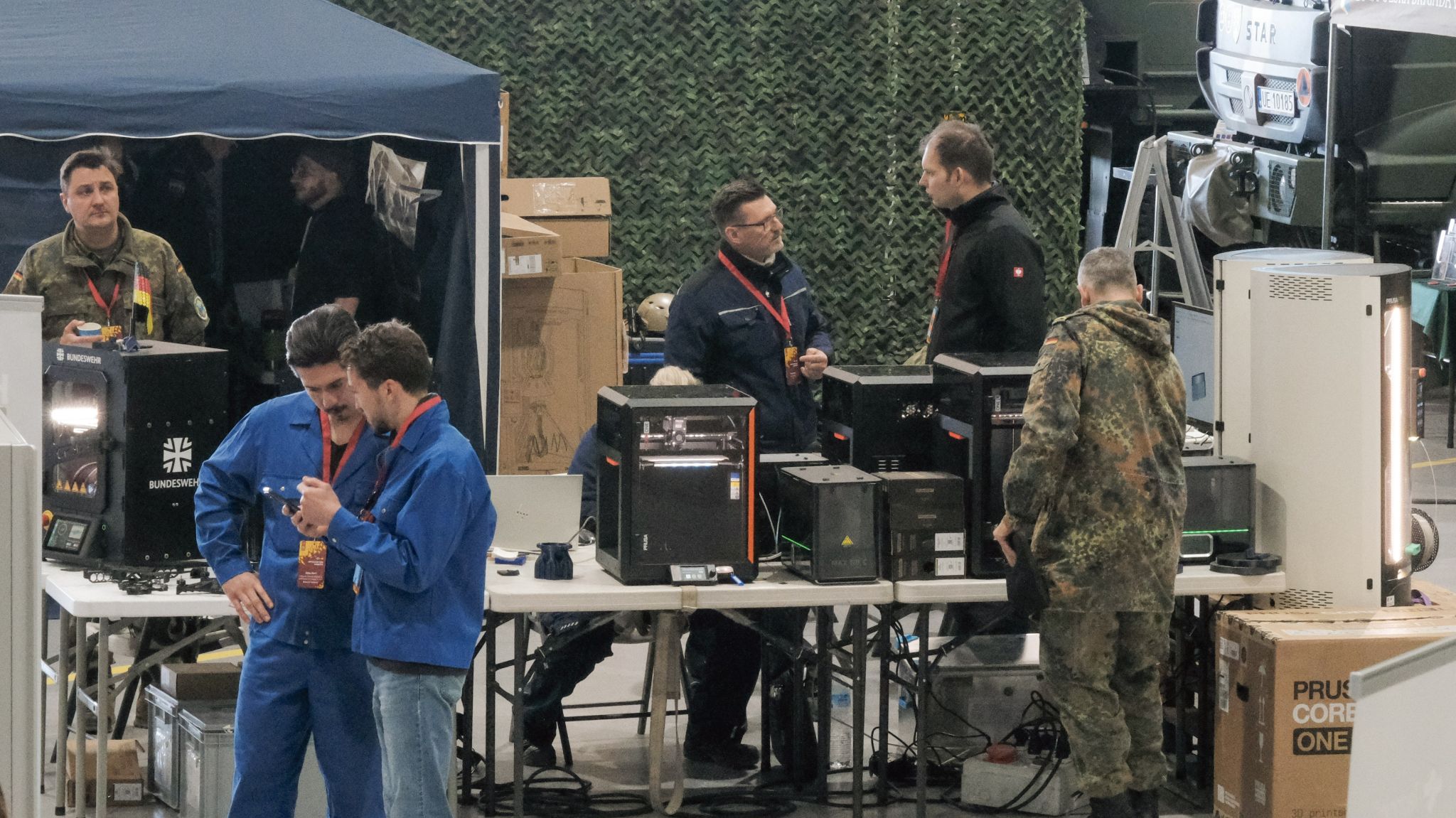
This is why initiatives like the Additive Manufacturing Village (AM Village) are critical.
Bringing together armed forces, industry, and research communities, these environments focus on something often overlooked: shared expertise.
Engineers and operators work side by side.
Ideas are tested in real conditions.
Knowledge is transferred, not assumed.
Over several days, hundreds of experts collaborate to move additive manufacturing beyond experimentation into practical application.
Because printing a part is easy.
Printing the right part—reliable, durable, and fit for purpose—is not.
This is where additive manufacturing evolves from a tool into a capability.
And that capability is transformative.
When production becomes decentralized, military units gain a new level of autonomy. They are no longer limited to what they carry or what can be delivered. They can adapt in real time.
Need a modification? Build it.
Need a replacement? Produce it.
Need a solution that doesn’t exist? Design it.
This changes how problems are approached.
It shifts the mindset from consumption to creation.
But it also introduces new responsibilities.
Quality control becomes critical.
Material management becomes essential.
Design validation becomes part of the operational workflow.
The line between user and engineer begins to blur.
And this may be the most significant shift of all.
Because the future of military capability is not just about having advanced equipment.
It is about having the ability to adapt that equipment instantly.
Additive manufacturing is not replacing traditional industry.
It is complementing it—extending its reach into places where it could never operate before.
The battlefield is no longer just a place of deployment.
It is becoming a place of production.
And in that environment, the advantage belongs not just to those who have the best tools—
But to those who can build what they need, exactly when they need it.