4NE1 from NEURA Robotics - Humanoid That Could Replace Half Your Workforce
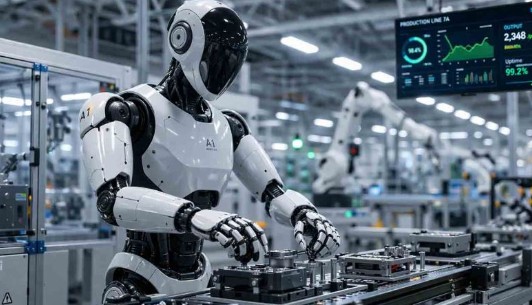
For years, humanoid robots lived in two worlds:
Science fiction—and demos.
Impressive videos. Smooth movements. Controlled environments.
But rarely real work.
That is changing—fast.
According to the latest industry analysis, humanoid robotics is entering a new phase: from experimental prototypes to industrial deployment. And systems like 4NE1 represent what this shift actually looks like when it hits the factory floor.
The numbers are hard to ignore.
Around 90 companies worldwide are now developing humanoid robots—up from just over 50 a year ago. The number of active robot models has nearly doubled. And for the first time, real commercial deployments are expected now—not in the distant future.
This is no longer a question of if.
It’s a question of where first.
And the answer is clear: industry.
Production lines. Logistics centers. Repetitive, structured environments where tasks are predictable, but labor is increasingly scarce. These are the first domains where humanoid robots begin to make economic sense.
Because the real breakthrough is not mobility.
Not AI.
Not even manipulation.
It’s cost.
The projected price point—around $55,000 per unit—changes the entire equation. At that level, humanoid robots are no longer experimental investments. They become financial tools.
Deployable. Scalable. Measurable.
And in many cases, they can pay for themselves in less than a year.
This is where the conversation shifts.
From technology → to economics.
From capability → to ROI.
4NE1 is not positioned as a futuristic assistant. It is positioned as a worker.
One that doesn’t get tired.
One that operates continuously.
One that performs repetitive tasks with consistent precision.
And that makes it valuable in places where humans struggle to remain efficient over time.
Logistics is a prime example.
Picking, sorting, moving, loading—tasks that are physically demanding but structurally simple. According to industry data, up to 96% of logistics activities are relevant for automation. In production, the number is slightly lower—but still massive.
Between 40% and 60% of manual tasks are considered automatable.
That is not optimization.
That is transformation.
But there are limits.
Today’s humanoid robots are not fully autonomous. They operate at mid-level autonomy, requiring structured environments and predefined workflows. Fine motor skills are still developing. Energy efficiency remains a challenge.
And in unstructured environments, performance drops significantly.
Which means the near future is not about replacing humans everywhere.
It’s about replacing them where it makes sense first.
Repetitive. Predictable. Physically demanding tasks.
The kind that companies struggle to staff—and workers often want to leave.
At the same time, new business models are accelerating adoption.
Robot-as-a-Service (RaaS) shifts the cost from capital expenditure to operational expense. Companies no longer need to invest heavily upfront. They can deploy robots as part of ongoing operations—just like software.
This lowers barriers.
And increases speed.
But perhaps the most important shift is psychological.
For years, humanoid robots were seen as future potential.
Now they are becoming current capability.
Not perfect.
Not universal.
But real.
And once a technology becomes real—even in limited form—it scales.
Fast.
4NE1 represents this moment.
Not the final version of humanoid robotics.
But the first version that makes economic sense.
And that is often the tipping point.
Because industries don’t adopt technology when it is perfect.
They adopt it when it is good enough—and profitable.
The question is no longer whether humanoid robots will enter industry.
They already are.
The real question is:
How fast will they spread once they do?