The $1,000 Drone vs. The Million-Dollar Missile: Inside Ukraine’s AI-Powered Hunt for Russia’s War Machine
The future of warfare does not always arrive wrapped in cutting-edge technology.
Sometimes it arrives with a wooden propeller.
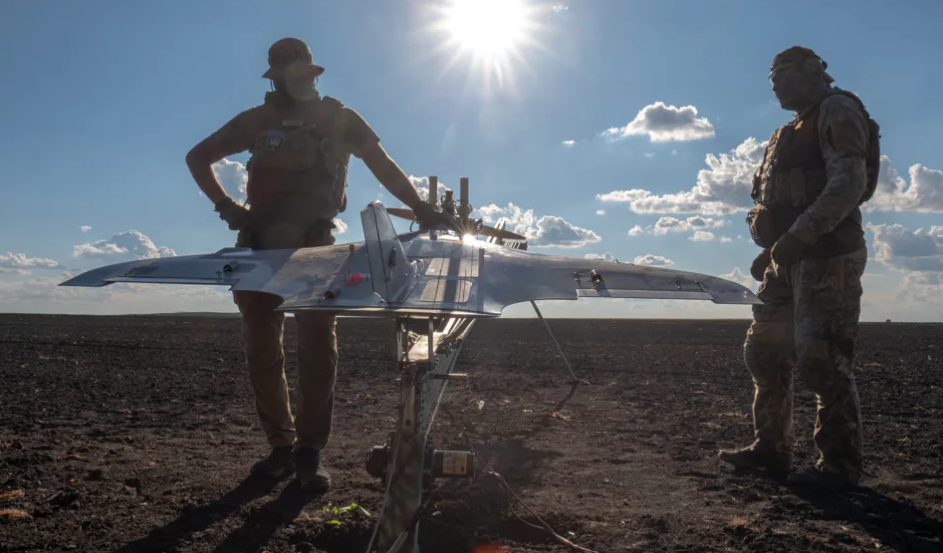
Hidden beneath a tree line somewhere in eastern Ukraine, a group of soldiers carefully prepares what looks more like a hobbyist aircraft than a weapon of war. The drone is triangular. Its propeller is made of wood. It launches from a catapult. The engine sounds like a lawn mower.
Yet within hours, this crude-looking machine will help destroy a Russian air-defense system worth millions of dollars.
Welcome to Ukraine's war of economics.
The Cheapest Weapon on the Battlefield
For decades, military superiority was measured through increasingly complex systems. Advanced fighter jets, precision missiles, radar networks, and armored vehicles represented the pinnacle of military power.
Ukraine has introduced a radically different equation.
Its domestically produced B2 strike drones are designed around one guiding principle: maximum destruction at minimum cost.
Each carries approximately 8 kilograms of explosives, travels up to 200 kilometers, and can cruise at roughly 120 km/h, accelerating to speeds approaching 180 km/h when necessary.
The technology itself is remarkably simple.
A wooden propeller.
A gasoline engine.
A launch catapult.
Commercial electronics.
The sophistication lies elsewhere.
It lies in the network.
How the "Birds of Magyar" Turn Drones into Strategic Weapons
Behind many of Ukraine's deep-strike missions stands one of the country's most famous drone formations: the Birds of Magyar.
Founded by former grain trader Robert Brovdi, known by his callsign "Magyar," the unit has evolved into a key force within Ukraine's expanding drone warfare ecosystem.
Their mission goes far beyond tactical battlefield strikes.
They target logistics.
Fuel.
Supply routes.
Radar networks.
Air-defense systems.
Anything that keeps Russia's military machine moving.
The objective is simple:
Make war too expensive to sustain.
The strategy has already produced noticeable results. Attacks against fuel infrastructure, logistics hubs, and transportation networks have forced Russia to adapt supply chains, reroute traffic, and increase security requirements across occupied territory.
In modern warfare, disruption often matters as much as destruction.
Uber Meets Warfare
Perhaps the most remarkable aspect of the operation is how digitalized it has become.
After launch, local operators guide the drone during its initial flight phase. Once stable, control can be handed over remotely through a networked command structure.
The pilot who ultimately flies the drone into its target may be hundreds of kilometers away.
Possibly sitting in Kyiv.
Possibly somewhere else entirely.
Operators compare the system to ride-sharing platforms.
Any authorized pilot connected to the network can monitor missions, take control of aircraft, and execute attacks when necessary.
Artificial intelligence continuously processes operational data, helping optimize fuel loads, flight profiles, payload selection, and target allocation.
The battlefield is increasingly cloud-based.
The launcher and the pilot may never meet.
The Million-Dollar Mistake
One mission observed near Mariupol perfectly illustrates the economics behind Ukraine's drone strategy.
As two B2 drones approached their target area, Russian forces detected them.
A Tor air-defense system, valued in the millions of dollars, responded by firing an interceptor missile.
The missile missed.
Then another missile launched.
It missed too.
The Russian system had just spent enormous resources trying to stop two comparatively inexpensive drones.
Moments later, one B2 accelerated and slammed directly into the launcher itself.
Impact.
Destruction.
Mission accomplished.
The second drone remained overhead, recording the strike and providing confirmation of the kill.
The attackers had won the exchange before impact even occurred.
Destroying Systems, Not Vehicles
According to commanders inside the unit, the real objective is not simply destroying individual targets.
It is forcing Russia to redesign its entire logistics architecture.
Convoys now travel differently.
Supplies move along alternate routes.
Traffic patterns shift.
Military planners must dedicate increasing resources to protection rather than offensive operations.
That adaptation is itself evidence of success.
When an adversary is forced to continuously redesign how it moves fuel, ammunition, equipment, and personnel, every operation becomes more expensive and less efficient.
In that sense, the drone campaign targets infrastructure, not just hardware.
The Human Factor Remains Decisive
Despite the growing role of software and AI, Ukrainian commanders remain skeptical of claims that machines will replace humans.
One brigade commander summarized it perfectly:
A drone is simply a modern arrow.
Technology may improve the arrow.
Artificial intelligence may help guide it.
But a human still decides where it flies.
The current war is often described as history's first artificial-intelligence conflict. Yet the soldiers launching B2 drones from muddy fields tell a different story.
They argue the war is not being won by algorithms.
It is being won by people who adapt faster than their enemy.
The Future of Warfare Is Already Here
Long after sunset, the launch teams continue working beneath the trees.
The operators know little about the pilots who will ultimately guide their drones to target.
The pilots know little about the crews who launched them.
They are connected by software, data, and a shared mission.
It is warfare reimagined.
A battlefield where inexpensive drones hunt million-dollar targets.
Where logistics become targets.
Where operators work in the cloud.
And where a wooden propeller can help change the course of a war.