Stop Counting Tanks: To Deter Russia, Europe Must Understand How Russia Fights
Europe knows a great deal about Russian weapons.
Analysts count tanks, track missile production, dissect drones, monitor artillery expenditure and estimate casualties. Satellite imagery reveals bases. Battlefield footage exposes tactics. Recovered electronics reveal supply chains.
And yet there is a dangerous possibility: we may know more and more about Russia’s weapons while still understanding too little about how Russia wages war.
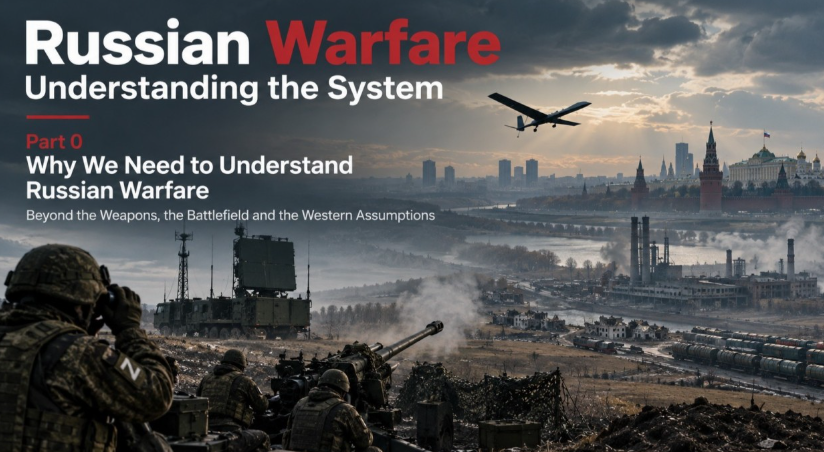
That is the central challenge raised by Eva Sula in Russian Warfare: Understanding the System, an ambitious analytical series examining Russian warfare not as a collection of weapons and battlefield techniques, but as an evolving political-military system.
It is an important distinction.
A missile is not a strategy
Knowing how many artillery pieces Russia possesses does not tell us how rapidly its forces can detect, identify and engage a target.
Counting drones reveals little about how effectively reconnaissance connects to commanders, electronic warfare, artillery or strike systems.
And calculating casualties does not automatically tell us when political leaders conclude that the price of continuing a war has become unacceptable.
Military power emerges from connections: sensors, communications, commanders, logistics, industry, manpower, weapons and political objectives.
Break enough connections and impressive equipment can become surprisingly ineffective.
Strengthen them and comparatively unsophisticated technology can become dangerous.
Russia's initial 2022 invasion of Ukraine demonstrated the first reality. Serious deficiencies in planning, logistics, coordination and assumptions about Ukrainian resistance undermined a force possessing formidable quantities of military hardware.
But stopping the analysis there would be another mistake.
Russian forces subsequently adapted aspects of their defensive operations, reconnaissance-strike processes, electronic warfare and unmanned systems.
Failure, in other words, did not mean paralysis.
Russia does not have to be brilliant to be dangerous
This may be the most uncomfortable lesson for European defence planners.
Russia does not need to execute warfare perfectly.
It needs to learn fast enough.
Debates about whether Russia is militarily competent or incompetent therefore risk asking the wrong question. A military institution can be dysfunctional in some areas while highly effective in others. It can repeat deep structural mistakes while simultaneously developing successful tactical adaptations.
Both realities can exist at once.
That means Western planners should resist two equally dangerous narratives: Russia as an unstoppable military machine and Russia as a fundamentally broken force destined to collapse under its own weaknesses.
Neither is a strategy.
The battlefield is bigger than the battlefield
Understanding Russian warfare also requires looking beyond visible combat.
Political pressure, information operations, cyber activity, sabotage, economic instruments, conventional military force and escalation signalling can operate within a wider confrontation.
That does not mean every Russian action is centrally orchestrated according to some flawless master plan.
Quite the opposite.
Institutions compete. Command structures malfunction. Intelligence is wrong. Plans fail.
The analytical challenge is determining what is deliberate, what is adaptation, what is institutional dysfunction and what actually produces results.
That distinction becomes vital for deterrence.
If Europe misunderstands what Moscow values, what costs it tolerates, how it measures success or how quickly its institutions adapt, Western governments risk building deterrence around assumptions their opponent does not share.
Ukraine is the laboratory, not the entire blueprint
Ukraine provides an extraordinary body of evidence about modern Russian warfare.
But another dangerous shortcut would be assuming that the next confrontation would simply reproduce Ukraine.
Different geography, NATO airpower, logistics, electronic environments, force structures and political objectives could produce different Russian behaviour.
The real question therefore is not simply:
“What is Russia doing in Ukraine?”
It is:
“Why has Russia chosen this method, what problem is it trying to solve, how successfully is the system working, and what happens when the conditions change?”
Those questions lead somewhere uncomfortable.
European deterrence cannot be built only on buying more equipment.
It requires industrial endurance, command resilience, intelligence, logistics, manpower, political cohesion and the ability to adapt faster than an adversary.
Because wars are rarely decided by the weapon with the most impressive specification sheet.
They are decided by systems capable of continuing to function when the original assumptions collapse.
And perhaps that is the most important warning for Europe:
Do not prepare merely to defeat the Russian military you see today. Prepare to confront the one that survives its mistakes tomorrow.