Saab's A3-001. The Fighter Jet Is Evolving Into Something Else
For more than a century, military aviation has revolved around a single idea:
Put a pilot in the cockpit.
No matter how advanced the aircraft became, no matter how sophisticated the sensors, missiles, or radar systems, the human remained at the center of aerial combat.
That assumption is now being challenged.
Not by science fiction.
Not by distant future concepts.
But by the strategic direction of some of the world's most experienced aerospace companies.
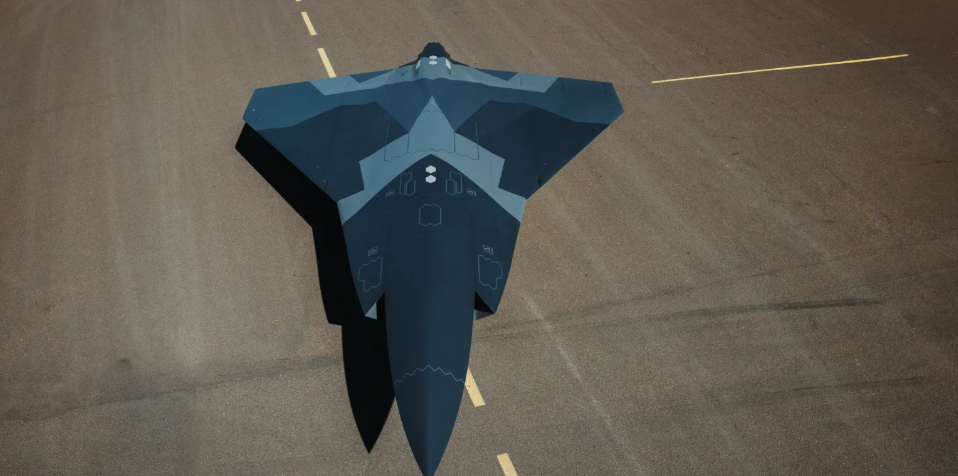
This week, Saab unveiled the full-scale concept model of its A3-001 unmanned combat aircraft at the Swedish Armed Forces Air Show in Linköping.
At first glance, it appears to be another stealth-inspired military drone.
Look closer, however, and a much bigger story emerges.
The A3-001 is not designed to replace a fighter jet.
It is designed to replace the idea that every mission needs a fighter pilot.
That distinction could define the future of air warfare.
The concept was presented as part of Saab's vision for next-generation combat aviation, where manned and unmanned platforms operate as an integrated system.
In Saab's view, future conflicts will not be fought by individual aircraft.
They will be fought by networks.
Piloted fighters.
Autonomous aircraft.
Space-based assets.
Ground-based sensors.
Electronic warfare platforms.
All connected.
All sharing information.
All contributing to a common operational picture.
The aircraft itself is intended for some of the most dangerous missions imaginable.
Electronic warfare.
Suppression of enemy air defenses.
Precision strikes deep inside heavily contested airspace.
In short, the missions where losing an aircraft is possible and losing a pilot would be catastrophic.
Historically, every military planner faced a difficult trade-off.
The closer an aircraft moved toward heavily defended targets, the greater the risk to its crew.
The solution was often better protection, better tactics, or greater stand-off range.
Autonomous combat systems introduce a different answer:
Remove the pilot from the aircraft entirely.
That changes everything.
An unmanned combat aircraft can accept levels of risk that would be politically, strategically, and ethically difficult with a human onboard.
It can fly deeper.
Stay longer.
Take greater chances.
And potentially operate in larger numbers.
This is why so many countries are investing heavily in autonomous air combat systems.
The United States is developing Collaborative Combat Aircraft.
Europe is accelerating work on next-generation combat systems.
Russia and China continue pursuing advanced unmanned platforms.
And now Saab is offering a glimpse into Sweden's vision.
What's particularly interesting is the timeline.
According to Saab, the company intends to test unmanned demonstration aircraft with fighter-like characteristics before 2030.
That means the discussion is no longer theoretical.
The transition has already started.
What follows is perhaps even more significant.
Saab is not marketing A3-001 as a standalone replacement for Gripen.
Instead, it positions the platform as a complement.
That reflects a growing consensus among air forces worldwide.
The future may not belong exclusively to manned aircraft or autonomous aircraft.
It may belong to teams composed of both.
A pilot inside a next-generation fighter could eventually command multiple unmanned aircraft simultaneously.
Some carrying electronic warfare payloads.
Some carrying sensors.
Others carrying weapons.
One pilot.
Multiple aircraft.
A force multiplier measured not in manpower but autonomy.
The implications extend beyond military tactics.
They reach into economics.
Training fighter pilots requires years and enormous financial investment.
Autonomous systems offer the possibility of generating additional combat mass without generating additional pilots.
That could become critical as militaries struggle with recruitment challenges and increasingly complex operational requirements.
Of course, major questions remain.
Artificial intelligence, communications resilience, electronic warfare vulnerability, human oversight, and rules of engagement will all shape how quickly such systems become operational.
The technology may advance rapidly.
Trust tends to move more slowly.
But the direction is unmistakable.
The unveiling of A3-001 is not important because it introduces a new aircraft.
It is important because it illustrates a new philosophy.
For decades, unmanned systems were viewed as support assets.
Today they are becoming combat assets.
Tomorrow they may become the defining assets of air power.
The fighter jet is not disappearing.
Just as tanks did not disappear when drones arrived.
Just as warships did not disappear when missiles emerged.
Instead, it is evolving into something more connected, more autonomous, and more distributed.
The aircraft standing on display in Linköping is therefore more than a concept model.
It is a glimpse of what air power could look like in the 2030s.
And perhaps a reminder that the future of air combat may no longer revolve around the cockpit.
It may revolve around everything operating outside it.