Russian GERAN Drone Family: The Drone Race Is Over. The Learning Race Has Begun.
For years, military analysts debated drones as if they were a category of equipment.
Today, that debate is becoming obsolete.
The real story is not drones.
The real story is speed.
Not simply the speed of the aircraft itself, but the speed at which entire military and industrial ecosystems can observe, adapt, produce, and scale new capabilities.
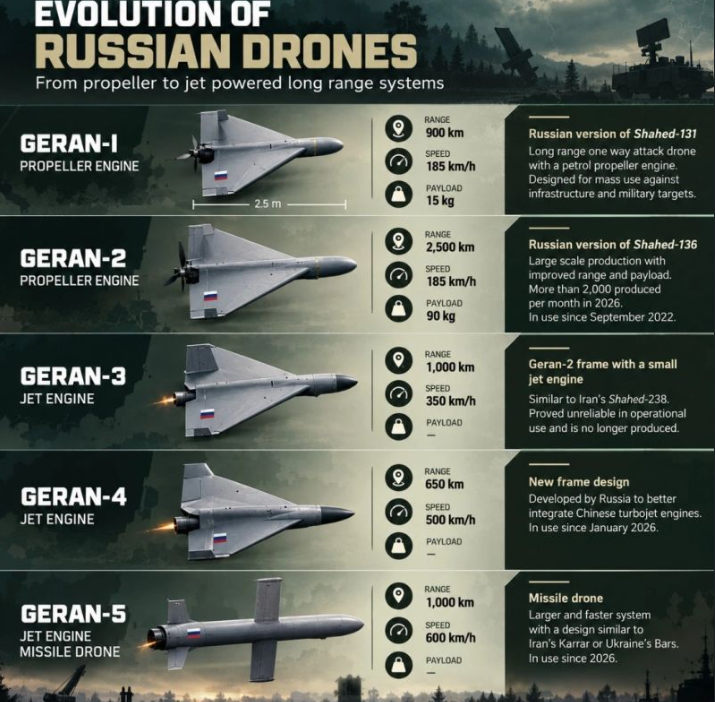
The evolution currently visible in long-range one-way attack UAVs illustrates the shift perfectly. What began as relatively slow, propeller-driven systems is increasingly moving toward faster, jet-powered variants capable of compressing defensive reaction times and creating entirely new operational challenges.
The implications extend far beyond propulsion technology.
They signal the emergence of a new military competition.
A competition where adaptation cycles may matter more than individual platforms.
The First Revolution Was Cost
The first generation of large-scale drone warfare created a simple but powerful dilemma for defenders.
The platforms were not technologically revolutionary.
In many cases they were relatively simple, inexpensive, and built around widely available technologies.
Their effectiveness emerged from a different source.
Scale.
A single drone might be intercepted.
Hundreds could force difficult decisions.
Every launch compelled defenders to detect, track, identify, allocate resources, and potentially expend expensive interceptors.
The pressure was not generated by sophistication.
It was generated by repetition.
Air defenses suddenly found themselves confronting a threat capable of continuously consuming attention, resources, and ammunition.
Military planners began discovering that affordability could become a weapon in itself.
The Second Revolution Is Speed
Now the equation is changing.
Speed transforms the problem.
A faster attack system reduces the time available for detection, identification, engagement, and interception.
The operational window for defenders shrinks.
Sensors must react faster.
Command chains must move faster.
Interceptors must perform better.
Decision-making becomes compressed.
And as speed increases, some of the low-cost countermeasures that proved effective against slower systems may struggle to remain effective.
The challenge is no longer simply finding a drone.
The challenge becomes defeating it before it reaches its objective.
At scale.
Repeatedly.
And sustainably.
That last word may be the most important.
The Air Defense Dilemma
Every military technology eventually creates a financial question.
Jet-powered attack drones are beginning to force one.
If inexpensive counter-drone solutions become less effective against increasingly fast threats, defenders may be pushed toward more capable systems.
More capable systems generally mean more expensive systems.
That creates an uncomfortable asymmetry.
An attacker can manufacture large quantities of relatively low-cost strike platforms.
A defender may be forced to respond with significantly more expensive interceptors.
The result is not merely a tactical challenge.
It becomes an industrial challenge.
A nation can possess excellent air defense capabilities and still discover that maintaining them over time becomes increasingly difficult if every engagement consumes disproportionate resources.
Future air defense success may therefore depend not only on interception performance but also on cost sustainability.
The Real Story Is Adaptation
The most important lesson emerging from Ukraine is not that drones are transforming warfare.
Military history is full of technologies that temporarily appeared decisive.
The important lesson is the speed at which technologies are now evolving.
A capability appears.
A countermeasure follows.
The capability adapts.
A new countermeasure emerges.
The cycle repeats.
And each cycle appears to be becoming shorter.
This dynamic creates a battlefield where advantages are temporary and innovation becomes continuous.
Technology no longer moves through decades-long generations.
It evolves through months, weeks, and sometimes days.
The side that learns fastest gains the initiative.
The side that learns slowly eventually reacts to someone else's decisions.
From Drone Race to Learning Race
Many observers still describe the current competition as a race between drones and air defense.
That interpretation is incomplete.
The real competition is between learning systems.
One side develops a capability.
The other develops a response.
The first adapts again.
The second adapts in return.
Military effectiveness increasingly depends on who can complete these cycles fastest.
The winners may not be those with the most advanced individual platforms.
They may be those with the strongest connection between battlefield observation, engineering innovation, industrial production, and operational deployment.
In other words, success may belong to the actors capable of turning information into capability faster than their opponents.
The future battlefield will not belong exclusively to the fastest drone.
It will belong to the fastest learning ecosystem.
And that is a much more difficult race to win.