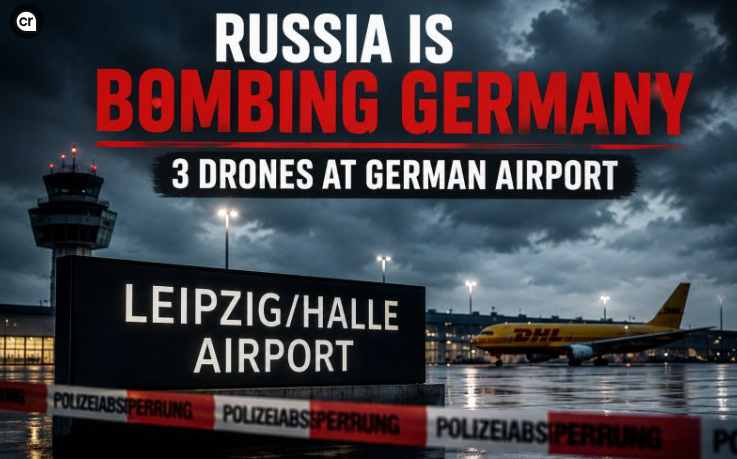
Russia is Bombing Germany. Three drones in Leipzig Airport.
Europe has a dangerous habit.
It treats strategic attacks as isolated events.
A cyberattack here.
A GPS disruption there.
A sabotage operation somewhere else.
Each incident is investigated separately, debated separately, and ultimately forgotten separately.
But what if they are not separate at all?
What if they are pieces of the same campaign?
That question is becoming increasingly difficult to ignore after a third drone carrying suspected explosives was reportedly discovered near Leipzig/Halle Airport, one of Europe's most important logistics hubs.
According to German media reports, the latest drone was found west of the airport alongside approximately 50 grams of a substance believed to be the military explosive RDX, also known as hexogen.
The discovery follows an earlier incident on August 4, when an explosives-laden drone was found near a Ukrainian Antonov cargo aircraft at Leipzig/Halle Airport. Reports also indicate investigators were searching for multiple drones associated with the operation.
German authorities have publicly described previous findings as part of a potential "hybrid attack scenario."
That term deserves attention.
Because "hybrid warfare" sounds abstract.
The consequences are not.
Leipzig/Halle is not just another airport.
It is one of Europe's key cargo hubs and an important logistics node connected to support activities involving Ukraine. Disruptions there affect more than commercial traffic. They affect supply chains, transportation networks, and strategic infrastructure.
And infrastructure is increasingly becoming the battlefield.
Modern conflicts are no longer defined solely by tanks crossing borders or missiles striking cities.
They increasingly unfold in the space between war and peace.
The target is not necessarily military forces.
The target is confidence.
Confidence that airports will function.
Confidence that logistics networks will operate.
Confidence that critical infrastructure remains secure.
The objective is often less about destruction and more about uncertainty.
Every suspicious drone sighting.
Every cyber intrusion.
Every sabotage attempt.
Every unexplained disruption.
Each creates friction.
Each forces governments to spend resources.
Each tests political resolve.
Most importantly, each pushes defenders into a familiar dilemma: how do you respond when attribution remains uncertain?
That is precisely why hybrid operations can be so effective.
The ambiguity is not a bug.
It is the strategy.
If responsibility is obvious, governments face pressure to respond decisively.
If responsibility remains just uncertain enough, debate replaces action.
Hours become days.
Days become months.
And the attackers gain room to operate.
To be clear, investigations regarding the Leipzig incidents remain ongoing, and definitive conclusions should be based on evidence established by authorities, not assumptions.
But an equally serious mistake would be ignoring the broader context.
Over recent years, European countries have reported a growing range of hostile activities, including cyberattacks, espionage operations, sabotage attempts, disinformation campaigns, and disruptions affecting critical infrastructure.
Viewed individually, many incidents appear manageable.
Viewed collectively, they reveal a pattern that should concern policymakers.
The challenge for Europe is that its security institutions were largely built to address traditional military threats.
Hybrid threats exploit the spaces between those institutions.
An airport incident may involve aviation authorities, police services, intelligence agencies, military organizations, and cybersecurity teams simultaneously.
No single institution owns the problem.
Yet the adversary benefits from treating it as one integrated campaign.
That is why incidents like Leipzig matter.
Not because one drone can defeat Germany.
Not because one airport closure changes the course of a war.
But because repeated incidents normalize a level of risk that would have been considered unacceptable only a few years ago.
The real danger is not the drone itself.
The real danger is gradual adaptation.
A society that becomes accustomed to sabotage.
A government that becomes accustomed to disruption.
A public that begins to view attacks on infrastructure as routine.
By the time a pattern becomes undeniable, the strategic environment may already have changed.
Europe therefore faces a choice.
Continue treating each incident as a standalone event.
Or recognize that modern conflict often arrives not as a single dramatic attack, but as a sequence of seemingly disconnected actions designed to test resilience, exploit ambiguity, and avoid meaningful consequences.
The drones discovered near Leipzig may ultimately prove to be one incident among many.
Or they may be remembered as a warning.
History often depends on whether warnings are recognized before they become realities.