“Russia Has Been Fine on Ukraine.” Fine? Then What Does War Look Like?
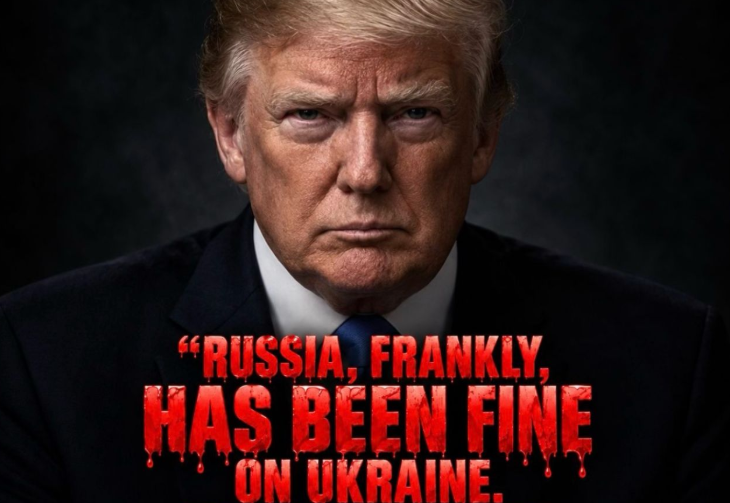
“Russia, frankly, has been fine on Ukraine. They haven’t been doing much.”
Those words came from U.S. President Donald Trump on October 19, 2026.
Read them again.
Not because the sentence is complicated, but because the reality behind it is.
Trump made the remark while speaking to reporters outside the White House. Multiple publications reported the same quotation.
But October 19 was not a quiet day in Ukraine.
According to the Kyiv Independent, a Russian daytime drone attack on a public park killed six people, including two children, that same day. The outlet also reported that during the preceding night Russia attacked Kyiv with more than a dozen ballistic missiles and targeted nearly 30 critical energy facilities across Ukraine.
And then came the words:
“They haven't been doing much.”
This is what makes the remark bigger than another controversial Trump soundbite.
Words spoken by an American president have strategic weight. They influence how allies understand Washington, how adversaries calculate American resolve and how the public interprets a war increasingly fought not only with missiles and drones, but with narratives.
Trump's comments also came during a broader attack on Ukrainian President Volodymyr Zelensky.
Trump told reporters that Zelensky should have settled the war earlier and argued that it was “time for somebody else to negotiate on behalf of Ukraine.” He also complained about the imbalance he sees in the U.S.-Ukrainian relationship, saying: “We've given a lot to Ukraine. They've given nothing to us.”
That is a remarkable reframing of the conflict.
Instead of concentrating pressure exclusively on Moscow as the country conducting the invasion, Trump's rhetoric increasingly places responsibility for ending the war on Kyiv and its leadership.
Perhaps this is negotiating strategy. Perhaps it is an attempt to force Ukrainian concessions. Perhaps Trump believes political pressure on Kyiv offers the quickest route toward a settlement.
But whatever the strategy, there is a difference between negotiating with Russia and normalizing what Russia is doing.
Peace requires diplomacy. Diplomacy does not require pretending the battlefield has disappeared.
That distinction matters because an American president's description of the war inevitably sends signals far beyond Ukraine.
Moscow hears it.
Kyiv hears it.
Europe hears it.
So do every country's leaders who are asking themselves a much larger question: What happens when military force collides with borders, alliances and international guarantees?
A peace agreement may eventually require painful compromises. Almost every major war ultimately ends around a negotiating table.
But negotiations begin with reality.
And reality cannot simply be edited because acknowledging it makes diplomacy inconvenient.
There is also something deeply revealing about the word“fine.”
Diplomatically, it sounds casual.
Strategically, it is anything but.
If continued Russian attacks can coexist with the description that Russia has been “fine,” then the debate is no longer simply about how to end the Ukraine war.
It becomes a debate about what behavior the world's most powerful countries are prepared to normalize in order to obtain a deal.
That question extends far beyond Kyiv.
Because agreements eventually expire. Governments change. Leaders leave office.
Precedents remain.
Ukraine needs peace. Ukrainians have paid an enormous price for this war.
But sustainable peace cannot be built by confusing exhaustion with resolution, or diplomatic convenience with reality.
So the uncomfortable question after Trump's extraordinary sentence is not whether Russia has actually been “fine.”
The evidence of continuing attacks makes that framing intensely controversial.
The real question is much bigger:
If this qualifies as “fine,” what exactly would Russia have to do before the answer finally becomes: enough?