Robots Against Mines. Rheinmetall’s Komodo Signals the End of Human Breaching
Landmines have always been one of warfare’s most brutal equalizers—cheap to deploy, devastatingly effective, and painfully slow to clear. For decades, breaching minefields has meant sending soldiers into one of the most dangerous missions imaginable: exposing themselves to hidden explosives in order to create a path for others.
Rheinmetall’s new MV‑8 Komodo Uncrewed Breaching System suggests that era may finally be coming to an end.
Set to be showcased at Eurosatory in Paris, the Komodo is not just another engineering vehicle. It represents a shift in how armies approach one of the oldest and most dangerous problems in warfare: clearing the way forward. And it does so with a simple but powerful proposition—remove the human from the minefield.
Developed as a collaboration between Rheinmetall, Croatian UGV specialist DOK‑ING, and Pearson Engineering, the Komodo combines heavy engineering capability with unmanned autonomy. This is not a prototype vision. It is a system built on proven technologies and designed specifically for modern, high-threat environments.
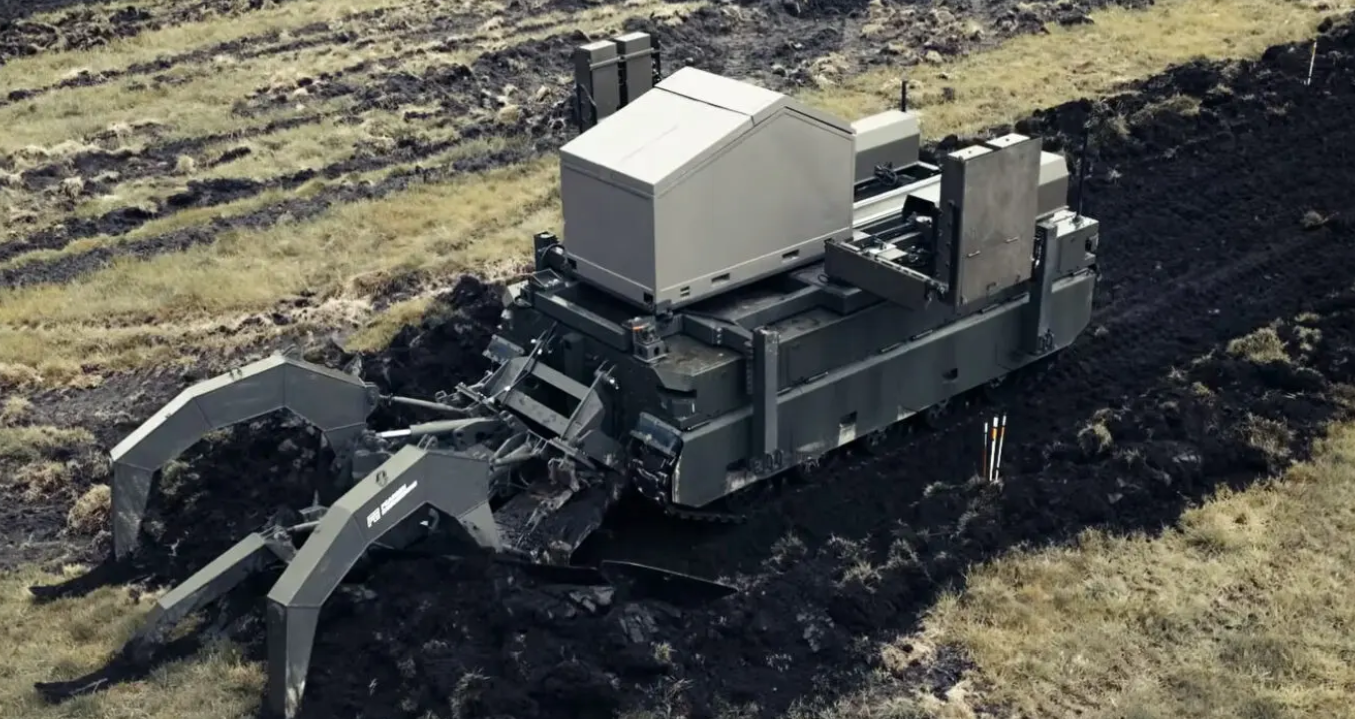
Weighing up to 17 tons, the MV‑8 Komodo is a compact but formidable platform. Its strength lies not in speed or stealth, but in purpose-built brutality against hidden threats. Equipped with a four-meter-wide mine plough from Pearson Engineering, it physically lifts buried mines out of the ground and pushes them to the side, clearing a navigable lane in real time.
What makes this particularly effective is not just the clearing process—but what comes next.
As the Komodo advances, it simultaneously marks the cleared path with an integrated lane-marking system, ensuring that following units can advance safely—even in low visibility, at night, or under combat pressure. In modern combat, where operational tempo and coordination are critical, that visibility can be the difference between breakthrough and disaster.
But the Komodo doesn’t stop at mechanical clearance.
It is also equipped with the Plofadder rocket-propelled line charge system, developed by Rheinmetall Denel Munition in South Africa. This system can rapidly create a cleared corridor—up to 160 meters long and nine meters wide—in just minutes. In practical terms, this allows forces to overcome heavily mined barriers quickly, opening routes where traditional methods would take significantly longer.
The combination of mechanical and explosive breaching gives the Komodo flexibility—adapting to different terrains, mine types, and tactical scenarios. It is not just a machine; it is a toolkit.
And crucially, it is a remote system.
This is where the real transformation lies. By enabling mine clearance without direct human presence, the Komodo significantly reduces risk to personnel. In an era where force protection is as important as firepower, that advantage is impossible to ignore.
But the implications go beyond safety.
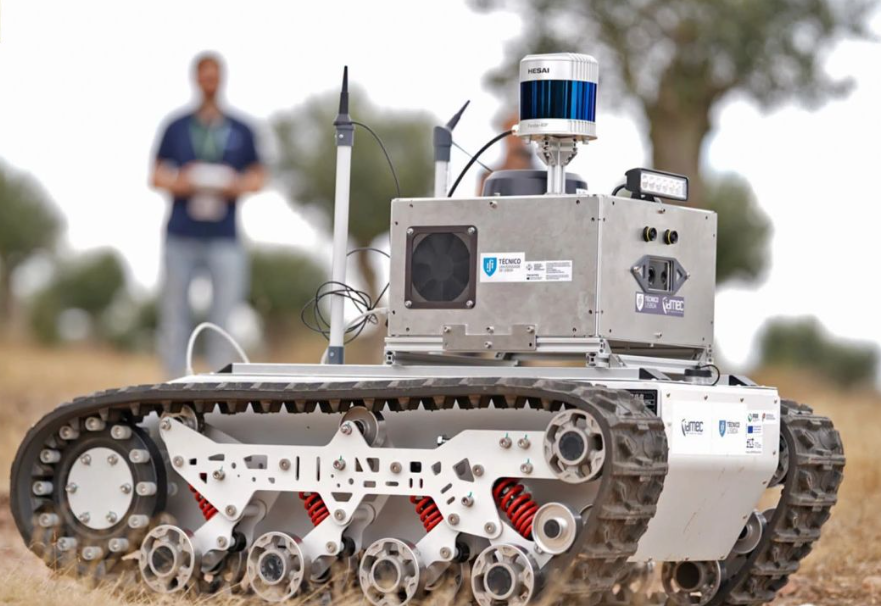
Uncrewed breaching systems like the Komodo are part of a broader trend in military technology: the automation of the most dangerous tasks. From logistics to reconnaissance to combat support, roles that once required human exposure are increasingly being handed over to machines.
The battlefield is becoming a place where humans direct—and robots endure.
Yet, this shift also raises questions. How reliable are these systems under real combat stress? Can they maintain performance in complex environments, where terrain, weather, and enemy actions introduce constant uncertainty? And how will doctrine evolve to fully integrate unmanned breaching into combined arms operations?
Rheinmetall’s answer, at least in part, is integration. By combining proven components—DOK‑ING’s unmanned platforms, Pearson’s engineering systems, and Rheinmetall’s own technologies—the Komodo is designed to minimize risk not just on the battlefield, but in deployment.
Still, the strategic message is clear.
Minefields are not going away. If anything, they are becoming more prevalent in modern conflicts. But the way they are dealt with is changing—and rapidly.
The MV‑8 Komodo is not glamorous. It doesn’t capture headlines like fighter jets or AI-driven drones. But it addresses a fundamental reality of warfare: before anything moves forward, someone—or something—has to clear the path.
Increasingly, that “someone” will not be human.
And that may be one of the most important technological shifts happening in defense today.