Portugal's Experiment May Reveal the Future of European Warfare
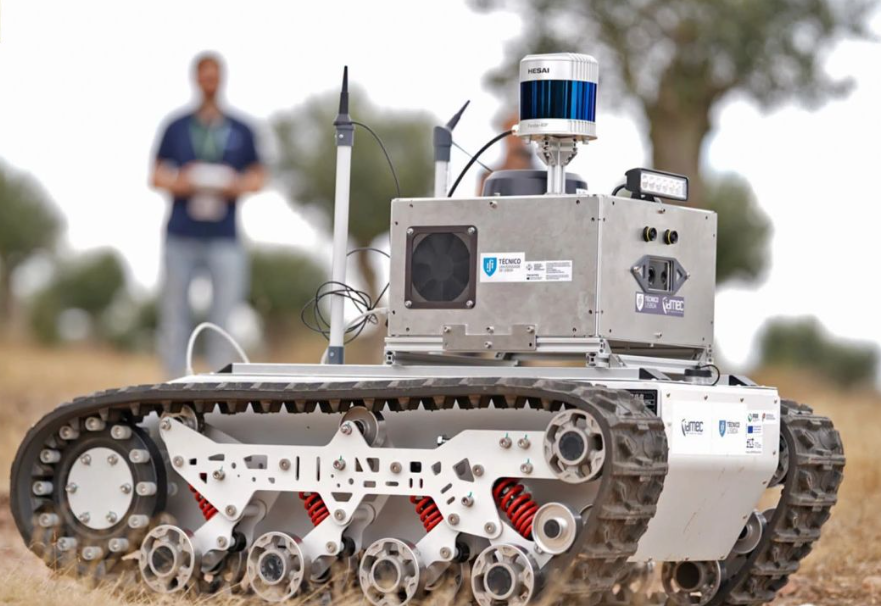
For decades, military procurement followed a familiar pattern.
A new vehicle appeared.
A new sensor was evaluated.
A new drone was tested.
A weapon's performance was measured.
Then decisions were made.
The underlying question was always the same:
"How good is this system?"
At Portugal's ARTEX26 and the European Defence Agency's HEDI OPEX26, a different question is being asked.
"How good are these systems when they work together?"
That distinction may sound subtle.
It is not.
It may represent one of the most important transformations currently taking place in European defense.
Because modern warfare is increasingly revealing a difficult truth:
The future battlefield will not be dominated by the best drone, the best sensor, or the best vehicle.
It will be dominated by the best network.
The Platform Era Is Ending
Military organizations have historically been structured around platforms.
Tanks formed armored forces.
Helicopters formed aviation units.
Artillery operated independently.
Reconnaissance systems gathered information.
Each system fulfilled a specific role.
The challenge today is that modern warfare increasingly ignores those boundaries.
Drones operate as sensors.
Sensors become shooters.
Artificial intelligence becomes an operator.
Communications networks become combat multipliers.
Autonomous systems move information faster than traditional command structures can process it.
A vehicle's value no longer depends only on what it can do.
Its value increasingly depends on what it can enable others to do.
This is why exercises like ARTEX26 matter.
They are not simply evaluating technologies.
They are evaluating relationships.
The Rise of Military Ecosystems
The war in Ukraine has accelerated a transformation military planners had long anticipated.
The decisive capability is increasingly not the individual platform.
It is the ecosystem surrounding it.
A drone without communication is limited.
A sensor without a network is isolated.
An autonomous vehicle without data is blind.
An AI algorithm without integration is merely software.
The military advantage emerges when these elements operate together.
This is exactly what Portuguese forces and the European Defence Agency appear to be exploring.
How can soldiers, autonomous systems, communications architecture, sensors, and command systems function as a single operational entity?
That question may become more important than any individual hardware specification.
Learning Before Buying
One of the most interesting aspects of ARTEX26 is its focus on experimentation rather than procurement.
This reflects a broader shift across defense organizations.
Historically, military acquisition often occurred before extensive operational integration testing.
Today, the sequence is reversing.
Experiment first.
Learn first.
Integrate first.
Procure later.
This may sound obvious.
Yet it represents a profound change in military culture.
The pace of technological change has become too fast for traditional procurement cycles.
A capability that appears promising in isolation may provide limited operational value once exposed to the reality of a connected battlefield.
The objective is no longer identifying the best product.
It is identifying the most effective combination.
Europe's Real Challenge
Europe's defense problem has never been a lack of technology.
Europe produces advanced sensors.
Advanced communications.
Advanced software.
Advanced platforms.
The challenge has often been integration.
Multiple nations.
Multiple standards.
Multiple industries.
Multiple procurement systems.
Multiple operational concepts.
Modern warfare punishes fragmentation.
An adversary does not care whether a failure originates in a communication system, a software architecture, or a procedural gap.
A disconnected system remains ineffective regardless of how advanced its individual components may be.
ARTEX26 therefore addresses a question far larger than Portugal.
Can Europe connect its technological strengths into operational advantages?
The Age of the Combat Network
The most important battlefield innovation of the next decade may not be a drone.
Or a robot.
Or an AI system.
It may be the network that connects them all.
Future military units may increasingly resemble digital ecosystems rather than traditional formations.
Soldiers equipped with real-time information.
Autonomous systems gathering intelligence.
Sensors providing continuous awareness.
Artificial intelligence assisting decision-making.
Communications architectures connecting everything into a common operational picture.
The battlefield becomes less about individual assets and more about collective intelligence.
The Real Experiment
What is happening at Santa Margarida is therefore more significant than a technology demonstration.
It is an experiment in military evolution.
The objective is not simply understanding what individual technologies can do.
The objective is understanding how capability emerges from interaction.
Because future warfare will likely reward those who integrate fastest.
Those who connect sensors to shooters most effectively.
Those who shorten the distance between information and action.
Those who transform separate technologies into a coherent system.
The lesson from ARTEX26 may ultimately be simple:
The future battlefield will not belong to the strongest platform.
It will belong to the strongest network.
And the countries that learn this first may gain an advantage no single weapon system can provide.