20 Ukrainian Companies Are Racing to Build Jet Drone Killers — Firebolt’s Griffen Has Already Drawn Blood
Russia is making its attack drones faster.
Ukraine's answer is simple: make the drones hunting them faster too.
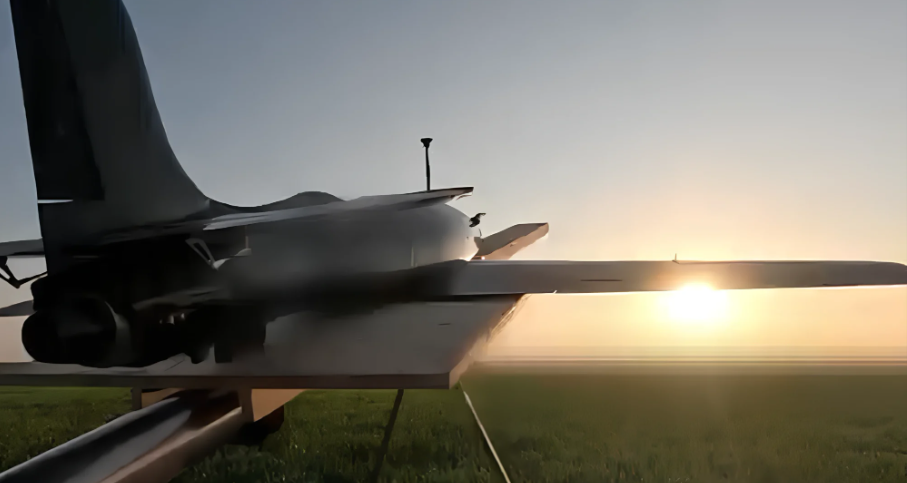
Around 20 Ukrainian companies are now working on jet-powered interceptor drones, according to Ukraine's Brave1 defense-tech cluster. Among the most interesting is Ukrainian-British startup Firebolt Engineering, whose Griffen interceptor has already recorded its first successful interception of a Shahed-type drone.
What is emerging is effectively a new class of air-defense weapon: small, relatively inexpensive jet-powered aircraft designed to hunt other unmanned aircraft.
And Ukraine is turning it into an industry.
Meet Griffen
Firebolt Engineering's Griffen is a fixed-wing jet interceptor capable of exceeding 350 km/h, climbing above 7.5 kilometers and flying up to 120 kilometers.
The company wants to push its speed beyond 400 km/h through further aerodynamic improvements.
That performance is becoming increasingly important as Russia introduces faster unmanned threats.
New jet-powered variants of the Geran/Shahed family can reportedly reach maximum speeds of around 500–600 km/h. Conventional propeller-driven interceptors can struggle to catch targets moving that fast.
Hence the jet engine.
Griffen currently uses Chinese engines, but Firebolt is already working to eliminate that dependency. British company Dynamic Propulsion is developing a dedicated turbojet engine for the interceptor, with test units expected to be supplied to the Ukrainian team.
The rest of Griffen's components come primarily from Ukraine and Europe.
From Odesa to a Ukrainian-British Defense Startup
Firebolt itself grew from Technary, an Odesa-based design bureau known for military training simulators and the ePPO application used for reporting aerial threats.
The team initially experimented with a multicopter interceptor before moving to a fixed-wing configuration for better energy efficiency.
Then came British capital.
Through the Defence Builder accelerator, the developers connected with British investment platform Grenadyr. Following the investment, Firebolt Engineering was established as a separate Ukrainian-British company.
The exact investment has not been disclosed, although Grenadyr's typical investments reportedly range between $350,000 and $1.3 million.
Firebolt now employs up to 25 people and has production, assembly, calibration and R&D capabilities.
Current production capacity is approximately 30 Griffens per month.
The Economics Could Be as Important as the Speed
One Griffen reportedly costs approximately UAH 370,000–470,000.
That isn't cheap for a drone.
But comparing it with another drone misses the point.
The relevant comparison is increasingly an air-defense missile.
If relatively inexpensive unmanned interceptors can destroy attack drones that would otherwise require scarce surface-to-air missiles, the economics of air defense change dramatically.
Ukraine can reserve expensive interceptors for the threats that actually require them while deploying cheaper systems against mass drone attacks.
This is particularly important in a war where Russia can send large numbers of unmanned aircraft during a single attack.
The Next Griffen May Hunt by Itself
Firebolt's ambition goes beyond speed.
The company is developing terminal guidance intended to move Griffen toward autonomous interception: the operator launches the aircraft, while the interceptor ultimately identifies and engages its target.
But autonomy exposes another weakness in Ukraine's emerging drone-defense architecture: radar coverage.
Firebolt's CEO says Ukraine's radar field remains insufficiently dense and fragmented. Even an autonomous interceptor needs accurate information telling it where to look.
That means the next revolution in drone interception may not come from the drone itself.
It may come from connecting thousands of sensors, radars and interceptors into one network.
Ukraine's New Arms Race
Firebolt isn't alone.
Ukraine's jet-interceptor field already includes systems such as Chaklun Jet, reportedly capable of around 320 km/h, and Degree-Trans' Bullet, reported at speeds up to 450 km/h.
Around 20 companies are pursuing the technology at different stages of development.
That number may be the most important detail in the entire story.
Ukraine isn't betting on one wunderwaffe.
It is creating competition.
Twenty engineering teams are attacking the same battlefield problem, testing different airframes, engines, guidance systems and production methods against an enemy that is simultaneously modifying its own drones.
The result is an extraordinarily compressed innovation cycle.
Russia builds faster Shaheds.
Ukraine builds faster hunters.
And somewhere between them, an entirely new layer of air defense is being invented in real time.