Petraeus: $55 Billion Drone Investment, But No Strategy to Fight With Them
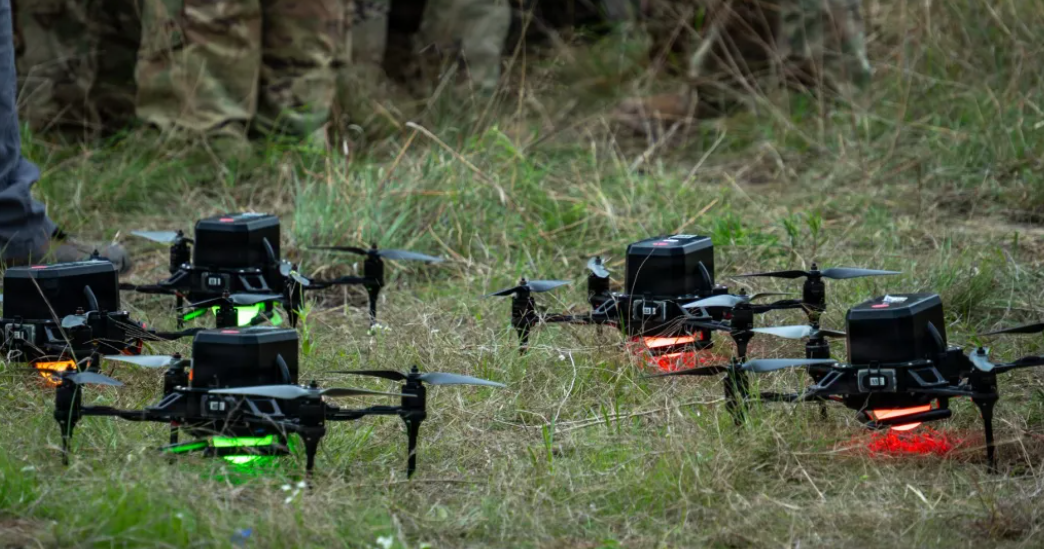
The Pentagon is about to spend $55 billion on drones.
That should sound like a turning point in the history of warfare.
Instead, according to General David Petraeus, it might become something else entirely:
a very expensive mistake.
In an opinion piece for The Hill, Petraeus and Isaac C. Flanagan delivered a blunt warning: the United States risks repeating one of its most costly military misconceptions—believing that technology alone creates capability.
It doesn’t.
The Illusion of Buying Power
The FY2027 budget proposal includes a staggering $54.6 billion allocation to autonomous warfare, representing roughly a 24,000% increase in spending in a single year.
It is, by any measure, historic.
But scale is not strategy.
Petraeus and Flanagan argue that while the investment is necessary—and even overdue—the Pentagon is focusing too heavily on hardware while neglecting the far more difficult challenge: how to use it.
Because in modern warfare, systems don’t win wars.
Institutions do.
The Doctrine Gap
At the core of their argument is what they call a doctrine gap—a disconnect between what the military is buying and its ability to deploy it effectively.
Today:
- There is no unified doctrine for commanding autonomous drone formations at scale.
- Less than 2% of funding is directed toward doctrine and integration.
- Training pipelines are not yet producing leaders who can translate human intent into machine-executable orders.
In other words, the United States is building the tools for a new kind of warfare—without fully understanding how to fight it.
A Lesson Already Paid For
This is not theoretical.
The U.S. military has already made this mistake once—with drones.
In the early years of Afghanistan and Iraq, the Predator UAV was seen as a revolutionary system. But as demand surged, reality hit hard.
Each continuous drone operation required around 150 personnel—from pilots and analysts to maintenance crews and intelligence specialists.
The bottleneck was not the aircraft.
It was everything around it.
As then-Secretary of Defense Bob Gates observed, the real challenge with unmanned systems wasn’t building them—it was manning them.
And it took years to build the training programs, command structures, and operational frameworks to make those systems effective.
Years the military didn’t have.
Speed vs. Structure
Today’s situation is even more complex.
Autonomous warfare isn’t about individual drones—it’s about swarms, networks, and machine-speed coordination.
The Pentagon’s new Defense Autonomous Warfare Group (DAWG) aims to develop these capabilities at scale.
But critics warn that policy, doctrine, and operational frameworks are lagging behind the technology.
Even lawmakers have raised concerns that the “rules governing when those drones can act” are not evolving fast enough to match the investment.
Meanwhile, adversaries are learning in real time.
Russia is adapting under battlefield conditions.
China is observing and refining its approach.
The U.S., paradoxically, risks outspending both—while falling behind in the one dimension that matters most: execution.
The Real Battlefield
The uncomfortable truth is this:
Autonomous warfare is not a procurement problem.
It is a systems problem.
It requires:
- New command structures
- New training pipelines
- New doctrines for machine-human cooperation
- Continuous feedback loops between battlefield experience and system design
None of these can be bought overnight.
And yet the funding surge suggests a belief that they can.
What Should Be Done
Petraeus and Flanagan’s recommendations are strikingly pragmatic:
- Allocate at least 5% of funding to doctrine, training, and force design
- Build continuous feedback mechanisms into acquisition processes
- Measure success by adaptation speed, not procurement volume
In short: invest not just in machines, but in the organizations that make them work.
The Bigger Risk
History doesn’t punish those who invest too little.
It punishes those who invest wrong.
The Pentagon’s $55 billion bet could define the future of warfare—or it could repeat the past at a much larger scale.
Because without doctrine,
without training,
without integration,
a drone is not a weapon.
It’s just hardware.
And $55 billion worth of hardware, without a way to fight with it, is not power.
It’s potential.
Unrealized.