DJI is the most lethal fighting force in the world for Pentagon. True?
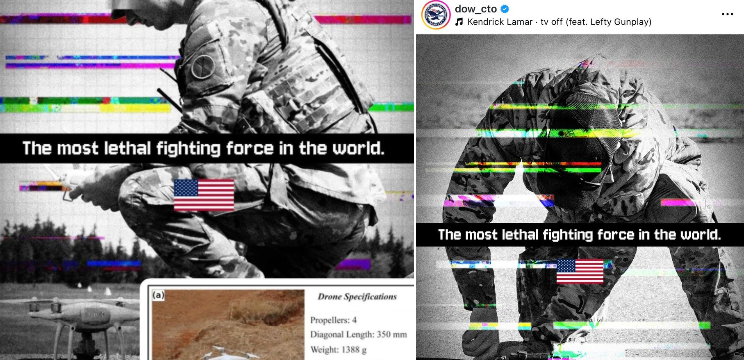
A now-deleted social media post from a U.S. defense office paired one of the most powerful slogans in military culture—“the most lethal fighting force in the world”—with an image that appeared to show a DJI Phantom drone. At first glance, it’s a minor slip. A stock image. A visual oversight.
But in today’s geopolitical context, it’s something else entirely.
It’s a signal.
Because at the very moment the United States is investing billions to reduce dependence on foreign drone technology—particularly from China—using a DJI-style platform in official defense messaging sends a message no policy brief can quietly undo: the gap between ambition and reality is still wide.
This isn’t about branding. It’s about credibility.
For years, DJI has dominated the global commercial drone market with overwhelming scale, cost efficiency, and technological maturity. Even as Western governments raise concerns over data security, supply chain resilience, and geopolitical risk, the practical reality persists: DJI platforms remain deeply embedded in global operations—from commercial users to emergency services.
And, apparently, sometimes even in the visuals meant to represent their alternatives.
That contradiction is where the real story lies.
The United States has made its intentions clear. It wants a sovereign drone ecosystem—domestically produced, secure by design, and resilient across defense and civilian use cases. Policies, funding programs, and procurement shifts all point in that direction. The language is consistent: independence, resilience, control.
But building ecosystems takes time. Messaging moves faster.
When those two timelines collide, cracks appear. A single image—whether selected carelessly or sourced casually—can undermine months of strategic signaling. In defense innovation, perception is not cosmetic. It is part of the architecture of deterrence, trust, and industry confidence.
If you claim technological sovereignty, every detail must reinforce it.
This is particularly important in the drone sector, where the battle is not just technological—it is narrative. Allies, partners, and industry players watch closely for signals of consistency. Mixed messaging creates uncertainty. And uncertainty, in strategic industries, slows investment, weakens partnerships, and dilutes momentum.
What makes this episode more than a communications mishap is its symbolic weight.
Drones are no longer niche tools. They are central to modern warfare, logistics, surveillance, and critical infrastructure. They represent a new layer of technological power—one that combines software, hardware, data, and autonomy. Control over this layer is increasingly seen as a pillar of national security.
And that means the stakes are high—even in something as simple as an image.
Because images do more than illustrate—they endorse.
Featuring a platform associated with a foreign supply chain you are actively trying to replace doesn’t just look inconsistent. It highlights dependency. It raises questions about how deep that dependency still runs—not just in procurement, but in perception.
That matters to domestic manufacturers trying to compete. It matters to policymakers trying to justify investments. And it matters to adversaries who are watching for signs of strategic coherence—or its absence.
None of this means the United States isn’t moving in the right direction. It is. But this moment illustrates how fragile that transition is. Industrial shifts are not just built in factories—they are reinforced through communication, symbolism, and attention to detail.
You cannot claim leadership in one breath and visually validate dependence in the next.
In a world where defense innovation is accelerating and narratives travel instantly, consistency is not optional. It is essential.
Because in the end, credibility is not built only through capability.
It is built through alignment—between what you say, what you show, and what you actually deploy.
And sometimes, it only takes one image to reveal the gap.
.jpg)